A
print-only version of the
2025 Response Readiness Review Guide guide can be found here.
PURPOSE & USE
The 2025 Mobilization Readiness Review Guide is the fifth edition and
the result of many conversations between Oregon State Fire Marshal (OSFM) staff and
our structural fire service partners.
This document will assist Oregon fire agencies in creating and maintaining a healthy
mutual aid system that allows for collaboration and relationships at the local,
regional, and state levels.
This guide provides a checklist for fire chiefs and Fire Defense Board chiefs to
assess their local capability to engage in statewide response through the OSFM.
This document supplements the Oregon Fire Service Mobilization Plan, which assumes
the existence of the systems and agreements outlined in this document.
This document neither supersedes any information in the current mobilization plan
nor does it seek to establish rules or regulations; instead, this guide promotes
conversations to strengthen the Oregon Fire Mutual Aid System (OFMAS) as a whole.
2025 RESPONSE REDINESS REVIEW TIMELINE
May 5, 2025: Fire Defense Board Chief Training and State Fire Defense Board Meeting, Bend, Oregon
May 20 - 22, 2025: Task Force Leader Symposium, Canyonville, Oregon
June 2 - 4, 2025: Annual Fire Defense Board Chief Drill with the OSFM Agency Operations Center (AOC), Statewide
FIRE DEFENSE BOARD CHIEF READINESS CHECKLIST
Below is a checklist to assist Fire Defense Board Chiefs in assessing readiness to mobilize statewide through the OSFM.
The Fire Defense Board holds regular meetings with all member agencies.
Meetings should be held semi-annually, at a minimum, and ensure that the points outlined in this guide have been discussed.
The Fire Defense Board Chief understands the mobilization plan and knows where to find information on personnel training requirements, apparatus typing, equipment standards, and which mobilization costs are reimbursable.
The Fire Defense Board Chief and their alternates know how to access, use, and submit the weekly online form to report resource availability to the OSFM Agency Operations Center (AOC).
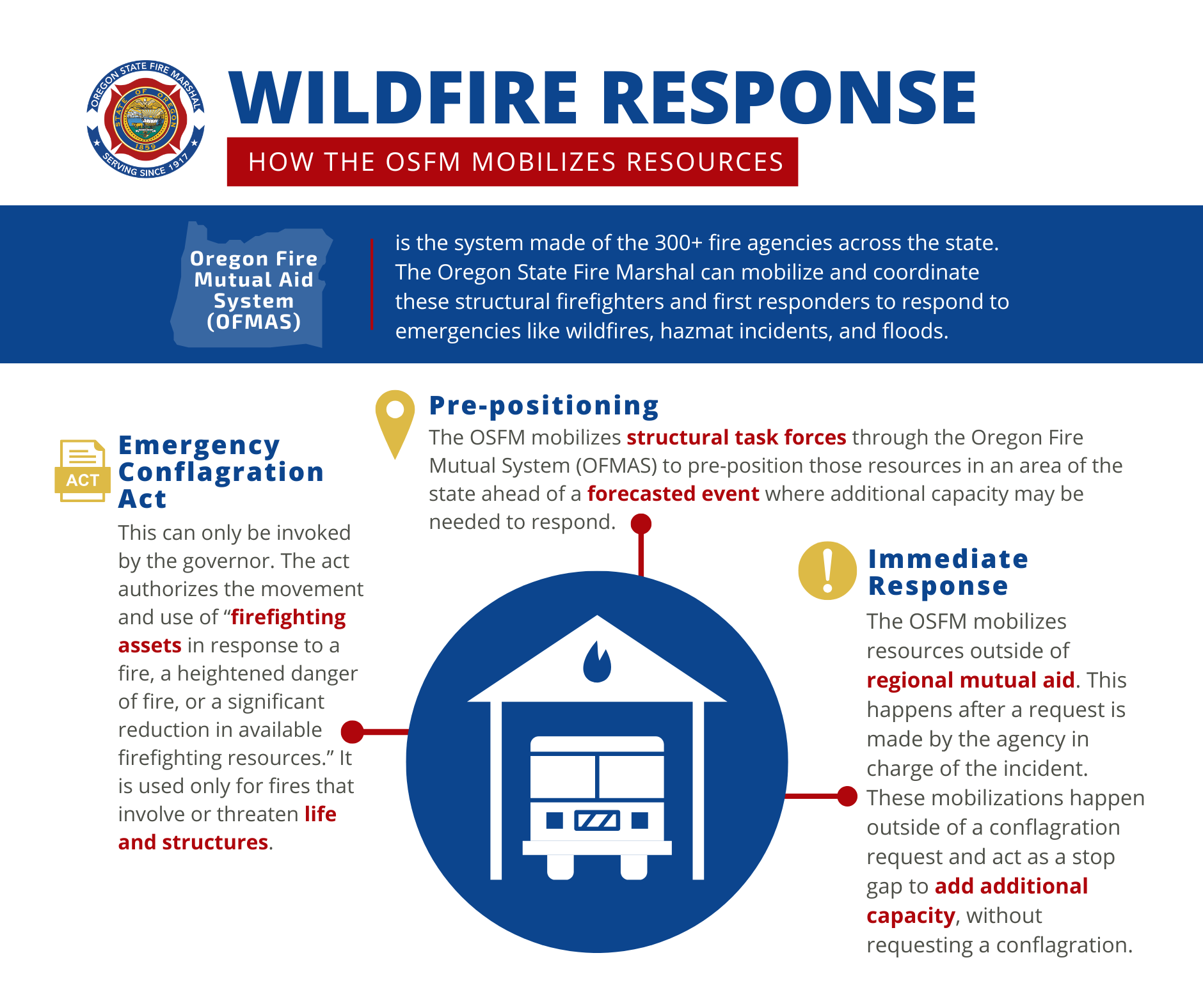
The Fire Defense Board Chief and their alternates understand the process to request a conflagration, immediate response (IR), or pre-positioned resource.
Whether requesting or responding to a conflagration, the process to participate is clearly understood as outlined in the mobilization plan and OSFM training.
The Fire Defense Board Chief and their alternates participate in the OSFM’s annual Fire Defense Board Drill on June 2 – 4, 2025.
The Fire Defense Board Chief and their alternates have participated in pre-season meetings with partners, including the OSFM Regional Mobilization Coordinator, county commissioners, county emergency manager, Oregon Department of Forestry, federal agencies, and law enforcement.
The Fire Defense Board Chief is encouraged to work with adjacent defense board districts to roster a task force or strike team when unable to do so with local resources, or to work with the Regional Mobilization Coordinator to accomplish this.
STATEWIDE MOBILIZATION PERSONNEL CHECKLIST
Once you have set your fire agencies up for success locally, ensure all agencies and personnel who mobilize through OSFM have completed training and understand appropriate documents. Below is a checklist of requirements for personnel mobilized by OSFM as part of a task force or strike team. Personnel requirements can be found in Appendix E of the mobilization plan.
All personnel meet the minimum training requirements for the position they are filling per National Wildfire Coordinating Group (NWCG) guidelines and the mobilization plan.
Trainee or assistant task force or strike team leaders are qualified as engine bosses at a minimum.
All engines have a qualified engine boss.
Along with meeting NWCG standards, all personnel mobilized by the OSFM are qualified as NFPA Firefighter 1.
Personnel have completed RT-130 annually and carry a fire shelter.
Personnel are prepared to remain at an incident for a minimum of seven days, up to 14 days, for conflagrations or pre-positioning, and 72 hours for immediate response incidents.
Personnel understand and are committed to following the code of conduct and safety expectations as outlined in the mobilization plan.
Personnel are covered by a workers’ compensation policy carried by their home agency.
Personnel from each agency are prepared to make necessary purchases, such as fuel, during travel to and from an incident.
Personnel understand the OSFM paperwork requirements.
Personnel are familiar with the OSFM’s Structural Protection Plan and how it is applied in the field.
Strike team/task force leaders have been identified, completed required training, reviewed the current Task Force Leader Guidebook, and understand the local plan for being notified of a mobilization.
OSFM Programs
Response Ready Oregon
— A statewide effort to increase community readiness and response capabilities across Oregon.
Fire Adapted Oregon
— Programs and tools focused on wildland fire risk reduction and community resilience.