Aboveground Tank Application & Installation Guidelines
2024
Download a print-only application and installation guidelines book here.
Introduction
This document is a user-friendly guide for the fire service, public, and industry in Oregon that addresses installation requirements of above-ground flammable and combustible liquid storage tanks for motor vehicle fuel dispensing.
Background
Regulations for storage and dispensing of motor vehicle fuels from aboveground storage tanks (ASTs) are found in the 2022 Oregon Fire Code.
Building Department Requirements
Consult with your local planning and building department for additional requirements that may apply.
Plan Review Requirements
Prior to installation and operation when an AST has a capacity of more than 1,000 gallons, single or aggregate, two sets of plans, including details for all applicable provisions, must be submitted to the Oregon State Fire Marshal for review.
Inspection Requirements
When tank installation is complete, a final inspection is required prior to filling. Contact the Oregon State Fire Marshal for an appointment.
If you have questions regarding farm installations, construction projects, vaults, or additional information, please contact:
Oregon State Fire Marshal Technical Services Unit
503-934-8204
osfm.ofc@osfm.oregon.gov
Application
Download the application form here.
Installation Guidelines
Tank Design Criteria Aboveground storage tanks shall be designed, fabricated, and constructed in accordance with nationally recognized standards. For the Oregon Fire Code, the following standards are recognized:
- UL 142 - Nonprotected Tanks
- UL 2085 - Protected Tanks
Piping
- Piping is required to be designed and fabricated from suitable materials having adequate strength and durability to withstand the pressure, structural stresses, and exposure to which they can be subjected.
- Piping must be tested before being placed in service. Hydrostatic testing is required to be 150% of the maximum anticipated pressure of the system, or pneumatic testing is required to be 110% of the maximum anticipated pressure of the system when operating, but not less than 3 psi and not more than 5 psi.
- Underground piping shall be properly designed, installed, maintained, and protected from corrosion by either a cathodic protection system or by being constructed of corrosion-resistant materials
Quantity of Fuel to Be Stored
- UL 142 (Nonprotected Tanks): 6,000 gallons individual shell or 18,000-gallon aggregate capacity
- UL 2085 (Protected Tanks): 12,000 gallons individual shell or 48,000-gallon aggregate capacity
- Tanks containing Class II or III-A liquids may be of greater capacity as approved by the fire code official.
Vehicle Impact Protection
Protection shall be provided when tanks are subject to vehicle impact. When guard posts are installed, the posts shall be:
- Constructed of steel, not less than four inches in diameter, and concrete
- filled.
- Spaced not more than four feet between posts on center.
- Set not less than three feet deep in a concrete footing of not less than a 15-
- inch diameter.
- Set with the top of the post not less than three feet aboveground.
- Located not less than three feet from the protected object.
Separation of LP Gas Tanks
The minimum horizontal separation between an LP gas container and a Class I, II, or III-A liquid storage tank shall be 20 feet.
Separation Requirements
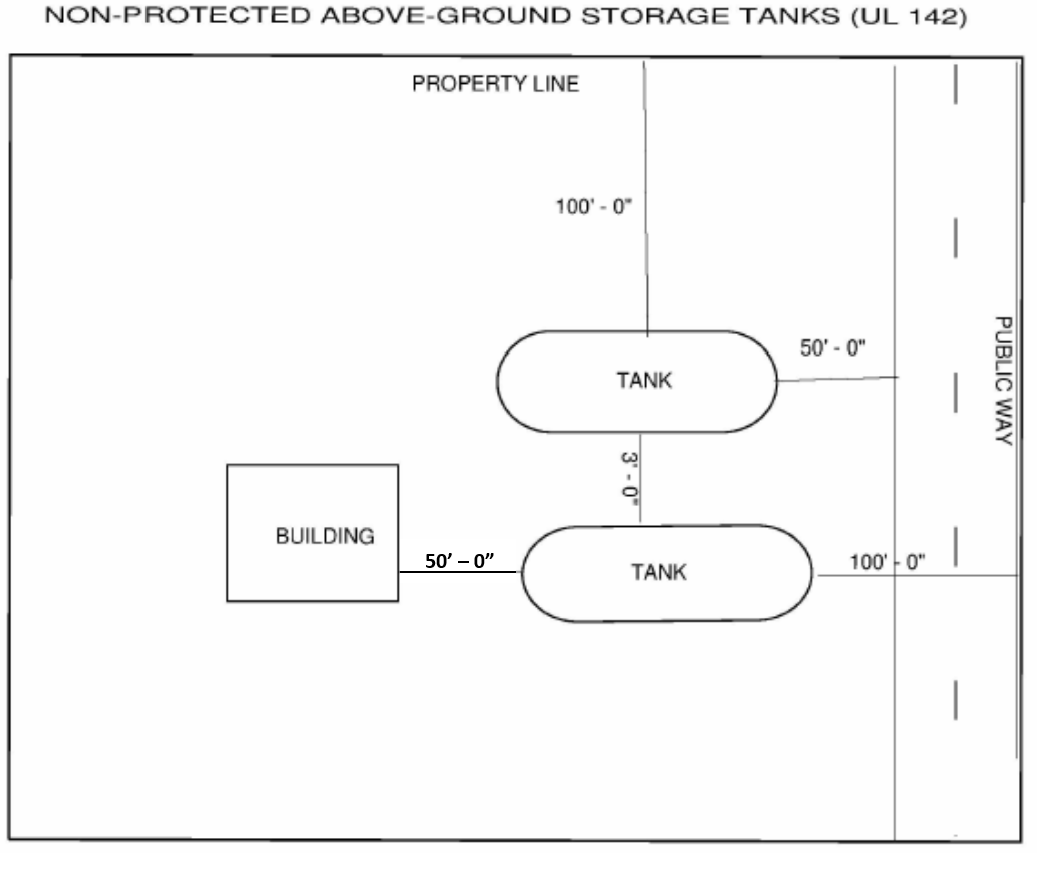
Nonprotected Tanks - UL 142
-
Tank Capacity (Gallons) - All
-
Property lines or opposite side of a public way (feet) - 100
-
Near side of public way or important building (feet) - 50
-
Distance between tanks (feet) - 3
Protected Tanks - UL 2085
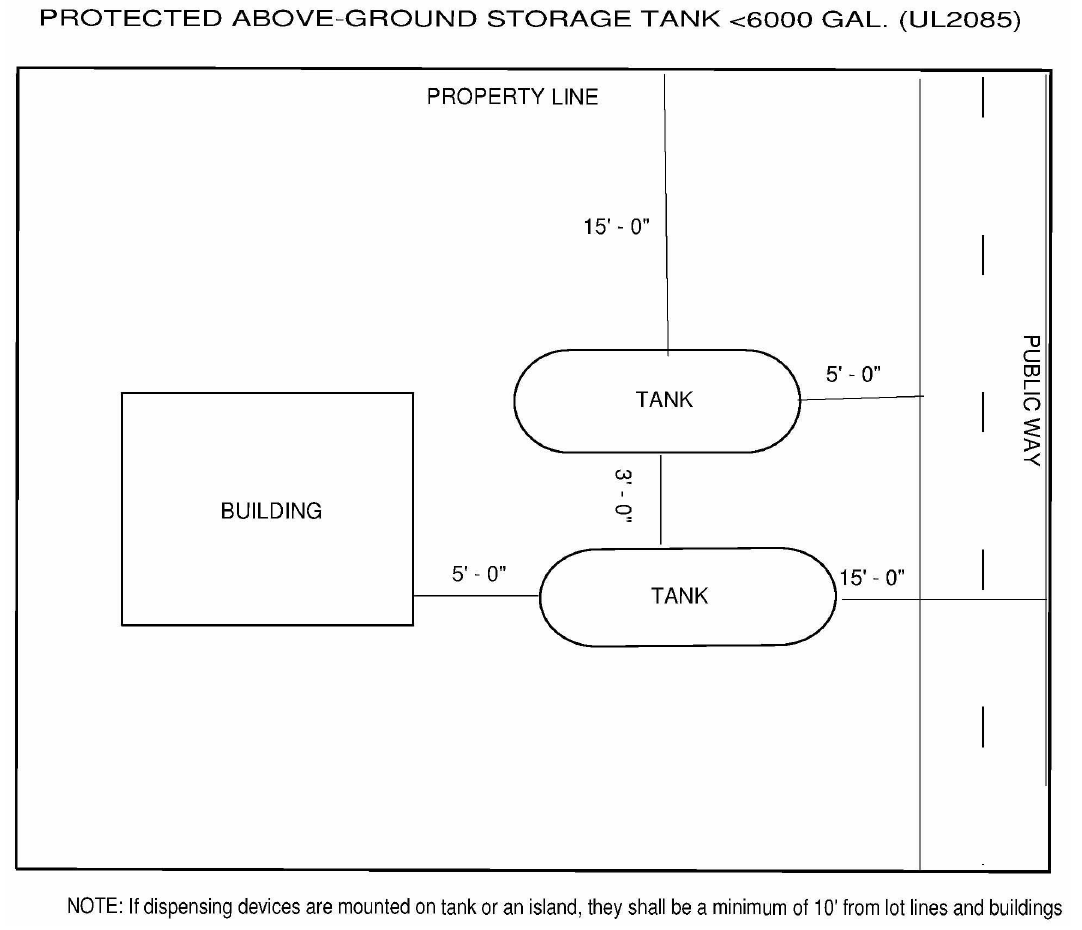
Tank Capacity less than or equal to 6,000 gallons:
-
Property lines or opposite side of a public way (feet) - 15
-
Near side of public way or important building (feet) - 5
-
Distance between tanks (feet) - 3
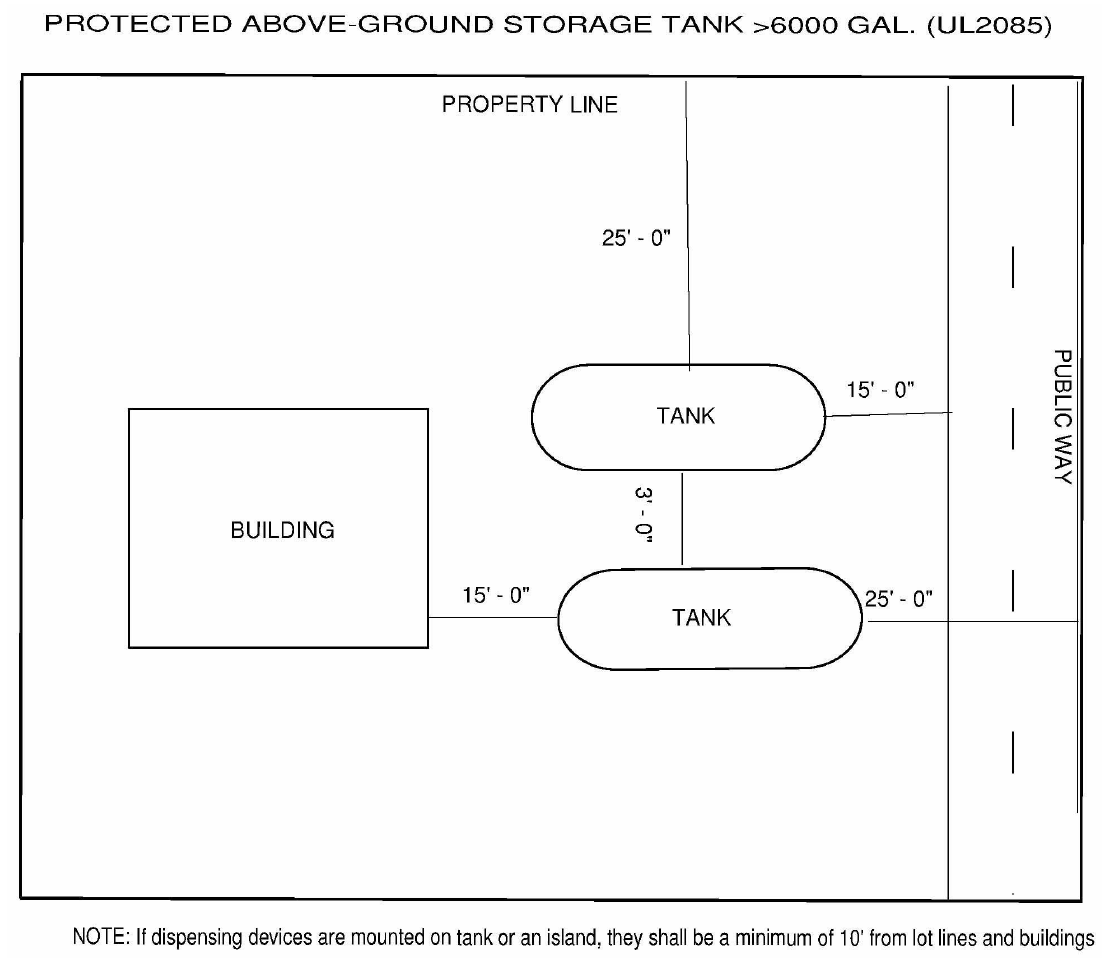
Tank Capacity greater than 6,000 gallons:
-
Property lines or opposite side of a public way (feet) - 25
-
Near side of public way or important building (feet) - 15
-
Distance between tanks (feet) - 3
Overfill Prevention
Tanks shall not be filled more than 95% of their capacity. An overfill prevention system shall be provided that shall:
-
Provide an independent means of notifying the person filling the tank that the fluid has reached 90percent of tank capacity by providing an audible or visual alarm signal, providing a tank level gauge marked at 90% of tank capacity or other approved means, and
-
Automatically shut off the fuel flow to the tank when the quantity of liquid in the tank reaches 95% of tank capacity or other approved method of overfill prevention.
-
A permanent sign shall be provided at the fill point for the tank documenting the filling procedure and the tank calibration chart. The filling procedure shall require the person filling the tank to determine the gallon age required to fill it to 95 percent of capacity before commencing the fill operation.
A spill container with a capacity of not less than 5 gallons shall be provided for each fill connection. For tanks with a top fill connection, spill containers shall be non-combustible and shall be fixed to the tank and equipped with a manual drain valve that drains into the primary tank. For tanks with a remote fill connection, a portable spill container shall be provided.
Venting (Normal and Emergency)
-
Vent pipe outlets for tanks storing Class I, II, or III-A liquids shall be located such that the vapors are released at a safe point outside of buildings and not less than 12 feet above the adjacent ground level.
-
Vapors shall be discharged upwards or horizontally away from closely adjacent walls to assist in vapor dispersion.
-
Vent outlets shall be located such that flammable vapors will not be trapped by eaves or other obstructions and shall be at least 5 feet from building openings or property lines of properties that can be built on.
Stationary aboveground tanks shall be provided with additional venting that will release excessive internal pressure caused by exposure to fire. Emergency vents for Class I, II, and III-A liquids shall not discharge inside buildings.
Tanks larger than 12,000 gallons in capacity storing Class III-B liquids not within the diked area or the drainage path of Class I or II liquids do not require emergency relief venting.
Warning Signs
Warning signs shall be conspicuously posted within sight of each dispenser in the fuel-dispensing area and shall state the following:
-
No smoking
-
Shut off motor
-
Discharge static electricity before fueling by touching a metal surface away from the nozzle
-
To prevent static charge, do not reenter a vehicle while gasoline is pumping
-
If a fire starts, do not remove the nozzle – use emergency shut off It's unlawful and dangerous to dispense gasoline into unapproved containers
-
Do not fill portable containers in or on a motor vehicle. Place container on the ground before filling.
Markings
Aboveground stationary tanks shall be marked by visible hazard identification signs as specified in NFPA 704 for the specific material contained. Signs shall be place on aboveground tanks and at the entrances to locations where hazardous materials are stored, dispensed, used, or handled in quantities requiring a permit and at specific entrances and locations designated by the local code official.
Dispenser Specifications and Location(s)
Dispensing devices shall be located as follows:
- 10 feet or more from property lines.
- 10 feet or more from buildings having combustible exterior wall surfaces or buildings having noncombustible exterior wall surfaces not part of a 1-hour fire-resistance-rated assembly or buildings having combustible overhangs. Exception: canopies constructed in accordance with the Building Code providing weather protection for the fuel island.
-
Such that all portions of the vehicle being fueled will be on the premises of the motor fuel-dispensing facility.
- Such that the nozzle, when the hose is fully extended, will not reach within five feet of building openings.
- 20 feet or more from fixed sources of ignition.
- Dispensing devices, except those installed on top of a protected aboveground tank that qualifies as vehicle-impact resistant, shall be protected against physical damage by mounting on a concrete island six inches or more in height or by other approved methods.
- Dispensing devices shall be installed and securely fastened to their mounting surface in accordance with the dispenser manufacturer’s instructions. Dispenser hoses shall be a maximum of 18 feet in length unless approved.
- Dispenser hoses shall be listed and approved. When not in use, hoses shall be reeled, racked, or otherwise protected from damage.
- Dispenser hoses for Class I and II liquids shall be equipped with a listed emergency breakaway device designed to retain liquid on both sides of a breakaway point.
Emergency Disconnect Switches
An approved, clearly identified, and readily accessible emergency disconnect switch shall be provided at an approved location to stop the transfer of fuel to the fuel dispensers in the event of a fuel spill or other emergency.
An emergency disconnect switch for exterior fuel dispensers shall be located within 100 feet of but not less than 20 feet from the fuel dispensers. For interior fuel-dispensing operations, the emergency disconnect switch shall be installed at an approved location. Such devices shall be distinctly labeled as EMERGENCY FUEL SHUTOFF. Signs shall be provided in approved locations.
Secondary Containment
Secondary containment for outdoor storage areas shall be designed to contain a spill from the largest individual vessel. If the area is open to rainfall, secondary containment shall be designed to include the volume of a 24-hour rainfall as determined by a 25-year storm and provisions shall be made to drain accumulations of groundwater and rainwater.
An approved monitoring method shall be provided to detect hazardous materials in the secondary containment system. The monitoring method is allowed to be a visual inspection of the primary or secondary containment or other approved means. Where secondary containment is subject to the intrusion of water, a monitoring method for detecting water shall be provided. Where monitoring devices are provided, they shall be connected to approved or audible alarms.
Drainage Control and Diking
The area surrounding a tank or group of tanks shall be provided with drainage control or shall be diked to prevent accidental discharge of liquid from endangering adjacent tanks, adjoining property or reaching waterways.
Exceptions
1)The fire code official is authorized to alter or waive these requirements based on a technical report which demonstrates that such tank or group of tanks does not constitute a hazard to other tanks, waterways, or adjoining property, after consideration of special features such as topographical conditions, nature of occupancy and proximity to buildings on the same or adjoining property, capacity and construction of proposed tanks and character of liquids to be stored, and nature and quantity of private and public fire protection provided.
2)Drainage control and diking are not required for listed secondary containment tanks.
Fire Extinguishers
Approved portable fire extinguishers with a minimum rating of 2-A:20-B: C shall be provided and located such that an extinguisher is not more than 75 feet from pumps, dispensers, or storage tank fill-pipe openings.
Sources of Ignition
Smoking and open flames shall be prohibited within 25 feet of fueling operations. The engine of vehicles being fueled shall be shut off during fueling. Electrical equipment shall be in accordance with NFPA 70.
Unsupervised Dispensing (Cardlock/Fleet)
A telephone not requiring a coin to operate or other approved, clearly identified means to notify the fire department shall be provided on the site in a location approved by the fire code official.
An approved emergency procedure sign, in addition to other required signs, shall be posted in a conspicuous location and shall read:
In case of fire, spill, or release
1. Use emergency pump shut off
2. Report the accident!
Fire department telephone number
Facility address
Dispenser operating instructions shall be conspicuously posted in approved locations on every dispenser and shall indicate the location of the emergency controls.
Dispensing equipment used at unsupervised locations shall comply with one of the following:
1. Dispensing devices shall be programmed or set to limit uninterrupted fuel delivery to 40 gallons and require a manual action to resume delivery. Exception: Class II or III-A liquid may be programmed or set to limit uninterrupted fuel delivery of up to 250 gallons.
2. The amount of fuel being dispensed shall be limited in quantity by a preprogrammed card as approved.
Contact the OSFM for additional rules regarding cardlock operations.
Compliance with the Oregon Fire Code does not automatically constitute compliance with EPA or other federally mandated rules; further research may be necessary. It's the applicant's responsibility to ensure all installations are in compliance with applicable statutes of the state and local codes and ordinances.
Information in this guide may not include every aboveground storage tank and fuel dispensing requirement as per the Oregon Fire Code. If a discrepancy is discovered, the Oregon Fire Code shall be the governing document.
Illustrations