10 Basic Items to Check Each Season for Paddlers 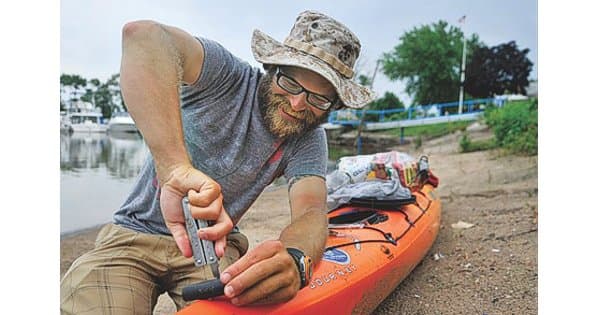
Shared from Paddling.com
While it is important to always check your entire boat and storehouse of gear, here are ten basic items to check each season:
1. Loose fittings and lines on your kayak - Nuts have a way of loosening themselves over winter. Usually, you can test these with your fingers. Likewise, while knots usually don't come loose, the tension on deck lines may need tightening - or replaced.
2. Rudder/Skeg systems- Kinks in cables, tight or stuck pulleys, stiff skeg releases - things lock up over winter. A good fall maintenance program usually mitigates these problems, but sometimes we forget until our first outing four months later. Usually, the same lubricant that you'd use for prevention (WD-40, Corrosion Block) can be used as the cure. If you prefer to use more environmentally friendly lubricants such as silicon, you may have to physically work the stiffness out of the moving parts and then apply the silicon (usually in a gel form). Kinks and other obstructions in cables can be worked out but should be checked as they do decrease the efficiency of the cable.
3. Stiff Foot Pedals- Either as part of your rudder system check or alone, foot pedals should be checked as well. While sand and dirt are the usual culprits for locking up foot pedals, salt-water corrosion can jam everything up as well. Make sure the cable attachment is solid, too. It's not uncommon to find out your pedal is stuck only after you press forward and tear out the cable attachment (There's a reason that the pedal isn't moving so pressing harder is not the proper option).
4. Zippers and Stopcocks - At least when a zipper is stuck open you can still use a gear bag. I find most often that on bags with a dual zipper where one side always seems to be stuck - and right at the base where the zipper pull is tucked under the seams. The biggest problem I've encountered with zippers is that it sometimes takes more force to loosen the pull than the material can withstand and you end up tearing the unit right out of the track. I've used Liquid Wrench, WD-40, and even the heat of a butane torch to wiggle zippers free. Keep them rinsed and lubricated in the first place! Stop locks usually chip and break and basically just need replacing.
If your dry bags are beyond saving, you can check out some of Paddle.com's top picks here.
5. Two-Piece Paddles- I usually don't like putting anything on my paddle tube to keep it from sticking. Occasionally I might smear on a light layer of silicon. I think the best protection is to thoroughly rinse the two sections after each use and let them air dry.
6. Clothing, and other gear- It's just good sense to make sure nothing is worn to the point it could fail while on the water. Of course, those things to be replaced should have been on your Christmas gift wish list, right?
7. Restocking your emergency kit- Things spoil, get wet or dry, and otherwise outlive their purpose. I carry a kit with extra batteries, matches, and such and most assuredly they need to be checked each season (and then some). A common practice is to steal food from survival/emergency packs to ward off hunger on those days you forget to pack a snack. You figure one energy bar won't matter. Say that when you are out of food during the real thing. Better to refresh the emergency rations each spring and then have the willpower not to raid them during a weak moment of hunger.
8. Batteries in general - It's generally not a good idea to store any battery-powered electronic gear for long periods of time without first removing the batteries. It makes sense then to remember to replace them each spring. While most pieces of gear will show you how much battery juice remains, it seems that indicator hits "empty" pretty quickly, and usually at a very inopportune moment. Freshen up your stash of batteries each spring.
9. Racks and Saddles - How's the padding on your racks and saddles? I use pipe insulation as padding on my roof racks and tend to replace them each summer or two depending on use. I've also noticed that sometimes there are contact spots on some saddles that require extra cushioning. It's a good idea to make sure the clamps on your rack aren't worn or twisted or otherwise compromised from taking a good grip on your vehicle.
10. Acclimate yourself! - May this be the spring you are going to push your paddling envelope to develop or enhance more skills! Is this the summer you are going to make the extended trip? Whatever goals you set last winter and haven't yet achieved, make those a priority. Maybe you took part in pool sessions. Use spring to hone those skills throughout the season.
I'm sure there are many things one can add or change to this list. The important thing is to maintain a responsible attitude towards your gear - for safety's sake and for optimum paddling pleasure. Good equipment works better and is safer. Now get out there and enjoy the season!