Expand Equitable Access to Evidence-Based Treatment Options
 Oregon has to prioritize a comprehensive range of treatment options that meet the diverse needs of individuals with substance use disorders -- starting with broader availability of medications for opioid use disorder (MOUD) and other medications to treat substance use disorders.
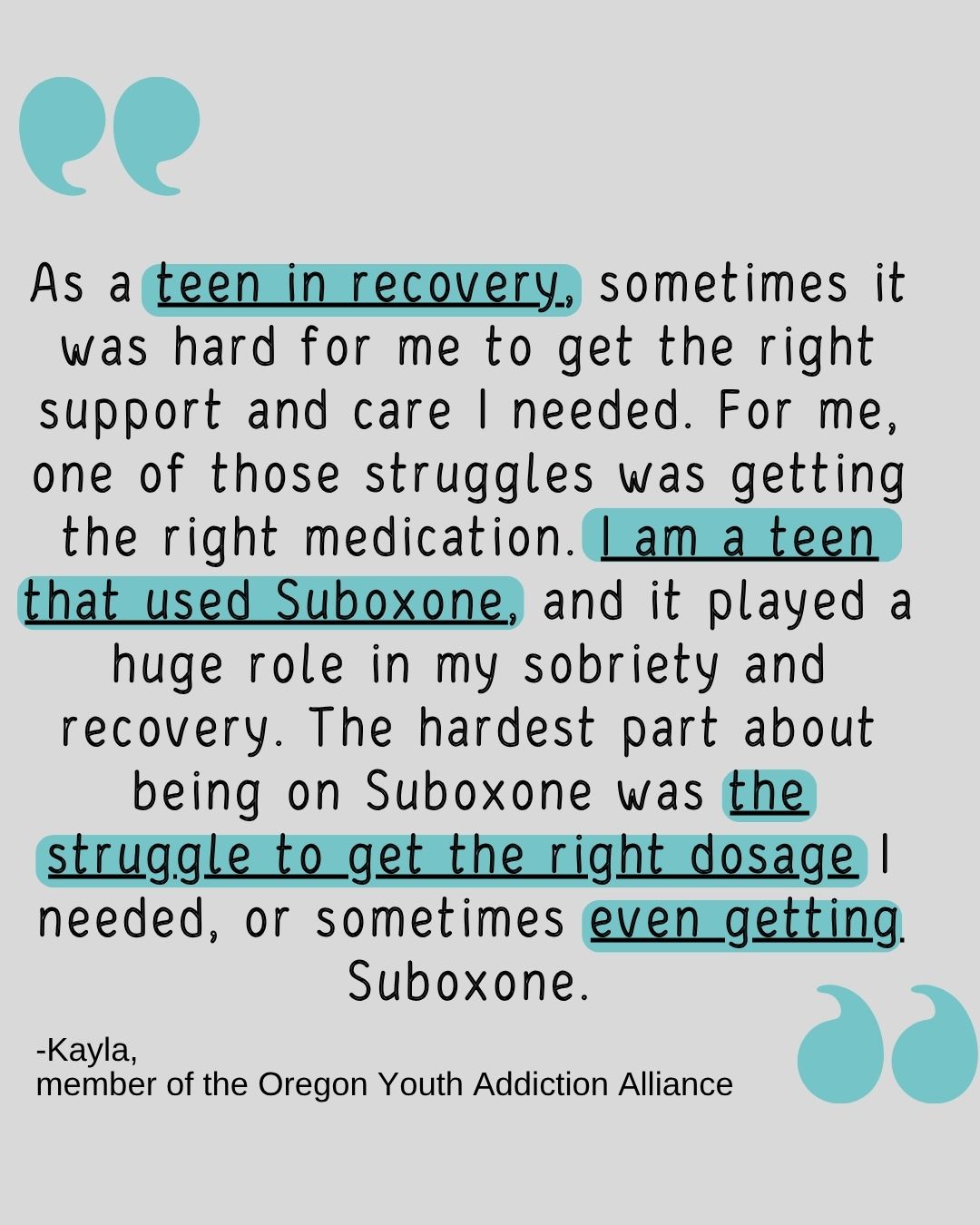
MOUDs are well-established medications that are proven to ease opioid withdrawal symptoms, reduce opioid cravings, and help people reduce or stop opioid use. In short, MOUDs save lives. Even so, professionals in the treatment field, as well as people with lived experience, will tell you that accessing MOUDs in Oregon has been harder than it should be. Kayla, one of the members of the Oregon Youth Addiction Alliance, shared her experience:
“As a teen in recovery, sometimes it was hard for me to get the right support and care I needed. For me, one of those struggles was getting the right medication. I am a teen that used Suboxone, and it played a huge role in my sobriety and recovery. The hardest part about being on Suboxone was the struggle to get the right dosage I needed, or sometimes even getting Suboxone."
Expanded access to treatment options should include newer and longer-acting MOUD delivery methods, which can significantly improve outcomes.
At the same time, non-pharmacological options, including but not limited to cognitive-behavioral therapy and contingency management, must be integrated to serve those with stimulant and other substance use disorders.
Crucially, care must be culturally and linguistically responsive, ensuring its effectiveness and affirming nature for rural and frontier communities, Tribal populations, and communities of color. By embedding these evidence-based treatments into accessible and inclusive service models, we move closer to a system where geographic or cultural barriers hinder no one's recovery.
Find the ADPC's detailed strategy below:
Ensure Timely Access to the Appropriate Level of Care at All Entry Points
A “no wrong door" approach is essential to ensure that every individual seeking help receives a direct path to the type and intensity of care they need, no matter where they reach out to in the community. Standardized frameworks like the ASAM Criteria, coupled with comprehensive training and oversight, can match clients to the right level of services while maintaining fidelity and quality.
Because a lack of infrastructure often hinders access in rural and underserved regions, investments in both outpatient and residential capacity must be prioritized to eliminate needless delays. Underscoring this point, the 2024
PCG Residential+ Facility study conducted a capacity analysis and found that Oregon at the time had just 301 withdrawal management facilities while it needed 888 – that's more than a 180% increase.However, the need was much greater in specific regions. The Mid-Willamette Valley and N. Central Coast required a nearly 240% increase in capacity, while Southern Oregon needed a 375% increase. The Columbia Gorge had no such facilities to begin with.
Additionally, financial incentives and alternative payment models can encourage clinicians and agencies to provide evidence-based, person-centered treatment, rather than relying on a one-size-fits-all model that may not fully address individual needs.
During
the ADPC's community engagement sessions, Sabrina Garcia, an enrolled tribal member of the Klamath Tribe and a person with lived experience with drugs and alcohol, explained the significant challenge that geographic disparities pose:
“Every small rural community or frontier community faces different challenges than larger populations. Larger populations have a streamlined road laid out for them…. We're literally making the road as we speak."
(Watch Garcia's remarks, at left, at the Medford community engagement session hosted by Oregon Recovers.)
Find the ADPC's detailed strategy below:
Facilitate Improved Transitions Throughout the Treatment and Recovery Journey
To help people treat their substance use disorders, Oregon's treatment services and supports need to meet people where they're at. A person's motivations and individual treatment goals may evolve from harm-reduction strategies to an abstinence-based approach or anywhere in between.

In practice, this means that clinical care providers – and providers of different recovery support services – need better ways to coordinate.
By coordinating efforts across mental health, justice, child welfare, and social service systems, we can expand the “recovery capital" needed—such as peer support, housing, education, and employment—to help individuals maintain long-term well-being.
Judge Clara Rigmaiden, a former ADPC commissioner, explained last year how crucial wraparound programming is for Oregonians participating in treatment courts. Judge Rigmaiden chaired
Oregon's Task Force on Specialty Courts in 2024.
“As you can well imagine, being unhoused is a real problem for participating in a treatment court,"
she told the ADPC. “You have so many obligations, and you have to make it to things — it's that whole chicken-and-egg problem of helping you get housing if you're not sober, and helping you get sober if you don't have housing."
A full continuum of care that includes assessment, stabilization, multiple levels of treatment, housing, peer-led support, and ongoing recovery management can help individuals avoid service gaps and maintain their recovery goals.
Find the ADPC's detailed strategy below:
Drive Quality and Accountability Across All Components of the Treatment System
Accountability starts with transparent and consistent measures that track access, retention, outcomes, and other critical indicators so that systems and providers can continuously refine their approaches. These data-driven insights can highlight areas for funding and policy reform, ensuring that resources flow to the most effective practices and interventions.
Workforce development is also key. Case in point: Logically, the emergency department (ED) is a key point of intervention for patients suffering from substance use disorder. However, ED physicians aren't always equipped to deliver the right treatment. In 2025,
Kerri Hecox, Medical Director at the Oasis Center of the Rogue Valley, testified about this issue before the state legislature and compared the substandard care someone with an SUD might receive to the care they would receive for a heart attack:
“If someone walks into a hospital, goes into a hospital with heart attack, their risk of death in the next year is 10%. If someone goes in with an opioid overdose, their risk of death in the next year is 10%... We have large systems to care for cardiac patients. We make sure they're on the right medications, [that] they get the counseling they need to manage their disease, and they are matched with outpatient follow up. That is not what is happening for most people with opiate use disorder in this country. I will note too, the difference between a heart attack and overdose death… The average age of overdose in Oregon last year was 40 years old – that's a lot of years lost."
(Watch Hecox's testimony, at left, before the Joint Committee on Addiction and Community Safety Response).
Robust training, supervision, and fair compensation all help providers deliver evidence-based practices with fidelity, while peer specialists and culturally responsive models must be integrated and evaluated under regulatory standards.
By weaving together comprehensive oversight, shared metrics, and a supportive workforce environment, we can build a treatment system that truly delivers high-quality, equitable care for all those on a recovery journey.
Find the ADPC's detailed strategy below:
Meet the APDC Treatment Committee
Beginning in 2024, the Treatment Committee began meeting to recommend high-level recovery strategies and goals for the ADPC's Comprehensive Plan. The Treatment Committee continues to work closely with ADPC Commissioners, ADPC staff, participating state agencies, and partner programs to advance recovery-related work across the state.
The committee strives to support and maintain a treatment service continuum that contributes to a broader recovery-oriented system of care (ROSC), aiming to support more holistically those who experience substance use disorders with a goal of assuring that those who interact with this system of care are met with dignity, person-centered, evidenced informed, and culturally responsive services. Read the ADPC Treatment Committee Charter.pdf
Kati Jokinen (Co-chair)
Bradley Buchheit (Co-chair) Moxie Loeffler Kristi McKinney Heather Jefferis Honorable Clara Rigmaiden Fernando Peña Joe Bazhegi Myque Obiero Amy Nortrom Art Zamudio Alison Noice Katrin Yount Lisa Weigum Beth Williams ADPC Staff Lead: Mitch Doig
|
If you would like to join an ADPC committee or nominate someone to serve on a committee, please fill out this form.
Para completar esta solicitud en español, haga clic aqui.