Japanese Beetles and Shipping Plants
February 1st
| NM (renewals required)
|
|---|
February 15th
| NV
|
|---|
May 1st
| AK, AZ, CA, CO, ID, MT, TX, UT, WA
|
|---|
Pending
| HI, Canada
|
|---|
Town Hall meeting recording 1/23/26
Link here
Background
The Japanese beetle can cause extensive damage to nurseries, seedbeds, orchards, field crops, landscape plants, and home gardens. Adult beetles skeletonize leaves, feed heavily on flowers, and consume developing fruits. They are known to feed on more than 300 plant species including roses, blueberries, grape vines, fruit trees, and many garden vegetables. Japanese beetle grubs live in the soil and primarily feed on the roots of turf grass and ornamental plants.
What has changed?
For the past several biennia, Oregon's Japanese beetle eradication efforts have been funded through one-time allocations from the Oregon Legislature, using funds outside of the ODA's base budget. During the 2025 legislative session, the bill that would have continued this funding did not pass. Because no funding was approved for the next biennium, the ODA will not be able to continue Japanese beetle eradication operations in 2026.
Without a funded Japanese beetle program, which includes statewide trapping, surveillance, and treatment, Oregon will no longer be recognized as actively managing the Japanese beetle populations. As a result, Oregon is at risk of losing its pest-free status. When this happens, other western states that are currently considered free of Japanese beetle will apply their quarantine requirements to plants shipped from Oregon. These measures are intended to prevent the spread of Japanese beetle into unaffected states.
2025 Oregon Trapping Map
Link to map
For further information and instructions about how to interpret this map, please go to the ODA's IPPM page located: here
Japanese Beetle State Categories
The U.S. Domestic Japanese Beetle Harmonization Plant (JBHP) helps prevent the spread of Japanese beetles through the movement of nursey stock and regulated materials. States are divided into four categories, depending on their regulatory status for Japanese beetle. Shipment regulations are based on the category of the shipping state and the receiving state.
Category 1 - Uninfested, and Japanese beetle is regulated
Category 2 -
Uninfested or partially infested
Category 3 - Partially or generally infested
Category 4 - Pest is unlikely to establish / not known to be infested
New Requirements
If you are shipping a regulated article to a Category 1 or 2 state, you will need to:
-
Enter into a Compliance Agreement with the ODA
-
Employ approved treatments and/or approved trapping
-
Apply for a Phytosanitary Certificate or Certificate of Quarantine Compliance (CQC) for shipments
Regulated Articles
-
Plants with roots and soil
-
Grass sod
-
Soil, compost, or growing media that is not commercially packaged and not sanitized
-
Any article that could harbor Japanese beetle eggs, larvae, or adults
Exempted articles include: bareroot plants free from soil or media, bulbs, corms, tubers, and rhizomes without soil attached.
Frequently Asked Questions
A quarantine is a federal or state legal regulation established to prevent the introduction and/or spread of harmful insects, diseases, invasive weeds, soils or other pests that could cause ecological, economic or social impacts to the environment or agricultural industries.
Regulatory agencies use a science-based Pest Risk Analysis (PRA) process to evaluate potential plant health threats and determine what actions are needed to prevent the introduction, establishment, or spread of pests and diseases.
Quarantines are not new. Many states across the United States have had long-standing quarantines for Japanese beetle and other invasive pests, often in place for decades. These quarantines have historically applied to states where the pest is established or under active management.
What is new is that Oregon nurseries are now more directly affected as shippers. As Japanese beetle detections have occurred in Oregon, other states that are considered pest-free or have strict management programs are applying their existing quarantine requirements to plant material shipped from Oregon. In other words, the quarantine rules themselves have not changed, Oregon's nursery shippers are now subject to these rules.
Quarantines can have operational and financial impacts on nurseries that ship or receive plants across quarantine boundaries. For this reason, it is important for nurseries to understand shipping restrictions, notification requirements, and inspections that may apply to their operations.
Nursery businesses are encouraged to work closely with their state nursery inspectors to ensure compliance and to help reduce disruptions to their operations.
A compliance agreement (CA) is a formal agreement with a regulatory agency that allows a nursery to ship plants under specific plant-health requirements. By signing a CA, the nursery agrees to follow certain required practices that help prevent the spread of pests or diseases.
The agreement places responsibility on the nursery to follow these practices consistently. While this allows nursery inspectors to issue shipping certificates without observing every step in-person, ODA continues to monitor compliance through inspections, audits, and record reviews to ensure the nursery is operating under an approved compliance agreement.
States may require nurseries to pre-notify their Department of Agriculture (or other regulatory agency) before shipments of quarantined plants enter their state. Pre-notification requirements can vary slightly by state, so shippers should be aware and confirm each destination state's specific requirements. These pre-notifications typically include emailing a shipping list and the associated CQC or phytosanitary certificate with the appropriate additional declaration (AD) indicating how the shipment meets import requirements. These documents are issued to nurseries by the ODA for shipments that meet all quarantine requirements.
States that currently require that pre-notifications of shipments are sent to them before the shipment arrives include:
California, Colorado, Idaho, Montana, Nevada, Utah, and Washington
California: Email the County Ag Office (contact information link)
Idaho: Email nsy.idaho@isda.idaho.gov
Montana:Pre-notification must be sent 48 hours in advance to agr@mt.gov. Use the statement, "This notification is in accordance with Montana Quarantine MTQ-2013-01"
A phytosanitary certificate (phyto) and a Certificate of Quarantine Compliance (CQC) are both official regulatory documents issued by the ODA, typically after an inspection is conducted by an ODA inspector. They are both designed to accompany shipments of regulated material and verify quarantine compliance but differ from one another in several important ways.
A phytosanitary certificate, or phyto, is issued for each individual shipment of plants. It may be required for domestic or international shipments, depending on the destination.
How much does a phyto cost?
For licensed nurseries:
- State phyto: $25 per shipment
- Federal phyto: $31 per shipment
Unlicensed entities may also apply for a phyto but will be charged inspector time and mileage, in addition to the standard certificate fee.
Can one phyto be used for multiple shipments?
No. Each shipment requires its own phyto. Phytosanitary certificates may not be copied or reused for multiple shipments.
How do I apply for a phyto?
Applications must be submitted through the USDA's Phytosanitary Issuance and Tracking System (PCIT): PCIT log-in page
If you do not currently have a PCIT account, please contact your ODA nursery inspector for assistance getting started. The USDA also has a training guide to help you navigate PCIT at this link: PCIT initial set-up guide
What is a CQC?
A CQC is a document issued by an ODA inspector for inter-state shipments. Once an inspector has confirmed that specific nursery stock meet all inter-state and Federal quarantines, they can issue a CQC to accompany shipments.
How much does a CQC cost?
CQCs do not have a specific cost and are funded through nursery license fees. If you have an active nursery license, your CQC will not cost you any money. Like a phyto, unlicensed entities can apply for CQCs but will be charged for inspector time and mileage.
Can one CQC be used for multiple shipments?
A CQC may be valid for a specific set of plants and/or a specific time range, as determined by a state plant regulatory official. A CQC may be copied and used for multiple shipments during its validity period.
How do I apply for a CQC?
Contact the ODA nursery inspector assigned to your region. They will talk with you about requirements to be eligible for a CQC and arrange a time to come to your site and inspect the plants and relevant records.
Approved growing media must be free of soil and made from clean materials that have not previously been used to grow plants or for other agricultural purposes. The media must also be free of plant pests and handled in a way that prevents all life stages of Japanese beetles from being introduced.
Examples of approved growing media include:
- Bark products (pine or hardwood bark)
- Peat or sphagnum
- Perlite, vermiculite, pumice, or volcanic cinder
- Expanded or baked clay pellets
- Rock wool
- Recycled paper products
- Ground coconut husk
- Processed plant byproducts (such as rice, cocoa or coffee hulls)
- Synthetic materials (such as styrofoam beads, floral foam, or synthetic sponge)
- Commercially processed sand
- Solid rooting materials (e.g. “Oasis Strips" and “Rubber Dirt")
What growing media is not allowed?The following are not considered approved growing media:
- Field soil or native soil
- Reused or previously used potting media
- Media containing unprocessed organic debris
- Compost or manure
- Media that has been stored or handled in a way that allows exposure to pests, soil, or standing water
Growing media that does not meet these standards may not be eligible for certification under Japanese beetle quarantine requirements.
Bare-root plants with clumps of soil or growing media less than 0.5 inches in diameter are exempt from Japanese beetle regulations. Roots must be essentially clean, with only trace amounts of soil present. As a general standard, soil clumps should be
less than ½ inch in diameter
.
To qualify as bareroot:
- Roots must be free of soil and potting media
- Soil must be removed by washing, shaking, or mechanical means
- No root balls, plugs, or container media may remain
- Any remaining soil must be minimal and incidental
If plants are not able to meet the bareroot qualification, nurseries must meet JBHP requirements through one or more of the following, as applicable:
- Approved trapping programs (including fields that grow bareroot stock that is unable to meet the bareroot qualifications)
- Approved treatments
- Screenhouse production
- Container size limitations
- Shipping outside the adult flight season
Your inspector can help determine which option is most appropriate for your operation.
If a single Japanese beetle is detected at an Oregon nursery, the nursery immediately loses its free-from status and can no longer use negative trapping data to certify shipments for the remainder of that shipping season. The nursery must use alternative certification options allowed under the Japanese Beetle Harmonization Plan (JBHP).
These options include:
- Approved chemical treatments, such as dip, drench, or granular incorporation
- Approved production systems, such as certified Japanese beetle-free greenhouses or screenhouses
- Other JBHP-recognized certification pathways accepted by the destination state
Category 1 states:
Shipments must use JBHP-approved mitigation options after a detection. For most growers, available options will be limited to treatment prior to shipment.
Category 2 states:
Nurseries may use any Category 1 option, as well as additional options listed in the JBHP appendix, including accreditation programs where applicable. (See JBHP, pgs. 7 to 18)
To learn more about how to ship plants to Category 1 and Category 2 states, please review the details below.
Shipping guidance
The Japanese Beetle Harmonization Program (JBHP)
The JBHP was developed by the National Plant Board as a framework to protect unifested states, while providing shippers with consistent certification requirements.
Official document: JBHP
Link to the National Plant Board JBHP site
The JB regulatory status map visualizes all 50 states and Canadian territories, coding them as Cat 1, 2, 3, or 4. This map is updated annually. Regulatory status is determined by the National Plant Board. The JB regulator status map for Canada is also available.
Oregon's Category Status
While Oregon has historically be classified as a Cat 1 state, in the absence of a state Japanese beetle program, Oregon will likely be re-classified as Cat 2 or 3. This is pending final determination by the NPB, and the ODA is actively working with the NPB to expedite the evaluation process.
Oregon nurseries shipping plants with roots, soil, or growing media to Category 1 or 2 states/areas must follow strict production and certification standards to protect pest-free regions. Regulated articles are subject to phytosanitary measures to meet import requirements of receiving states. Whether a receiving state is Category 1 or 2, will dictate the exact requirements. These nurseries must have a Compliance Agreement with the ODA to be eligible for certification.
Certification Standards
The options listed in the JBHP are the default standards that most states follow. However, the JBHP is not a federal quarantine, and does not override individual state regulations. To learn more about treatment options and state regulations that vary from the JBHP, please read through the drop-downs below.
Link to the JBHP manual
Shipment Options to Category 1 States
To qualify for shipment into a Category 1 state, nurseries must meet one of the approved pathways and enter into a compliance agreement with the ODA. The adult flight season for JB is June 1 – September 30 and is non-negotiable. Regulated articles must be safeguarded from JB during the flight season.
Production in a Protected Facility
Plants maintained in a state approved screened greenhouse or structure during the flight season. Must be potted in sterilized soil or potting media. The facility must be inspected annually by the state.
Production During a Pest-Free Window
Rooted plants must be grown, finished, and shipped outside the adult flight period: October 1 – May 31.
Application of Approved Treatments
Treatment with an ODA-approved insecticide under supervision by a state official before shipment or conducted under a signed compliance agreement. Treatments may be applied by nursery staff or an approved pest control company.
Negative Trapping/Survey Verification
Nursery must demonstrate pest-free status through an approved trapping survey that is conducted on the nursery property during the entire adult flight season. In addition, 1-mile buffer area around the nursery must also be trapped. Traps must be regularly monitored by regulatory authorities throughout the entire season. If one or more beetle is caught or found on a plant via inspection, treatments will be required prior to shipment. Nurseries may contract with an approved pest control company.
Shipped Bare root
Plants are shipped bare root, free from soil or growing media. Free from soil means plants with less than the amount of soil or growing media that can harbor any life stage of Japanese beetle (egg, pupa, or larva). Some states define free from soil or growing media larger than ½ inch.
Shipment Options to Category 2 States
To qualify for shipment into a Category 2 state, nurseries must meet one of the approved pathways and enter into a compliance agreement with the ODA. The adult flight season for JB is June 1 – September 30 and is non-negotiable. Regulated articles must be safeguarded from JB during the flight season.
Application of Approved Treatments
Treatment with an ODA-approved insecticide under supervision by a state official before shipment or conducted under a signed compliance agreement. Treatments may be applied by nursery staff or an approved pest control company.
Negative Trapping/Survey Verification
Nursery must demonstrate pest-free status through an approved trapping survey that is conducted on the nursery property during the entire adult flight season. Traps must be placed and regularly monitored by regulatory authorities throughout the entire adult season. If one or two beetles are detected across all traps, the nursery might be able to keep its pest free status. This is at the discretion of the receiving state. Delimiting survey is required the following year (i.e. additional trapping around the positive trap location). If delimitation yields no JB finds, the nursery can be considered pest-free again. If more than two beetles are detected in either the initial or delimiting survey, the site is considered infested. Nurseries may contract out that work to an approved pest control company.
Field Grown Nursery Stock Accreditation Program
Applies to balled & burlapped, field-potted plants from nurseries within an infested area. Requires regular soil sampling (Sept – May) and mitigation if JB larvae are recovered. Certification not possible if more than one JB larvae is found. Other requirements include maintaining weed-free zones around plantings and treatments.
Containerized Nursery Stock Accreditation Program
All containers must: be potted in approved growing media or sterilized media; containers must be kept on barrier to prevent JB infestation; certified lots must be clearly marked and separated; and apparently free of weeds. Grasses and sedges are not eligible for this option.
Sod Shipment Requirements
Permissible if sod originates from site free of JB through trapping program. Alternatively, if sod originates from sites under a compliance agreement which requires: treatment for JB on peripheral of farm, removal of JB host plant species from the immediate growing areas and treatment of the sod, and visual inspection at time of harvest as well as time of shipment.
Treatment Options
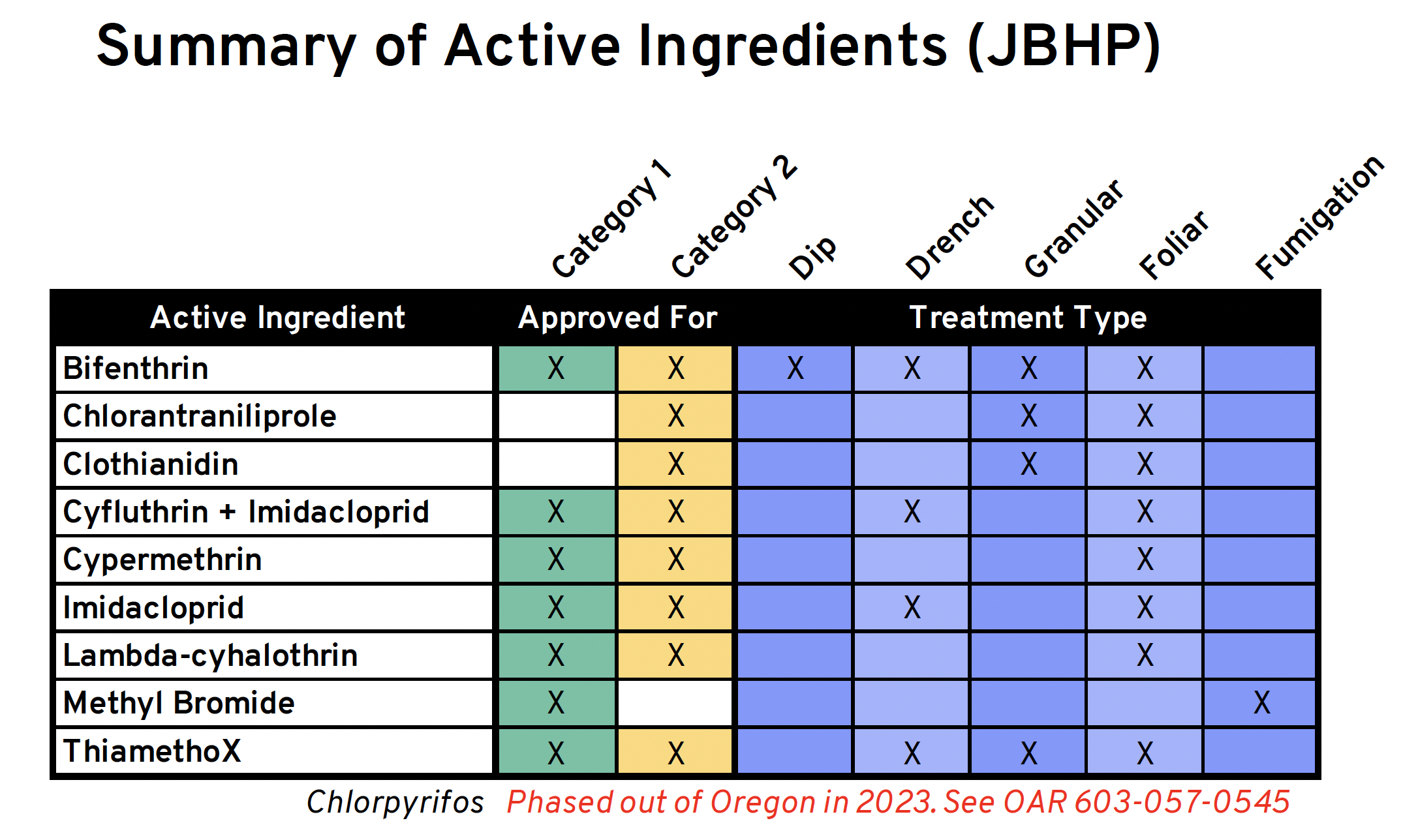
For Japanese beetle certification of plant material according to the Japanese Beetle Harmonization Plan. All treated product must be safeguarded from re-infestation during the flight season. Chemical options are summarized below.
Pesticide Options
The JBHP has a table listing active ingredients and products that have been agreed upon among the states. Not all of these are registered for use in Oregon, and not all of the products registered for JB in Oregon are on the approved JBHP table. Please review the attached Excel document to see lists of JB treatments in Oregon and those which are also found in the JBHP list.
Detailed list of Active Ingredients for Oregon and the JBHP
Please download this file to view all of the pesticide lists.
JB Treatment table.xlsx
There are four tabs in this Excel file:- Summary of active ingredients for JB registered in Oregon
- All active ingredients and combinations for JB registered in Oregon
- JBHP Pesticides for Category 1 States
- JBHP Pesticides for Category 2 States
To identify if a product is registered for use in Oregon, please use this search engine:
Pesticide Information Center OnLine (PICOL):
Chemical Treatments table for JBHP:
Treatment options for Category 1 States
1. Dip treatment intended to kill larvae (grubs) in containers or B&B
Only acceptable for material in containers that are 12" in diameter or smaller. B&B material of the same size limit can also be dip-treated, but only if the soil is non-clay. It is presumed that most soils in Oregon will not be suitable for this treatment due to clay content.
- The rooted portion of the container or ball must be completely submerged in pesticide solution for a minimum of 2 minutes or until complete saturation occurs, as indicated by the cessation of bubbling.
- The ambient temperature must be at least 50F at time of dip.
- Upon removal from solution, the plants must be allowed to drain according to label directions.
- During JB flight season (June through Sept.) dip treatments are only good for 2 weeks of certification. If more time passes, an additional treatment would be required.
- Treatments performed outside of the flight season are suitable for certification until the time of the next flight season.
2. Drench treatments for containers to target eggs and first instars of JBThis is considered a preventative treatment. It is only acceptable for material in containers that are 12” in diameter or smaller. Potting media must have started clean (never previously used in agricultural production) and contain no mineral soil or sand.
- Plants grown in field soil then potted into soilless container substrates are not eligible.Plants must be treated prior to JB flight season and certification expires after 16 weeks.
- Plants must be treated prior to JB flight season and certification expires after 16 weeks.
- The goal is to completely drench the surface of the potting media while at the same time limiting run-off through leaching from the bottom of containers. It is recommended to use 1/5 of the container volume as an application rate per container.
- Treated material must be maintained on an impervious barrier.
3. Media (granule) incorporation for containers to target eggs and first instars of JB.This is a preventative treatment prior to potting up. It is only acceptable for plants being potted up into containers 12” in diameter or smaller. Potting media must start clean (never previously used in agricultural production) and contain no mineral soil or sand.
- Plants grown in field soil then potted into soilless container substrates are not eligible.
- Plants being stepped up into treated media must first be treated by drench or dip to clean up any remaining untreated potting media attached to their roots
- Granular insecticide must be thoroughly mixed into batches of potting media prior to potting up.
- Finished plants should be watered at least 2 times prior to shipment.
4. Methyl Bromide FumigationThis option would provide certification for nursery stock of all sizes and media including soil. However, pesticide label limits and plant susceptibility to harm make it an unlikely option.
5. Adult Beetle MitigationDuring flight season between June 1 and September 30th, nurseries are responsible for ensuring that clean stock does not become infected by adults. The JBHP outlines critical control points to monitor. Insecticides that target adults are provided in the JB-labeled product list, to be used for certification if adults are present. There are different insecticides for use on plant material and container (truck/trailer) spaces.
Treatment options for Category 2 States
**Note: New Mexico is not included in this, they have unique requirements**
1. Any treatment that allows for certification to Category 1 states is also suitable for certification to Category 2 states. 2. Dip treatment intended to kill larvae (grubs) in containers or B&B. Acceptable for nursery stock in containers and B&B plants that are 32” in diameter or smaller.
- The rooted portion of the container or ball must be completely submerged in pesticide solution for a minimum of 2 minutes or until complete saturation occurs, as indicated by the cessation of bubbling.
- The ambient temperature must be at least 50F at time of dip.
- Upon removal from solution, the plants must be allowed to drain according to label directions.
- During JB flight season (June through Sept.) dip treatments are only good for 2 weeks of certification. If more time passes, an additional treatment would be required.
- Treatments performed outside of the flight season are suitable for certification until the time of the next flight season.
3. Pre-Harvest Soil Surface TreatmentsField grown material of any size may be harvested and certified from fields that are treated prior to harvest in the months of May through July.
- Insecticide must be applied to rows in bands that extend six (6) inches wider than actual root ball diameter to be dug. Do not allow bands in adjacent rows to overlap.
- Vegetation should be mowed to a height of 3 inches or less before application. Do not mow until after sufficient irrigation or rainfall has occurred.
4. Field Grown Nursery Stock Accreditation Program (possibility that treatment would be required)This is a compliance agreement program that allows for certification of field grown material to Category 2 states.
- The program requires the maintenance of a weed-free zone around field plants as well as soil sampling to monitor for beetles.
- Insecticides could be used in this program for treatment of larvae and adults and these are found in the JB-labeled product list.
5. Shipments of sod (lawn or turf-grass) It is possible to ship sod to Category 2 states with compliance agreement. Certification would likely involve the use of both adulticide treatment around periphery of the sod farm and larval treatments of the sod.
Insecticide options are found in the JB-labeled product list.
6. Adult Beetle MitigationDuring flight season between June 1 and September 30th, nurseries are responsible for ensuring that clean stock does not become infected by adults. The JBHP outlines critical control points to monitor. Insecticides that target adults are provided in the JB-labeled product list, to be used for certification if adults are present. There are different insecticides for use on plant material and container (truck/trailer) spaces.
State Requirements that vary from the JBHP

Details about variations
Arizona
- Turfgrass shipments may require additional permissions and trapping. Contact the ODA for guidance.
California
- Plants certified by media incorporation must be potted at least 30 days prior to shipment
- Dip treatments are only accepted between September 1st and May 1st
- Pre-notifications required
Colorado
Idaho
- Bareroot plants must be completely free of soil
- Plant crowns or roots for propagation under 50mm plug are exempt
- Liner rooting media is exempt
- Dip treatments are not approved for any B&B nursery stock
- Pre-notification of shipments coming into Idaho to nsy.idaho@isda.idaho.gov
- Pre-notifications will need to show how these shipments met Idaho's Japanese Beetle Rule and the Japanese Beetle Harmonization Plan
- Pre-notifications required
Montana
- Liner rooting media is exempt
- Shipments must arrive outside of the adult flight season (October 1 – May 31)
- Shipments of field grown nursery stock and sod are prohibited during the period of June 1 – September 30 unless shipped under a compliance agreement bonded with the Montana Department of Agriculture.
- Bareroot plants with soil or media clumps less than 0.5 inches are exempt. This does not include grasses/sedges
- Treated plants are allowed entry only October 1- May 31
- Pre-notifications required
Nevada
- Pre-notifications required
New Mexico
- Treatments are not approved for shipments of grasses and/or sedges
- Plants certified by media incorporation must be potted at least 30 days prior to shipment
Utah
- Drench treatments are not approved for shipments of grasses and/or sedges
- Plants certified by media incorporation must be potted at least 30 days prior to shipment
- Pre-notifications required
Washington
- Dip treatments are not approved
- Pre-notifications required
Resources