What is a Marine Sanitation Device (MSD)?
A Marine Sanitation Device (MSD) is defined as “any equipment for installation on board a vessel which is designed to receive, retain, treat, or discharge sewage, and any process to treat such sewage." (
EPA MSD website)
Section 312 of the Clean Water Act requires the use of operable, U.S. Coast Guard-certified MSDs on board vessels that are:
1) equipped with installed toilets, and
2) operating on U.S. navigable waters (which include the three-mile territorial seas).
33 U.S.C. 1322(h)(4) (PDF) (10 pp, 170 K).
Vessels that do not have installed toilets (e.g., vessels with "porta-potties") do not need to follow the MSD requirements.
In 2019, the Marine Board adopted
rules and
definitions related to sewage collection and disposal for recreational marine sanitation devices at the state level. The requirements now mirror federal discharge regulations.
It is illegal to discharge ANY sewage (raw or treated) into:
- freshwater lakes
- reservoirs
- or other bodies of water where entrances and exits are too shallow for boats with installed toilets to navigate.
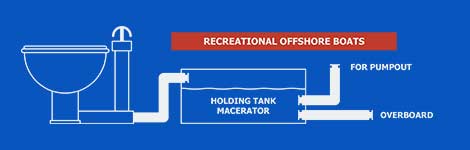
The Flow Process
Once waste moves through an MSD, it meets a “Y-valve." To prevent discharge overboard, the Y-valve must be in the closed position. While in the closed position, sewage goes towards the opening at the deck level. To dispose of sewage, use a
pumpout station.
Remember, it is against the law to discharge untreated sewage from your boat less than three miles offshore.
Three Types of Marine Sanitation Devices
On recreational boats, a Type III MSD is a holding tank to collect and store untreated sewage. Use a pumpout station to remove waste from a holding tank once you return to shore.
Type I and Type II MSDs are flow-through sewage treatment systems. Type I MSDs use a grinding or blending mechanism to reduce human waste into a liquid. This makes it easier to pump out and disinfect. Type II MSDs use biological treatment and disinfection. Find more information on treatment requirements from the federal Environmental Protection Agency.