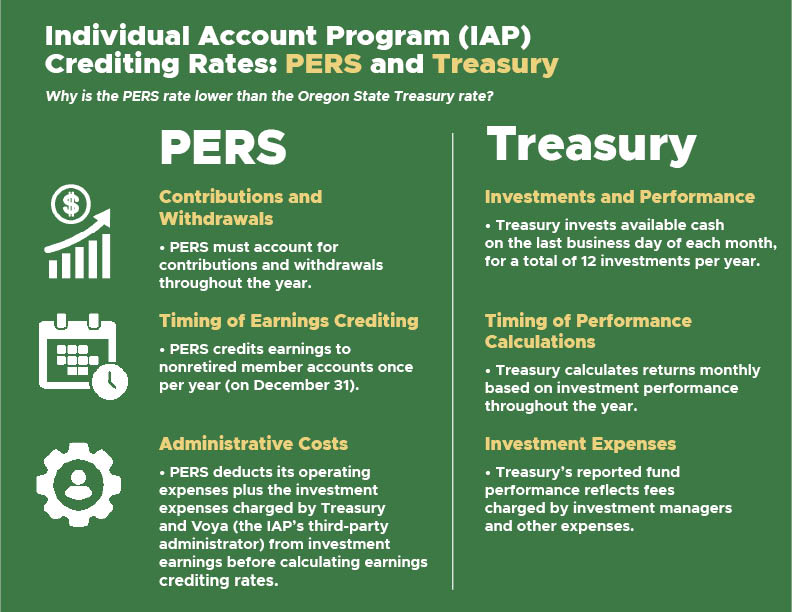
Changes to PERS Individual Account Program (IAP) performance rates published by
Oregon State Treasury (aka Treasury)
are based solely on investment fund performance, while PERS takes into account additional factors to set the final
earnings crediting rates that ultimately get applied to member IAP accounts.
The difference between the Treasury performance rates
and PERS crediting rates can be explained by the way cash flow
impacts crediting rates. For instance, when a member retires during the year, their IAP account is credited earnings
as of the date of distribution of the account balance. The rate applied to the distribution may be higher than the
final earnings crediting rate applied to all member accounts, which means there will be less earnings available for
crediting and therefore a lower crediting rate.
Examples for the following two calculations are provided in the attached Excel spreadsheet:
-
Treasury performance rate calculation — Treasury invests contributions throughout the year and
calculates earnings rates based on investment gains or losses divided by invested funds, which increase monthly
with contributions and decrease with payments to the member, if they’re retired or have otherwise opted to
withdraw their IAP.
-
PERS earnings crediting rate calculation — Earnings are credited by PERS at a fixed point in
time, which is always December 31 of each year. The rate calculated for each target-date fund (TDF) is based on total
investment earnings for that fund minus the agency’s administrative costs and earnings already distributed to
members during the year, divided by the final fund balance as of December 31 each year. Oregon law requires that
earnings be credited to IAP accounts once per year.
While investment risk is the primary driver of TDF rate variances in Treasury performance calculations, another
significant driver of rate variances between target-date funds’ is the effect of deposits (contributions) and
withdrawals (benefit payments) from the fund throughout the year. This activity tends to include more deposits
coming into the later (2060, 2065, 2070) target-date funds as younger members contribute to the fund, and more
withdrawals coming out of the earlier (Retirement Allocation, 2030, 2035) target-date funds as older members retire.
The scale of this activity can vary significantly from year-to-year and fund-to-fund based on decisions made by
members.
For all of these reasons and the effect of administrative expenses, which were approximately 0.12% of the total fund
balance for the calendar year that ended December 31, 2023, the published PERS earnings crediting rates were — and
will always be — lower than the fund performance rates published by Treasury.