Tracking the Big 3 Goals
1. Reducing the Prevalence of Substance Use and Substance Use Disorders

More than one out of five Oregonians had a substance use disorder in 2023, according to SAMHSA’s
National Survey on Drug Use and Health. Compared with the national average (17.1%), Oregon's significantly higher figure demonstrates the need for all Oregonians to have timely access to adequate substance use services.
The ADPC's work across prevention, health and safety interventions, treatment and recovery aims to decrease the prevalence of substance use disorders. Each of these areas plays a necessary role in the reduction of SUDs.
Substance use disorders are often tracked using survey data, since this allows for the inclusion of individuals who have not been diagnosed with an SUD but still have symptoms consistent with an SUD. While these surveys provide essential information, changes in methodology and resources make it difficult to accurately measure over time.
The SUD picture is best supported by looking at several measures rather than any one alone.
Along with a high prevalence of substance disorders (21.6%), surveys show as many as 74.1% of Oregonians with an SUD were not receiving treatment, 12.1% of Oregonians were struggling with drug use disorder, and 11.7% suffered from alcohol use disorder. At the same time, binge drinking
among youth has declined in recent years, according to the Oregon Student Health Survey.
Data from Goals 2 and 3 (reducing deaths and disparities, respectively) can also help demonstrated the magnitude of the SUD issue. Oregon saw 1,833 people die from an overdose in 2023, according to the Oregon Center for Health Statistics. Deaths from alcohol-related causes amounted to more than 3,000 in 2022, according to Oregon death certificates.
To address issues with substance use disorder prevalence, the ADPC's committees identified associated strategies in the 2026-2030 Comprehensive Plan:
- Prevention: Create a Center of Excellence providing a one-stop shop of training support, data collection, evaluation and technical assistance with the aim of equipping professionals with evidence and culturally-informed strategies.
- Health and Safety Interventions: Increase access to strategies that reduce the harms of substance use. This includes strategies like drug checking for people who use drugs to make informed decisions, and data collaboration between agencies.
- Standardize entry and transition practices, increase data-derived insights, and offer treatment services in a more timely and responsive manner.
- Recovery: Clarify peer roles and expectations, ensuring peer services are delivered efficiently and effectively, drawing on lived experience of the peer.
- Youth: Establish and support in-home and home-based models of care, which includes evidence-based family supports.
2. Reducing Substance Use-Related Deaths
1,833 people died from drug overdoses in Oregon in 2023. There were more than 3,000 alcohol-related deaths in Oregon in 2022. Increasing delivery of risk reduction and other services can reduce preventable deaths.
Drug overdose deaths reached a peak in 2023, with preliminary figures showing a slight decrease in 2024. These figures come from Oregon Death Certificates.
In 2019, 2,300 Oregonians died from alcohol-related causes. These include things like poisoning, chronic disease like liver disease, cancers, and accidents. These figures come from Oregon Death Certificates and use the CDC's Alcohol-Related Disease Impact (ARDI) methods for analysis.
To address issues with substance use-related deaths, the ADPC's committees identified associated strategies in the 2026-2030 Comprehensive Plan:
- Prevention: Prioritize reducing and delaying use among transition-aged youth. This includes those in college and going straight to the workforce.
- Health and Safety Interventions: Increase access to naloxone by clarifying available resources and by providing technical assistance and guidance on distribution and administration of naloxone.
- Treatment: Expand MOUD access, address common pain points experienced by those receiving treatment services, and standardizing transitions between providers.
- Recovery: Develop a regulatory framework to increase safe and secure funding for housing, education for landlords and tenants, and increase community welcoming of recovery housing, ensuring inclusion of youth and family housing.
- Youth: Shore up services at Oregon Youth Authority and Department of Corrections, particularly evidence-based, life-saving interventions such as MOUD.
3. Reducing Substance Use-Related Disparities
There is a lack of care tailored to the needs of youth and culturally specific populations, in addition to geographic disparities in access to care. The plan focuses on geographic and population disparities to ensure actions taken focus on improving access where there currently exist gaps in care.
American Indian and Alaska Native Oregonians had an overdose death rate of 110 (per 100k), compared with the statewide rate of 43 (per 100k, Oregon Death Certificates). Black or African American Oregonians had a rate of 104 (per 100k). That means American Indian and Alaska Natives were almost three times as likely to die from drug overdoses, and Black or African American Oregonians were more than twice as likely.
In addition to disparities in the drug overdose death data, American Indian and Alaska Native Oregonians are twice as likely to die from alcohol-related causes.
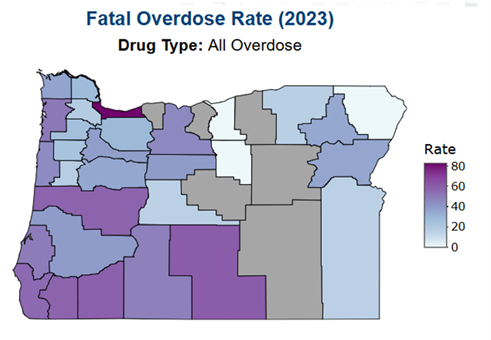
Disparities also exists geographically. While the most overdose deaths occur in Multnomah County, overdose death rates differ widely across the state (Oregon Death Certificates). In addition to high rates of overdose death in Multnomah County, rates are high in Southwest Oregon, including counties like Coos Curry, Jackson, and Josephine. Note that counties in gray do not have calculated rates.
To address issues with substance use-related disparities and inequities, the ADPC's committees identified associated strategies in the 2026-2030 Comprehensive Plan:
- Prevention: Increase access through greater engagement of youth-serving and allied organizations in primary prevention activities at the community level, delaying use of substances though education and prosocial activities.
- Health and Safety Interventions: Ensure comprehensive injury prevention services are available to all Oregonians by incentivizing existing programs to provide mobile services and encouraging community safety net providers.
- Treatment: Expand access to medications for substance use disorders in community and carceral settings, launching technical assistance or informational campaigns, and increasing use of common assessment tools.
- Recovery: Expand peer-led Recovery Community Centers and Recovery Spaces, with a focus on culturally-informed programming, supports for all ages, geographies, and carceral settings.