In 2025, Oregon Legislature passed
House Bill 2337, directing the Department of Administrative Services (DAS) to create a Small Business Procurement Program and authorizing the Certification Office for Business Inclusion and Diversity (COBID) to develop a new Oregon Small Business Enterprise (OSBE) certification. The OSBE program establishes a structured, mandatory preference designed to strengthen Oregon's economy by prioritizing state contracting opportunities for certified Oregon-based small businesses and is supported by
administrative rules.
What is Oregon Small Business Enterprise Certification?
The OSBE certification is a race and gender-neutral small business certification for Oregon-based businesses. COBID began certification on April 1, 2026. There are currently over 300 OSBE certified businesses and growing. More information about OSBE certification requirements and the application process can be found on the COBID website.
Why was the OSBE Certification and Preference Program Created?
The state of Oregon spends billions of dollars on contracted services every year. Small businesses make up 99.4% of Oregon's economy and also employ over half of all Oregon employees. Despite this, many Oregon small businesses struggle to compete for state contracts with large out-of-state businesses. The OSBE preference program aims to help Oregon small businesses participate in public procurement. The preference program went into effect July 1, 2026, and is applicable to all state agencies under DAS authority.
How Does the Preference Work?
The OSBE preference applies to small and intermediate procurements only, and includes several exemptions.
For small procurements (up to $25,000) OSBE has been added before statewide price agreements in the Buy Decision. This means that before an agency purchases from a statewide price agreement, they must first check to see if there is an OSBE that can meet their need. If there are no OSBEs that can meet the need, the agency may continue through the Buy Decision to statewide price agreements.
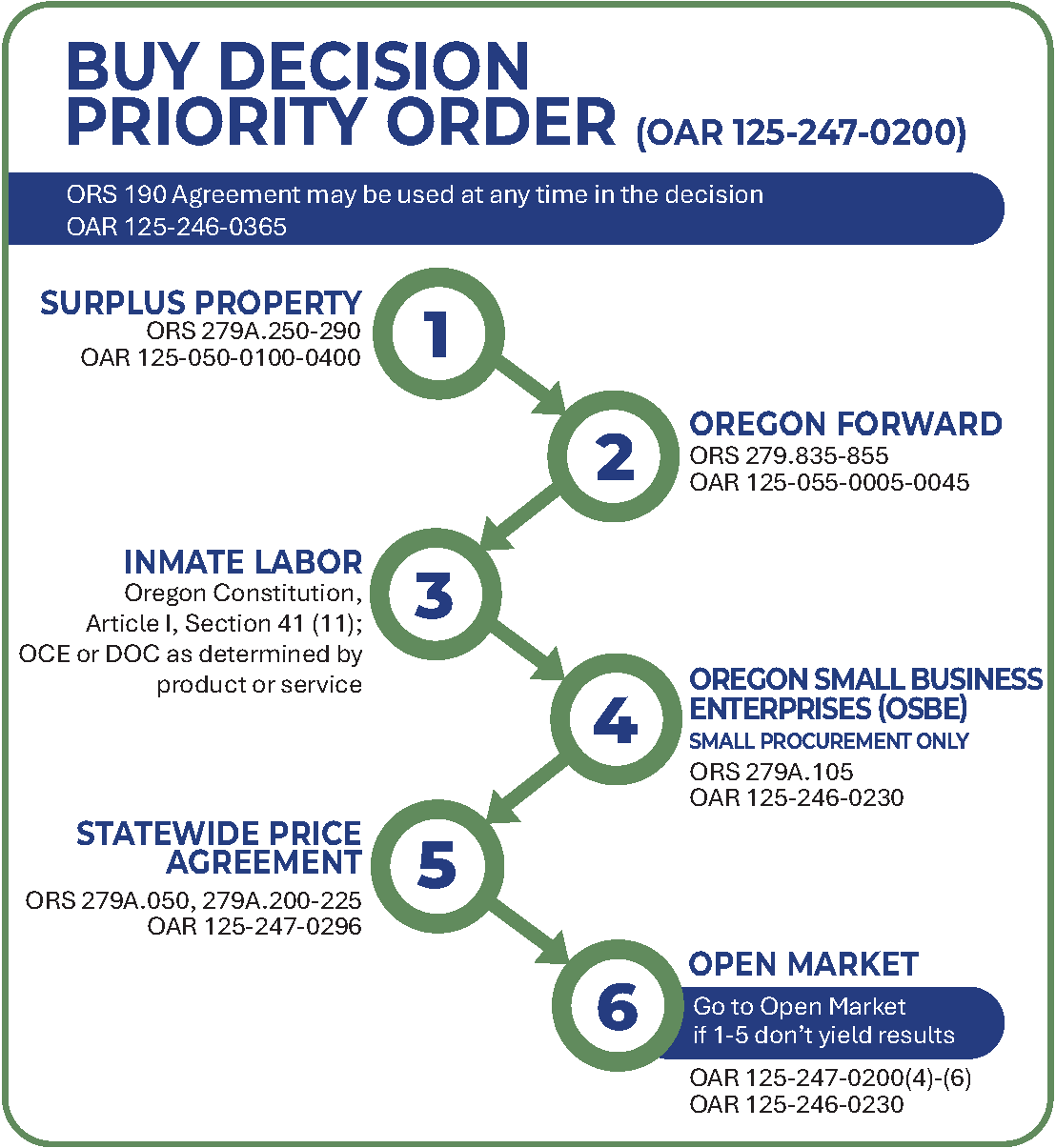
Intermediate procurements (over $25,000, up to $250,000) will implement the OSBE preference in the open market stage which is after statewide price agreements in the Buy Decision. For unwritten solicitations such as phone quotes, agencies must solicit offers from three OSBEs before seeking offers from non-OSBEs. For written solicitations, a preference of greater than 0% and up to 10% must be applied to OSBE offers according to OAR 125-246-0230:
- Evaluation based on price: Apply the preference by reducing the OSBE's evaluated price by the selected percentage. This reduction is for the evaluation only - the contract price does not change.
- Best Value Evaluation: Apply the preference by increasing the OSBE's total score by the selected percentage.
- Non-Scored Procurements: Consider how purchasing from an OSBE:
- Strengthens Oregon's economy, and
- Supports local jobs
The OSBE preference may be combined with other procurement preferences.
OSBE Mandatory Reporting
DAS is mandated to report annually to the Governor and Legislature on the number and aggregated value of public contracts awarded to OSBEs. To ensure accuracy and completeness, each agency must submit its OSBE spend data to DAS. Any missing agency submissions must be noted in the state dataset.
Who Can Report for an Agency?
Each agency may determine its own process. Reporting can be completed by:
- Individual SPOTS cardholders
- Departmental Procurement Officers (DPOs)
- Finance or Procurement staff designated by the agency
All submitted data will be combined into a single statewide report.
How to Report
Submit your agency's spend using the official OSBE Reporting Form. You may enter data line-by-line or upload your own tracking logs as outlined in the Reporting Form Instructions.
Reporting Schedule
Agencies will report their data every six months: at the end of January and July.
Questions
See the OSBE Reporting FAQ for frequently asked questions.
Please contact Alexandria Straub for any questions about OSBE reporting.
OSBE Frequently Asked Questions
OSBE is a mandatory preference and must be applied to Small and Intermediate Procurements.
The OSBE preference applies to agencies and procurements under DAS authority. If an agency is partially independent from DAS authority, that agency is responsible for obtaining any legal determination related to the OSBE preference rules. For example:
The Oregon Department of Education (ODE) is under DAS authority and also has independent authority for goods and services related to student assessment. If ODE wants to contract for a trainer to lead a team building event, this would likely be subject to the OSBE preference. If ODE wanted to contract for training related to how to structure an assessment of 3rd grade reading comprehension, this may not be subject to the OSBE preference. ODE could consult its DOJ attorney if needed to help determine whether the OSBE preference applies.
For small procurements, OSBE is a new priority in the Buy Decision, above statewide price agreements. This means that if you have a small procurement need, you'll go to the COBID directory to look for an OSBE before you consider price agreements. If you find an OSBE that can meet your need, use them. Determining what meets your need is up to you. The OSBE preference rule (OAR 125-246-0230) includes exemptions for office supplies, IT hardware and software, and vehicles. For these items, you'll continue to use statewide price agreements (unless of course a higher priority like Surplus can meet your need).
In the intermediate range, if you are simply picking up the phone and getting 3 quotes as required by statute, all 3 must come from OSBEs. If there are fewer than 3, you can fill the gap with non-OSBE suppliers. If you get OSBE quotes and none of them meet your need, you can seek non-OSBE quotes.
If you have a written solicitation instead, you need to provide a preference for OSBEs. The preference must be more than 0% and can be up to 10% - the amount is up to you - and your solicitation needs to inform potential suppliers that you'll be doing this.
For price-based evaluations, reduce the price of any OSBE's offer by the preference amount stated in your solicitation and then compare prices. Note that this does not change the supplier's actual price. This is for evaluation purposes only. For evaluations based on best value, increase the total score for any OSBE offer by the preference amount in your solicitation. Both of these actions make OSBEs more competitive.
If you are requresting offers from OSBE and non-OSBE firms, you do need to provide the OSBE preference. "Written," includes email (see OAR 125-246-0110(185)).
No, the OSBE preference only applies to Small and Intermediate Procurements.
The OSBE preference does not apply to:
- Amendments
- Procurements that use funding sources or follow laws that don't allow the preference (example: some federal awards don't allow geographic preference)
- Small Procurements for office supplies, IT hardware or software (including cloud and online services), and vehicles
- Best value analysis against statewide price agreements
- Procurements under 279C (note that construction under 279B is not exempt from the OSBE rules)
Determining what meets your need and how to document your decision is up to you. There are a lot of eyes on this program and DAS is required to report OSBE activity to the Governor's Office and the Legislature.
The primary difference between OSBE and ESB is the size of the business and the geographic requirement. ESBs have two tiers of certification (to allow for growth over the duration of participation in the program). Tier one ESBs must have fewer than 19 employees and tier two ESBs must have fewer than 29 employees. Three-year average gross revenue must be under the respective threshold for construction and non-construction businesses.
OSBEs must have fewer than 50 employees, be for profit, have a primary place of business in Oregon, and have filed at least one year of federal tax returns. Gross revenue caps for OSBEs are determined by industry code.
ESB certification has a limited duration of up to 12 years participation. OSBE does not expire but does require annual renewal. See the COBID website for more details.
Yes, businesses with other COBID certifications such as ESB, VBE, DBE, MBE, and WBE can apply and many will also be eligible for OSBE certification. There is a "fast-track" OSBE application for firms that already hold another certification. See the COBID website for more details. All COBID certifications are included in the COBID Certified Directory online.
There are currently two trainings available in Workday Learning:
- DAS -SPS Buy Decision
- DAS-SPS Oregon Small Business Enterprise (OSBE) Preference
The
COBID Certification Manual provides guidance on how COBID certification works, how to search the directory effectively, and troubleshooting tips.
The Procurement Impact Unit Outreach team is available to offer individual agency training about the OSBE preference upon request. To request training, fill out the
Outreach Request Form found on the
Outreach and Events page.
Yes, the OSBE preference applies regardless of payment method. SPOTS purchases have always been and will continue to be subject to all applicable procurement rules.
Resources
COBID Website
COBID Vendor Directory
COBID Procurement Guide
Common NAICS to NIGP Code Crosswalk
OSBE Reporting FAQ
OSBE Reporting Form
Workday Trainings for Procurement Professionals:
- DAS - SPS Buy Decision
- DAS - SPS Oregon Small Business Enterprise (OSBE) Preference