Outreach Events
This
page will continue to be updated with information as it becomes
available and we approach the March 1, 2028, deadline. Please continue
to check this page periodically for important updates!
Additionally, if you would like to receive GovDelivery email updates, please subscribe to the Harney Basin listserv.
Information Resources
Background
Criteria met for SWMPA Designation
Groundwater levels were declining and not recovering each year. There are frequent occurrences of surface or ground water shortages caused by use of water from streams or wells. Shortages may be evidenced by complaints from water right holders, requests to regulate water use, degraded water quality, or failure to meet administrative restrictions or minimum streamflows.
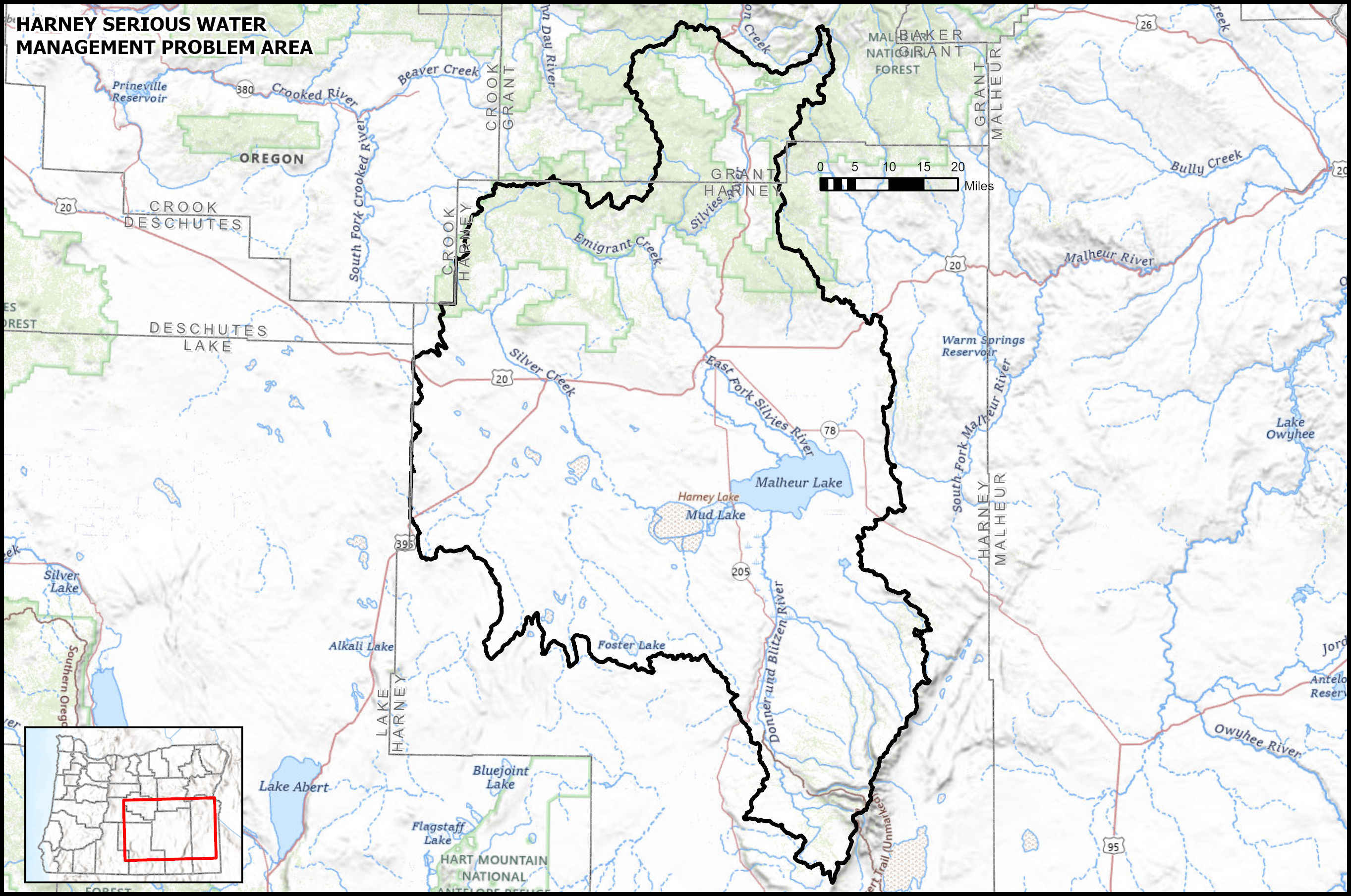
Oregon
Revised Statue (ORS) 540.435 and Oregon Administrative Rules (OAR)
690-085 authorizes the Oregon Water Resources Commission to go through a
rulemaking process to identify and designate areas where water concerns are significant enough to warrant
special attention and potentially stricter management practices.
Serious Water Management Problem Area (SWMPA) requirements can be
applied to current and future water use, whether it is surface water,
groundwater, or both. For the purposes of the Harney SWMPA, OWRD is
requiring this only for groundwater users within the designated SWMPA
boundary (see Exhibit 3 map).
A SWMPA can be designated based on a variety of community water concerns, such as:
For
effective implementation of groundwater use reductions in the Harney
Critical Groundwater Area (CGWA), water use measurement and reporting is
needed. Comprehensive water use data within the basin will provide OWRD
staff with data needed to better understand the relationship between
groundwater pumping and water-level changes. Water use measurement and
reporting also serve as another tool for field staff to identify overuse or unauthorized use.
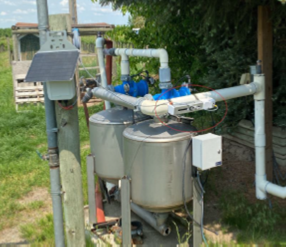
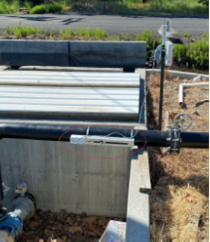
Example of a flowmeter installed in the Walla Walla Subbasin
Please note: Flow meters are required to be installed by March 1, 2028, on points of appropriation on valid water rights. NOT exempt use wells.
Serious Water Management Problem Area (SWMPA) Rules
Adopted by the Water Resources Commission on December 11, 2025. They became effective on January 14, 2026.
(1)
Groundwater conditions within the SWMPA boundary defined in OAR
690-512-0020(3) meet the criteria defined in OAR 690-085-0020(1)(a) and
OAR 690-085-0020(1)(f).
(2)
Any state-issued groundwater rights or federally reserved groundwater
claims held by a Federally Recognized Indian Tribe are exempt from the
requirements of this rule.
(3) By March
1, 2028, each groundwater right holder, well owner, or well operator
shall install a totalizing flow meter in accordance with manufacturer
specifications on each well listed as a point of appropriation on a
valid groundwater right within the Harney SWMPA boundary as defined in
OAR 690-512-0020(3). The Department may extend the deadline as needed.
If the deadline is extended, the Department will notify each groundwater
right holder, well owner, or well operator at least 60 days before
March 1, 2028.
(4)
Totalizing flow meters and the method of flow meter installation may be
subject to approval by Department staff. Once installed, totalizing
flow meters must be maintained in good working order. Department staff shall have reasonable access to the totalizing flow meters upon request pursuant to ORS 537.780(1)(e).
(5)
The groundwater right holder, well owner, or well operator shall keep a
complete record of the volume of water appropriated each month. The
groundwater right holder, well owner, or well operator shall submit
annually a report that includes water use measurements to the
Department by December 31 of each calendar year for water used between
November 1st of the preceding year and October 31st of the current year.
Reports shall be submitted using a form developed and maintained by the Department.
(6) A totalizing flow meter shall meet the following specifications:
(a) A totalizing flow meter shall have a rated accuracy of plus or
minus 2 percent of actual flow for all flow rates for which the meter is
expected to measure;
(b) A totalizing flow meter shall measure the entire discharge from the well;
(c) A totalizing flow meter shall have a visual display and shall be
equipped with a sweep hand or digital readout so that instantaneous flow
rate can be read;
(d) The totalizing part of the flow meter shall have sufficient
capacity to record at minimum the quantity of water authorized to be
pumped over a period of 2 years. Units of water measurement shall be in
acre-feet, cubic-feet, or gallons, and the totalizer shall read directly
in one of these units. Flow meters recording in acre-feet shall, at a
minimum, read to the nearest 1/10th acre-foot, and the decimal
multiplier shall be clearly indicated on the face of the register head;
(e) Totalizers on each meter shall not be field reset without notice to
and written permission from the local watermaster. Prior to resetting
the totalizers, the final reading must be recorded and reported;
(f) The totalizing flow meter shall be installed in accordance with all manufacturer specifications. There shall be no turnouts or diversions between the well and the flow meter; and
(g) The totalizing flow meter shall be installed no more than 100 feet
from the well head unless an exception is approved by the watermaster in
writing.
(7) A water user shall report broken flow meters to the local watermaster’s office within 48 hours after determining that the flow meter is broken. A water user shall not appropriate water for more than 60 days without an operating flow meter.
(8)
While the flow meter is broken, the water user shall use other methods
of reporting as defined under OAR 690-085-0015(5) until the flow meter
is replaced or repaired. The water user shall keep the monthly data and
mail the data to the local watermaster upon request. The data shall
include a statement of the initial
reading on the newly installed flow meter, the current power meter
reading and the time of operation. The water user shall notify the local
watermaster within 48 hours of installing the repaired or replacement
flow meter.
(9) Failure to have and maintain a properly installed,
functioning totalizing flow meter by the deadline will result in the
local watermaster regulating and controlling the unmetered well such
that no groundwater may be pumped or appropriated until a flow meter is
installed consistent with these rules.
(10)
Groundwater wells that are regulated off and disconnected from all
water use infrastructure including power and plumbing do not require a
totalizing flow meter to be installed or to report water use unless or
until use is permitted to resume.
(11) Any governmental entity required to submit water use reports under OAR 690-085 is exempt from the reporting requirements of this rule.
(12)
Consistent with ORS 536.900, ORS 183.745, and OAR 690-260, the
Department may assess civil penalties for violation of these rules.