 Habitat Conservation Plan
The final Western Oregon State Forest Habitat Conservation Plan and its appendices are available.
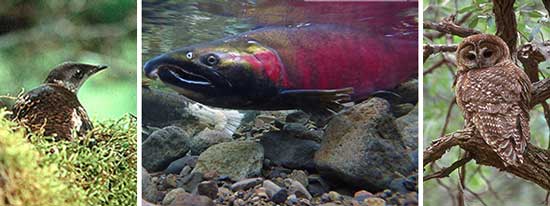
The Department of Forestry received the Incidental Take Permit (ITP) from National Marine Fisheries Service for the 10 fish species covered under the HCP on Sept. 11, 2026. The Department has applied for the ITP from the United States Fish and Wildlife Service and is supporting the development of the Biological Opinions for the pending ITP issuance for the five terrestrial species covered by the HCP.
Background
As a landowner, ODF must comply with the Endangered Species Act (ESA). The agency is also required to provide for the social, economic, and environmental benefits required by the
Greatest Permanent Value rule (OAR 629-035-0020). This stewardship approach to land management provides habitat for many threatened and endangered species across state forest lands. Without a Habitat Conservation Plan (HCP), ODF uses a process called “take avoidance" to protect these species. This approach requires extensive and costly species surveys, resulting in shifting protections that, over time, are likely to limit the quality and durability of the habitat provided. It also creates more uncertainty around the long-term financial viability of managing state forests for the economic benefits articulated in the Greatest Permanent Value Rule.
The Western Oregon State Forests Habitat Conservation Plan covers about 640,000 acres of ODF managed lands west of the Cascades. It provides an integrated, collaborative, ecosystem-based approach to species conservation across the landscape. These conservation measures are designed to offset potential impacts from forest management, ensuring species conservation and stability in harvest levels for a 70-year permit term. The HCP is a more holistic, cost-effective approach to complying with the ESA, while facilitating economic outcomes, as required in the Greatest Permanent Value Rule.
The HCP provides conservation measures to protect covered species. This is an important part of a larger suite of forest management activities such as harvest and reforestation, implementing recreation, education and interpretation programs, monitoring forest and watershed health, etc. State Forests has developed a new Forest Management Plan designed to implement the HCP as well as the full complement of management activities required for achieving Greatest Permanent Value.
The HCP was developed using a multi-agency governance structure consisting of a Steering Committee, which provided policy direction and oversight of the HCP process, and a Scoping Team of technical experts, which developed the conservation strategies to be considered in a potential HCP. This structure had representatives from:
- Oregon Department of Forestry
- Oregon Department of Fish and Wildlife
- Oregon Department of Environmental Quality
- Oregon Department of State Lands
- Oregon State University
- U.S. Fish and Wildlife Service
- NOAA Fisheries