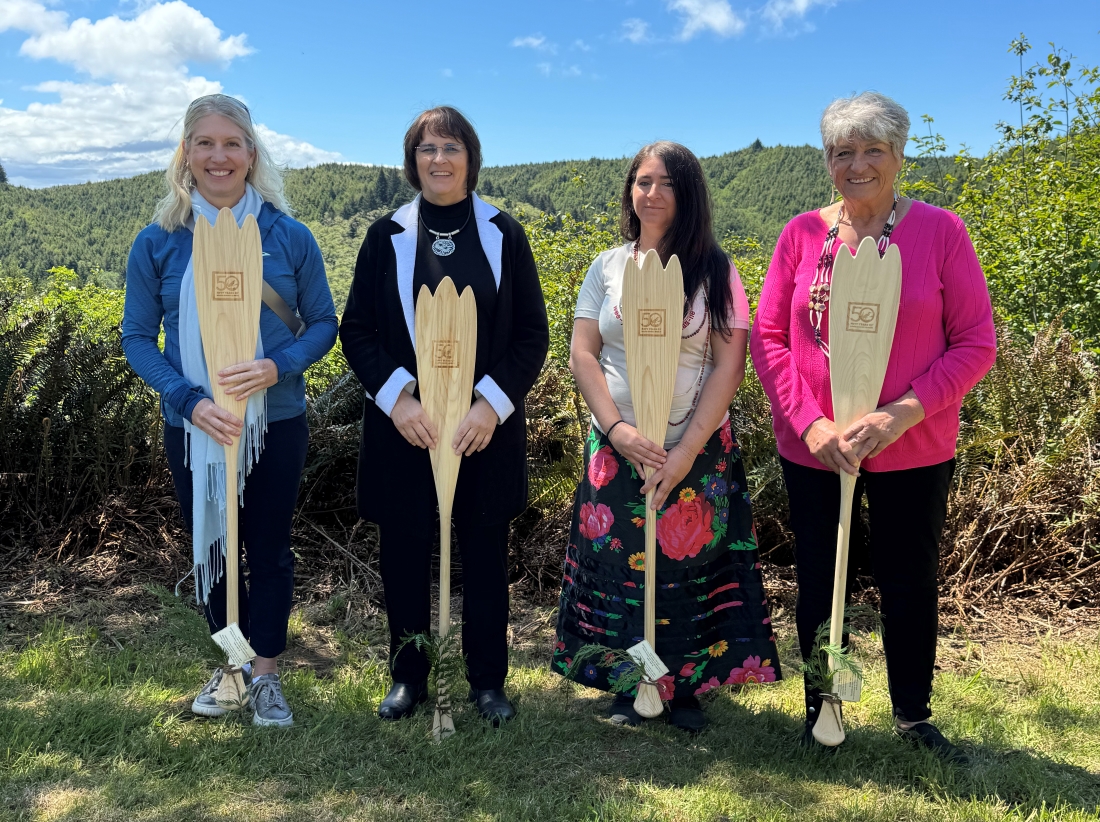
 The Reserve is located on Oregon’s southern coast, within the ancestral homelands of the miluk coos people. Today, descendants of the miluk coos people are citizens of Tribal Nations whom maintain deep cultural, historical, and stewardship connections to this place:
-
Confederated Tribes of Coos, Lower Umpqua and Siuslaw Indians (CTCLUSI
-
Coquille Indian Tribe
-
Confederated Tribes of Siletz Indians (CTSI)
Co-managed by the Oregon Department of State Lands and the National Oceanic and Atmospheric Administration, the Reserve maintains government-to-government relations with Tribal Nations and recognizes the importance of Tribal sovereignty, Tribal stewardship, and meaningful engagement in the management of cultural and natural resources.
Co-Stewardship
Tribal Nations are important co-stewardship partners. Co-stewardship reflects a commitment to braid Indigenous Knowledge and western scientific approaches in caring for cultural and natural resources. When Tribal Nations share cultural knowledge, the Reserve meets this generosity with a commitment to Indigenous data sovereignty grounded in early and often communication and relationship-building.
Coordination with Tribal Nations informs Reserve planning, restoration, cultural resources protection, research, interpretation, and education. In additional, Tribal staff participation on the Reserve Management Commission and technical advisory groups.
Current and Recent Initiatives
Currently, the Reserve is in partnership with Tribal Nations to restore a 525-acre area in the southern portion of the Reserve. The Wasson Creek Restoration Project is restoring land and waters, as well as reconnecting people to place. Tribal citizens and staff have contributed cultural knowledge, technical expertise, and cultural resources review to help inform project planning and implementation.
PDF on Wasson Creek Restoration Project
Visit the Stewardship webpage to learn about opportunities to volunteer on Reserve land.
- The Reserve contributes to a vital water monitoring program across 30 estuary reserves. Three of the stations in the monitoring program are managed through Confederated Tribes of Coos, Lower Umpqua and Siuslaw Indians (CTCLUSI) and Coquille Indian Tribe. In addition, the Reserve partners with CTCLUSI to maintain telemetry equipment on the North Spit/BLM station. These monitoring stations contribute data to research projects investigating everything from understanding drivers of eelgrass population change to temperature and sediment impacts on native species.
- CTCLUSI collaborated on a recent project to further Oregon’s understanding of ocean acidification and hypoxia through evaluating the interaction of water quality and eelgrass in the Coos estuary using a complete, validated biophysical model for the Oregon Ocean Science Trust.
- In April 2024, Reserve staff as well as Tribal members of both CTCLUSI and Coquille Indian Tribe traveled to the He’eia National Estuarine Research Reserve in Hawaii to learn about the co-stewardship framework, biocultural restoration practices, and perspectives on weaving together conventional and Indigenous Knowledge systems. Link to more information on the NERRS website.
The Reserve works with Tribal Nations to better reflect the cultural history and living presence of Indigenous peoples in South Slough through interpretation, exhibits, and educational programming. Recent collaboration has included Tribal participation in updates to the South Slough Visitor Center exhibits, including review and development of interpretive text, incorporation of Tribal language, and inclusion of cultural items created by Tribal artists and weavers. These efforts help ensure that visitors encounter the Reserve as a place with deep Indigenous history and ongoing Tribal relationships.
The Reserve also works with Tribal partners to incorporate culturally significant plants and cultural knowledge into restoration, landscaping, and educational spaces where appropriate. This includes the Visitor Center rain garden, which features a number of culturally important species, including: camas, kinnikinnick, Oregon iris, slough sedge, blue eyed grass, wild strawberry, harvest brodiaea, and chocolate lily.
Tribal Partners
The Reserve values its relationships with the Tribal Nations connected to the Coos estuary and surrounding landscapes. To learn more, please visit: