A landowner may be interested in converting their forest land to agricultural use. This can include conversion from forest land to pasture, hay, vineyards, cropland, or any type of agricultural use. To do so, a landowner needs to contact both Oregon Department of Forestry (ODF) and the Oregon Department of Agriculture (ODA). Please contact your ODF Stewardship Forester and your ODA Regional Water Quality Specialist.
The new agricultural operation will need to be abide by ODA water quality rules. There are 38 sets of rules specific to regions of Oregon. However, all sets of rules have the following in common:
- Streamside vegetation: Agricultural activities must allow streamside vegetation to establish and grow. The vegetation must provide shade, stabilize banks, and filter runoff.
- Erosion control: Properties must be managed to prevent erosion and soil entering waterways.
- Manure and nutrient management: Fertilizers and manure must be used in a way to avoid contamination of water. This includes surface and groundwater.
Your local Agricultural Water Quality Rules can be found on the Area Rules webpage.
Common water quality concerns related to forest to agricultural conversions include:
- Removing trees, shrubs, and ground cover within streamside areas. These streamside areas are protected. They can be found around seasonal, non-fish streams, perennial streams, or wetlands.
- Excessive erosion. Tree clearing and stump removal can cause sediment to enter road ditches or streams.
If you are converting to agricultural use, it is required that you begin using the land for agricultural purposes within two years. An example of this is clearing stumps and planting pasture seed within two years.
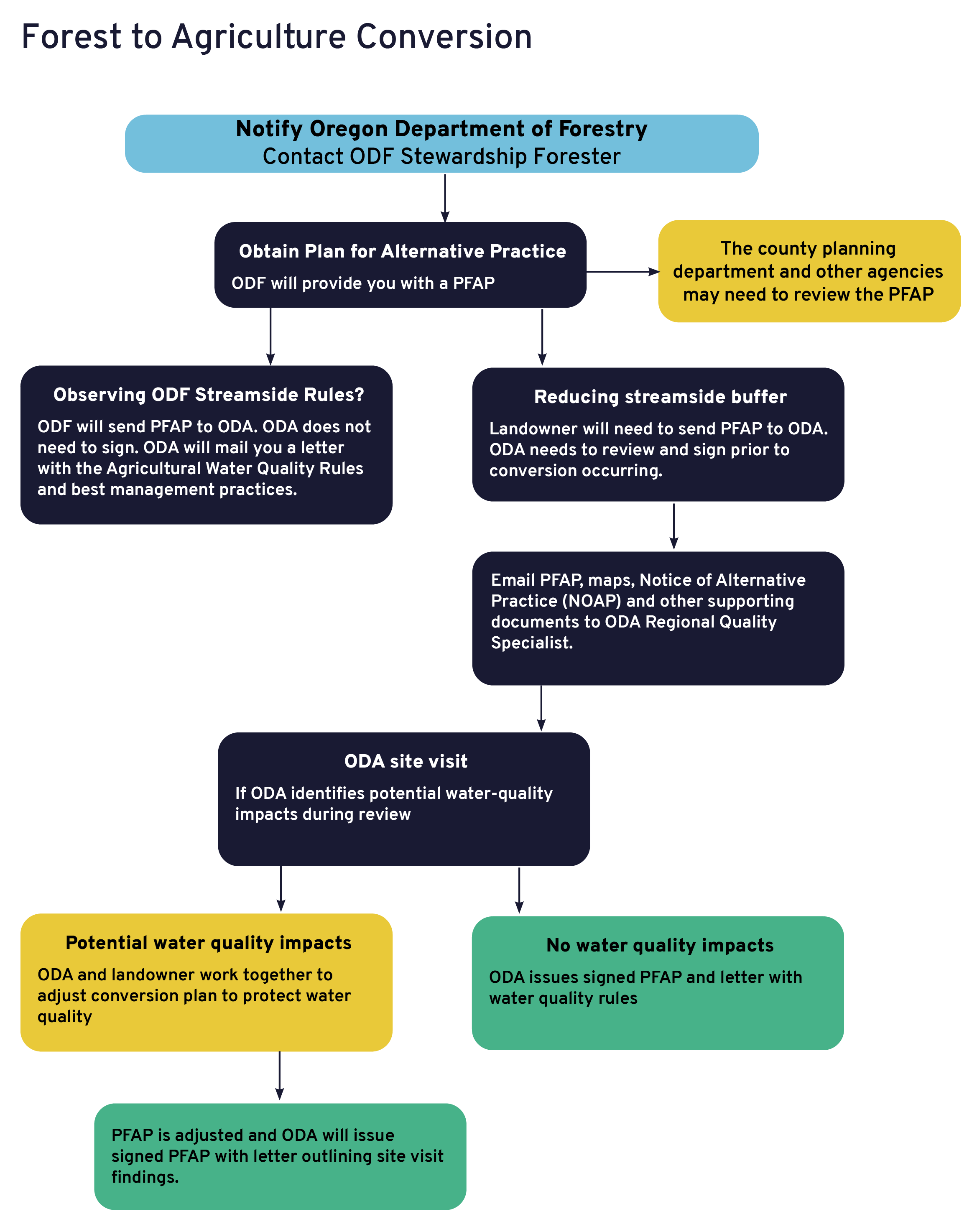
Steps for Converting Forestland to Agricultural Use in Oregon
- Notify ODF: Contact your local Oregon Department of Forestry (ODF) stewardship forester to notify them of your intent to convert forestland to agricultural use.
- Obtain a PFAP: ODF will provide you with a Plan for an Alternate Practice (PFAP) ODA will need to review your PFAP. Your county planning department and other agencies may also need to review your PFAP for your proposed forest to agricultural conversion.
- a. If your conversion from forest to agricultural land observes all ODF Rules pertaining to water quality protection, then ODF will contact ODA and provide them with a copy of the PFAP for review. This type of conversion does not require a signature from ODA on the PFAP. ODA will mail the landowner a letter summarizing the applicable Agricultural Water Quality Rules and best management practices to help maintain compliance throughout the conversion process.
- b. If your conversion proposes to not observe ODF protections but will take actions, such as reducing the riparian streamside buffer area, then ODA will need to review your PFAP in more detail. In this case, you, the landowner, will need to contact your ODA RWQS. Email the completed PFAP form and any other supporting maps, written plans, ODF NOAP to your ODA Regional Water Quality Specialist. The PFAP form will need to be signed by ODA staff prior to the conversion occurring.
- a. ODA review: ODA Water Quality Program staff will need to review your proposed forest to agricultural land conversion. ODA will evaluate the proposed conversion to assess potential impacts to waters of the state, including streams, wetlands, and other surface water features.
- b. Site visit (if needed): If ODA identifies the potential for water quality impacts, they will coordinate a site visit with the landowner or operator. During the visit, staff will review the proposed conversion area and discuss applicable agricultural water quality rules.
- c. ODA Response:
- i. If impacts are likely: ODA will work with the landowner to adjust their conversion plan to ensure the property will be in compliance with the Area Agricultural Rules. Once the appropriate information ensuring compliance with the Rules is included in the PFAP, ODA will issue a signed PFAP along with a summary letter outlining the site visit findings and any concerns. The letter will include recommendations to ensure compliance during and after the land use change.
- ii. If impacts are unlikely: ODA will issue a signed PFAP along with a letter summarizing the applicable rules and best management practices to help maintain compliance throughout the conversion process.