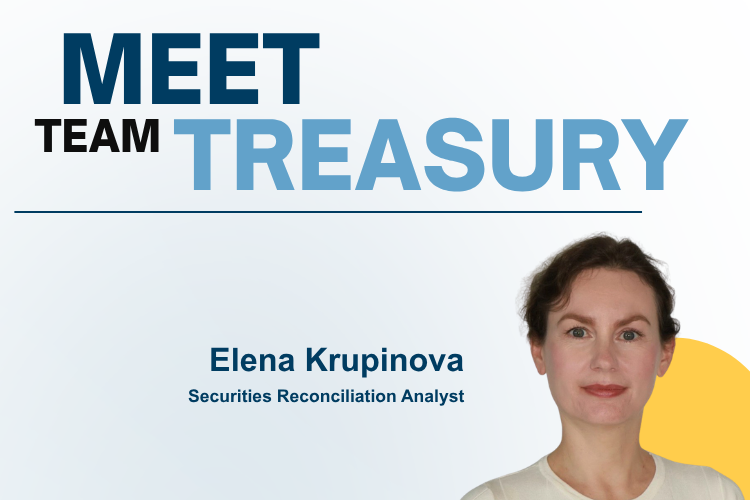
After building her career across international banking and financial technology in Russia, Elena Krupinova relocated to the US three years ago looking for a role that would continue to challenge her. As a Securities Reconciliation Analyst for Treasury’s Trust Property team, Elena ensures that every stock, bond, and financial asset reported to Unclaimed Property is accurately tracked and available for its rightful owner to claim. It’s detailed, technically demanding work, and Oregon is one of the few states doing it at this level.
What is your professional background and what brought you to this role?
I started my career at one of the largest banks in Russia, where I had the opportunity to work with a wide range of financial products, including credit cards, deposits, mortgages, and mutual funds. It gave me a broad understanding of the financial industry.
From there, I moved to the Global Operation Department, where I supported complex trades between our bank and some of the largest banks around the world. That experience gave me much of the knowledge I rely on today.
Later, I moved into the technology side of banking, leading a team of system analysts that developed and supported brokerage software, including the logic for calculating taxes on clients’ investment accounts. I loved that role because it brought together two things I’m passionate about: finance and technology.
When I moved to the United States three years ago, I was looking for a role that would let me use what I already knew while still giving me room to grow and learn. When I came across this position at Treasury, my immediate thought was, “This is an ideal fit.” I knew very little about unclaimed property when I started, but I was excited to learn. And that’s how I ended up here. Treasury has been a great place to work, and I feel very lucky to be part of the team.
Securities reconciliation isn’t something most people have probably heard of. How would you explain what you do to someone outside of Treasury?
In simple terms, I make sure that the securities we have in our system match the securities we actually hold. When a security is reported to the Unclaimed Property Program, I work to get it transferred to our custodian, or to our “in house” account when the shares cannot be transferred. Once the transfer is complete and the report is reconciled, the asset becomes available on our website for the rightful owners to claim.
I also keep our portfolio up to date. Securities don’t just sit still – dividends get paid, stocks splits, companies merge. All of those events need to be reflected correctly in our system.
I'm making sure that the balances we see in our system match what we actually have with our main custodian and with third party brokers. I'm making sure all the pieces line up and that we have an accurate picture of the assets we are holding.
It can get a little complicated, some transactions have to be entered manually and corporate actions come with a lot of nuance, but that’s what makes it interesting.
Oregon is ahead of most states when it comes to having a reconciled securities portfolio for unclaimed property. What sets Oregon apart?
I think what sets Oregon apart is having a clear vision and the discipline to execute it step by step. Having a manager who understands the unclaimed property program so well, including all its details and nuances, also makes a big difference. It helps us make good decisions without losing sight of the bigger picture.
When I started, reconciling our securities portfolio was made a priority from day one. That really resonated with me because I like when things are organized, accurate, and working the way they're supposed to.
Accuracy matters especially when you’re managing financial assets. Every transaction needs to be recorded correctly, and keeping everything current also saves significant time for me, the Claims team, and our custodian. Most importantly, it means that when someone visits our website looking for lost or forgotten property, the information they find is correct and their assets are protected.
There is still work ahead. In addition to our main custodian, we have four other large brokers whose accounts are currently going through the reconciliation process, and I’m continuing to work toward having the entire portfolio fully reconciled.
What aspects of your work are you most passionate/excited about?
The problem-solving. I really enjoy mathematical and logical challenges, and my role offers plenty of them. Sometimes I feel like a detective.
Some problems are technical, like figuring out why an algorithm isn’t behaving correctly and working with a vendor’s IT team to fix it. Others are more like puzzles and tracing transactions back five or ten years to find where a discrepancy started. You gradually piece together what happened and when it finally clicks, it’s genuinely satisfying.
What I enjoy most is that the work keeps me thinking. It's technical and analytical, but it also requires communication, patience, and the ability to look at a problem from different perspectives. Every day brings something different.
What book, podcast, or other resource(s) has influenced your thinking recently?
Recently I've been listening to Becoming Supernatural by Joe Dispenza. It's actually not the first time I've listened to it, but I find something new in it each time I return to it.
One of the ideas that has really stayed with me is how much of our everyday life happens automatically. We can fall into patterns of thinking, feeling and reacting without even noticing it. In a way, we can live on autopilot, repeating the same patterns and missing opportunities to see things differently.
One idea I find particularly practical is that when a person or situation determines how we feel, we are giving it control over our emotional state. Simply becoming aware of that gives us a chance to pause and choose our response rather than reacting automatically. I find that useful both personally and at work. When something frustrating happens, I try to notice my reaction before I respond. I don't always get it right, of course, but even noticing the pattern helps.