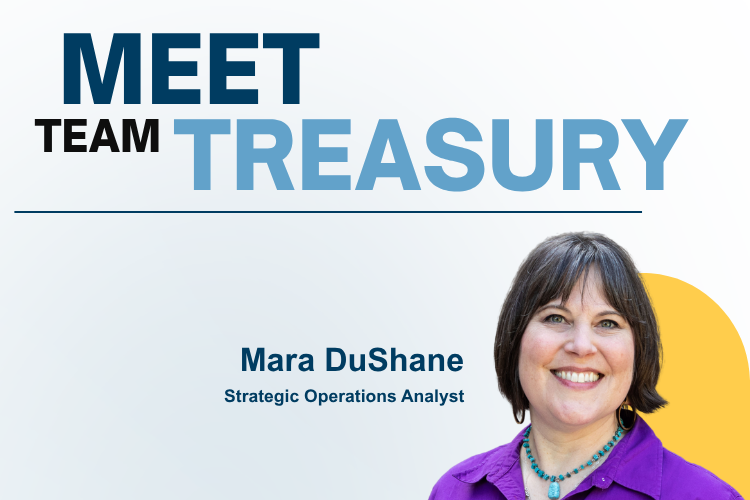
Mara DuShane is a returning member of Team Treasury, now serving on the Risk and Resiliency team. Mara’s depth of experience with emergency management and building continuity plans will help keep OST’s critical functions running if things go sideways. For her, planning for the unexpected is the ultimate creative challenge.
What is your professional background and what brought you to this role?
I worked as a graphic designer for 20 years before I started to move toward eLearning development and adult classroom training. I lead the training program for a state agency in Texas and they said, “By the way, we’d like you to write the continuity plan.” I didn’t know what that was! I learned quickly, fell in love with the work, and I’ve now been working in the field for over ten years. Since then, I’ve had the honor of working with some incredible public safety, emergency management, FEMA, and other public servants and volunteers. A highlight of my career was attending a closed meeting with top national officials to workshop the current guidance, the FEMA Continuity Guidance Circular.
You’re actually a returning member of Team Treasury. What was it like coming back to a familiar place in a new role?
Like coming home! It was so nice to see familiar faces. I missed the people and the statewide importance of the work. It was wonderful to pick up where I left off, some work from my previous role in the Finance Division merged with some of the work done by the previous Risk & Resiliency Team, who I got to work with a few years ago. It has been an easy onboarding process since I previously knew several people and the structure of the agency. It’s a dynamic and great place to work.
Most people don’t think about continuity planning until something goes wrong. What does it mean to plan for the unexpected, and why does it matter for an organization like OST?
Planning for the unexpected can certainly be something folks would rather avoid, but I see it as the ultimate creative challenge. The more proactive brainstorming you can do when calm, the better. Then when it really counts—like during a crisis—a well thought-out plan and the muscle-memory from practice can help lead the way. The planning process itself helps get people in a resilience mindset. To me, a team approach and collaborative thinking is what creates even better problem solving and results.
I love working with peers in different state agencies and governments and have learned so much about how the state works. I am thankful our Governor has prioritized continuity for all state agencies over the years. It’s been terrific to work with OEM and Continuity practitioners at other state agencies—when one is in trouble, we can all help out.
I consider OST a vital part of Oregon’s infrastructure. Like water, we don’t want to go without it for long! Because we provide so many services to the state, I’m thankful to be part of making our state more resilient.
Continuity planning is different from emergency preparedness. How do you explain the difference to people who aren’t familiar with these topics?
They absolutely help each other, have some things in common, but have differing goals. A way I like to think of the two is that emergency management is “organizing what goes outside” and continuity is about “organizing the things inside.”
For emergency management, it’s a focus on a crisis which usually involves safety, security, or dealing with an immediate threat. Continuity is about “keeping the lights on,” the business processes, restoring operations as soon or as efficiently as possible. For example, even if an emergency forces us to leave our location, the continuity plan includes backup measures to keep critical functions going in that all-hazard plan and the business processes that are the very reason we exist—our mission! Only we can be the Oregon State Treasury. Continuity talks about the why, who is in charge, and the list of priorities we focus on first when things are sideways.
Where both areas share likeness is that the planning efforts use risk management and proactive mitigation measures to try to lessen impacts. No matter the end goal, or which plan you’re crafting, we do training and exercises when not in crisis on a ‘blue sky day’ so we’re more resilient and better prepared for when things are sideways, aka a ‘grey sky’ day.
What book, podcast, or other resource(s) has influenced your thinking recently?
The Gentle Art of Swedish Death Cleaning by Margareta Magnusson has been so fascinating. I’ve helped a few friends recently with their loved ones’ belongings and managing the estate after their loved one passed. It has been a good reminder of what people like my Grandmother experienced when living through the Depression. The book is a beautiful way of looking at our lives and belongings in a new light and new way. This was also made into a great reality TV show (same name) on the Peacock channel narrated by Amy Poehler.
Return to article selection