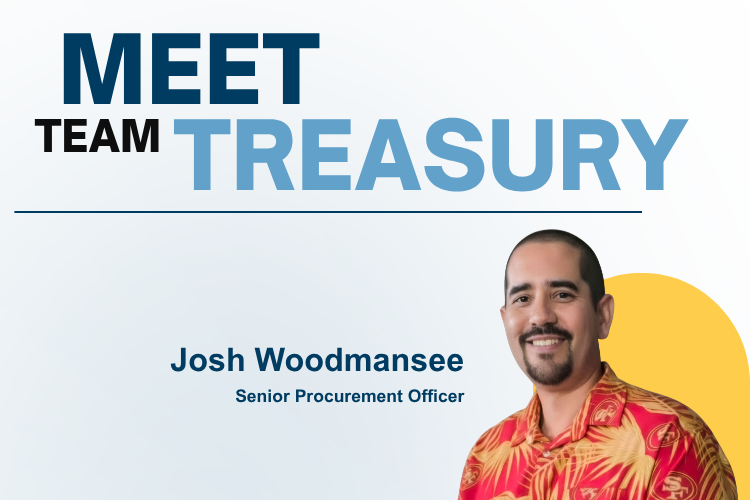
Procurement is more than clicking “add to cart.” As Treasury’s Senior Procurement Officer, Josh Woodmansee makes sure every purchase follows state laws, protects public funds, and supports Treasury’s mission. Simply put, Josh strives to create a level playing field for qualified vendors so businesses of all sizes and backgrounds have a fair shot at Treasury’s business.
What is your professional background and what brought you to this role?
Believe it or not, I started my career in manufacturing sales for steel cast parts. I started at a large factory in Berkeley, CA, then took over the Northwest territory for a manufacturing plant based out of Hartford, WI. That is what brought me up to Oregon. After a little over a decade in sales, I wanted to move over to the other side of the table (I did some purchasing of outside services during my sales career). I was lucky enough to land a role with Treasury and grow from there.
Most people think of procurement as just buying things. What does it actually involve at a state organization like Treasury?
Most people think procurement is just buying things, but it is WAY more than that. We do not just “Add to Cart” and pay for a good. We make sure every purchase follows state laws, protects public funds, and supports Treasury’s mission.
Procurement is less about transactions and more about building the controls, documentation, and partnerships that keep Treasury’s operations running smoothly and responsibly.
What surprised you most going from the private sector to the public sector?
The biggest surprise is how different the pace and priorities are and how much of it is by design. In the private [SE1.1]sector, the goal is usually all about speed and low price. In the public sector, the goal is fairness, transparency, and accountability, which means slowing down enough to make sure every step is documented, defensible, and compliant. This is not just about “buying things,” it is protecting public funds, following statutes, and making sure all vendors get a fair shot.
In the private sector, you support a business. At Treasury, you support Oregonians. It is a different type of pressure since we are dealing with taxpayer money, but it can be incredibly rewarding.
Equity in contracting is an important priority for Treasury. What does that mean in practice and how does it shape the way you approach your work?
Equity in contracting means ensuring that every qualified vendor has a fair and meaningful opportunity to compete for Treasury’s business. It is about creating processes that are transparent and free from unnecessary barriers.
In practice, this is about creating opportunities through solicitations that provide clear requirements, setting reasonable timelines, and ensuring criteria reflect what truly matters for performance.
Equity is a commitment to level the playing field and build a strong, resilient vendor community that supports Treasury.
What book, podcast, or other resource(s) has influenced your thinking recently?
While I have not finished the book yet, The Happiness Advantage by Shawn Achor has been a good read about making small mindset shifts to create big improvements in how you show up in life and work. It is about training your brain to notice the good, build habits that support resilience, and approach challenges with a little more optimism. In procurement, you can either see obstacles or opportunities to improve a process.
Return to article selection