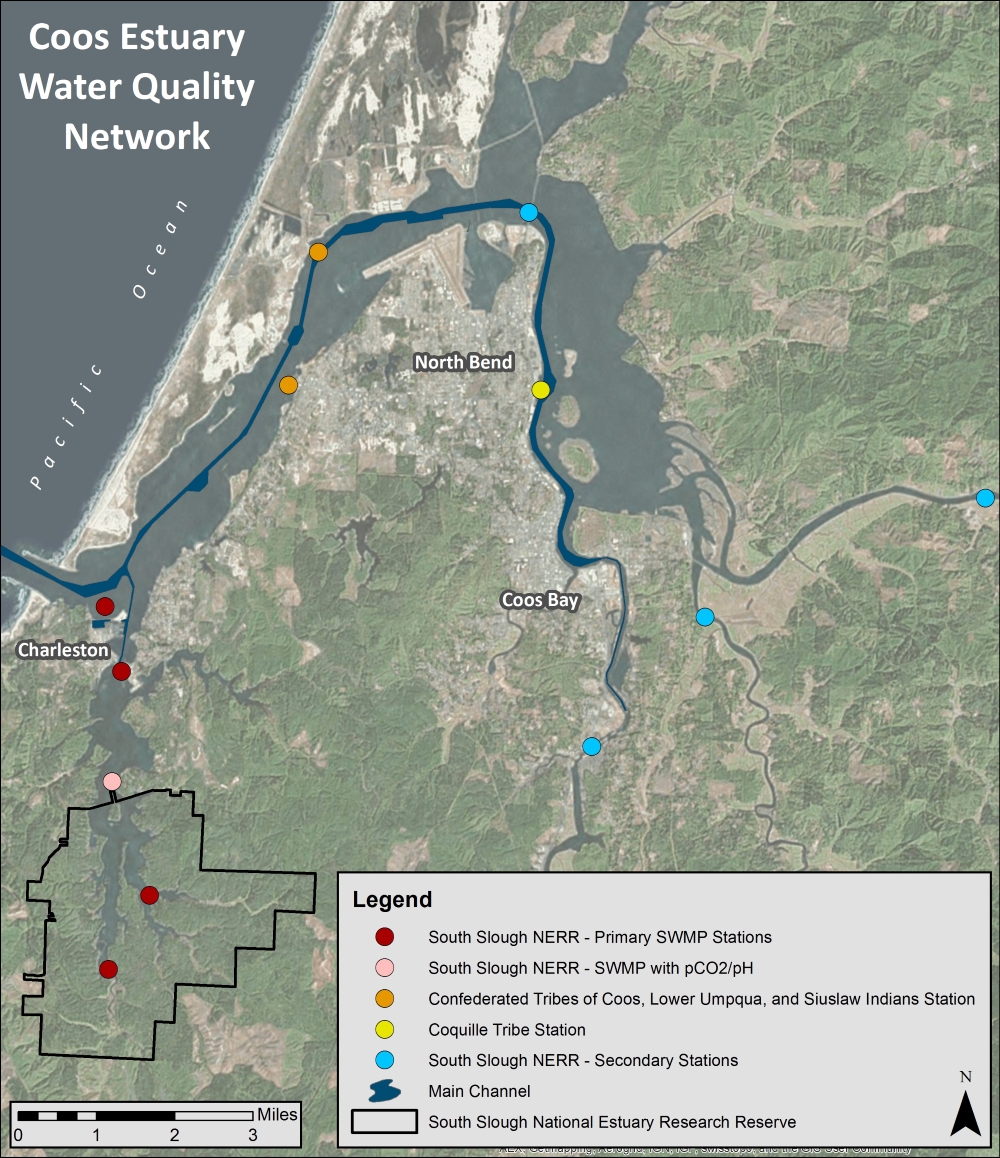
The Coos estuary contains a network of 10 continuously operating water quality monitoring stations. Monitoring began in 1995 when the South Slough Reserve installed two continuous water quality stations as part of their System-Wide Monitoring Program. Since that time, the network has expanded throughout the entire Coos estuary (see map).
The network is maintained by the Confederated Tribes of Coos, Lower Umpqua, and Siuslaw Indians (two stations), the Coquille Indian Tribe (one station), and the South Slough NERR (seven stations). All stations are equipped and maintained similarly (e.g., all stations use Yellow Spring Instrument (YSI) sondes).
At each station, measurements of water temperature, specific conductivity, salinity, dissolved oxygen, pH, turbidity and depth are collected every 15 minutes. Half of the stations transmit their data real-time, which can be downloaded through the Centralized Data Management Office (South Slough primary stations) and viewed through the Northwest Association of Networked Ocean Observing Systems Visualization System (NANOOS NVS) (South Slough primary stations, and the Confederated Tribes North Spit - BLM station)
The network allows us to capture a more complete picture of water quality conditions in the entire Coos estuary, to help us understand both current conditions and the future effects of climate change. In addition, these stations help determine episodic, seasonal and annual patterns in known areas of the bay that have temperature, turbidity, or hypoxia concerns.