Tier One Interactive Example Statement
Tier Two Interactive Example Statement
Tier Two Zero Dollar Balance Interactive Example
Statement
How should I read my member annual statement?
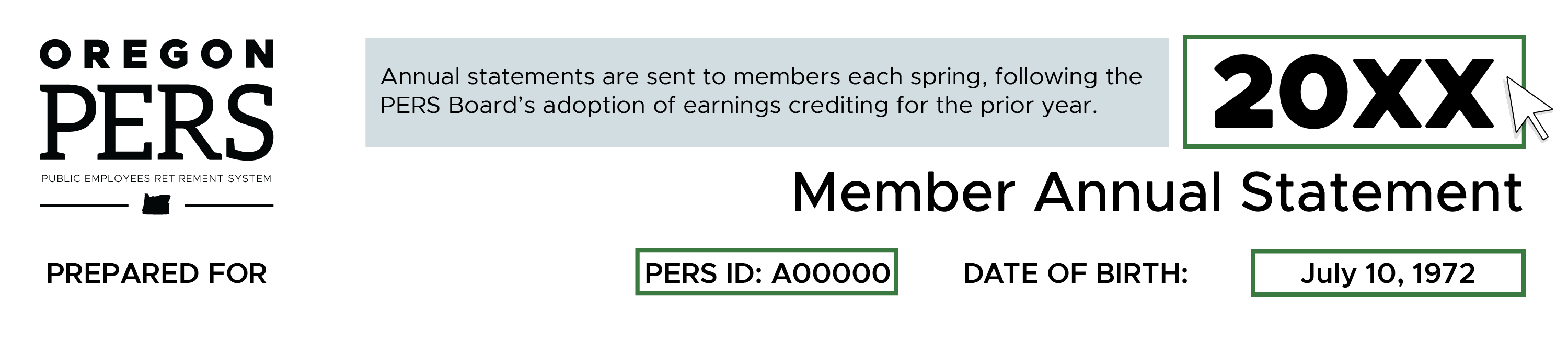
Check out the interactive example statement listed above that most closely matches your membership type.
If you download and view the PDF in Adobe Acrobat, you can move your mouse around the examples and find helpful
information associated with the sections highlighted (in green boxes) on the sample statements.
Your annual statement will provide three key points of information that are important for you to check: your date of
birth, years of service, and Individual Account Program (IAP) information.
As of July 1, 2020, if your gross pay in a month exceeds the monthly
salary threshold, a portion of your 6%
contributions is redirected to the Employee Pension Stability Account
(EPSA). EPSA will be used to pay for part of
your future pension benefit. As an OPSRP member, 0.75% of your 6% contributions will go into your EPSA. The remaining
5.25% will go to your existing IAP account.
Information about your EPSA account also will be included on your statement.
Why do I see multiple accounts on my annual statement?
Tier One and Tier Two members working in qualifying positions after January 1, 2004, have two parts to their
PERS retirement plans: a Tier One/Tier Two pension benefit and an Individual Account Program (IAP) account.
Watch a video that explains the two
parts to
your future retirement.
Pension
The regular account (pension) balance shown on your statement will be used to pay for a portion of your monthly
pension benefit. If you elected to participate in the Variable Annuity Program, you
will also see a variable account balance on your statement. Variable account balances are included in the
calculation used to determine monthly pension benefits. See more under the heading “How does my variable
account balance impact my monthly Tier One or Tier Two benefit payment?” below.
Your Tier One/Tier Two monthly pension benefit can be paid to you for your lifetime and to a beneficiary for the
beneficiary’s lifetime, after you die, if you chose one.
IAP
The other account balance you can see on your statement will be for your IAP.
Since January 1, 2004, your PERS contributions (6% of your salary, whether paid by you or your employer)
have gone into your IAP, which is invested in a
target-date fund based on your year of birth.
Before 2004, your contributions went into your Tier One/Tier Two account(s).
As of July 1, 2020, if your gross pay in a month exceeds the
monthly salary threshold, a portion of your 6%
contributions is redirected to the Employee
Pension Stability Account (EPSA). EPSA will be used to pay for part of
your future pension benefit. As a Tier One/Tier Two member, 2.5% of your 6% contributions will go into your EPSA.
The remaining 3.5% will go to your existing IAP account.
Your IAP account balance can fluctuate, depending on investment gains and losses in your target-date fund. Unlike
your pension, there is no guaranteed investment return for your IAP.
The benefit from your IAP also is finite: The balance of your IAP account at the time you retire is more or less
all* that you will have available from this account throughout your retirement. However, at retirement, you may
choose how your IAP is paid to you: in a lump-sum rollover to a qualified plan or in installments* over various
time periods.
(*If you choose to receive installments from your IAP in retirement, your account balance also may be credited
with earnings or losses over time.)
How is my Tier One/Tier Two pension benefit calculated?
PERS uses three methods to calculate a Tier One monthly pension benefit amount and two methods to calculate a
Tier Two monthly pension benefit amount. The calculation methods are:
- Tier One – Full Formula, Formula Plus Annuity (only for eligible Tier One members) and Money Match
- Tier Two – Full Formula and Money Match
The highest amount produced by these calculations is what you will receive as your monthly pension benefit.
Here is how the calculations work:
Full Formula
(Tier One and Tier Two)
Your years of service are multiplied by your final average salary and a set percentage. The percentage depends on
your service type.
General service:
1.67% × years of service credit × monthly final average salary = monthly pension benefit
Police and firefighters:
2% × years of service credit × monthly final average salary = monthly pension benefit
Money Match
(Tier One and Tier Two)
Your member account balance is matched by your employer, and the result is multiplied by a variable representing
the estimated life expectancy for people in your age group (aka your “age factor”).
Age factor × account balance × 2
Formula Plus Annuity
(only Tier One members who made contributions before August 21, 1981)
This method has two parts, the first of which is similar to Full Formula but uses a different set
percentage.
Your total from this first part is then added to an annuity payment, which is calculated by multiplying your
member account balance by a variable representing the estimated life expectancy for people in your age group (aka
your “age factor”). This second part looks similar to the Money Match formula.
General service:
1% × years of service credit × final average salary + Age factor × account balance
Legislators, police, and firefighters:
1.35% × years of service credit × final average salary + Age factor × account balance
Notes and definitions:
-
Most Tier One/Tier Two members now retire under the Full Formula method. Tier Two members are unlikely to
have Money Match result in their highest calculated benefit because their account balances are generally low
(due to having fewer years of contributions into the member account before 2004, when contributions were
diverted to the IAP).
-
Service credit is the number of months and years you have worked in a PERS-qualifying position. A
“qualifying” position is one in which an employee performs 600 or more hours of service in a calendar year for
one or more PERS-participating employers. Hours worked with different participating employers in the same
calendar year are combined to determine if the 600-hour standard has been met for that year. Under certain
circumstances, if you are not employed for the full calendar year, you may earn service time for a partial year
with fewer than 600 hours of employment. One month of service time is earned for each major fraction of a month
worked.
-
In general, your final average salary is the greater of
these amounts:
- The average gross monthly salary that results from the three years in which you earned your highest total
salaries from one or more PERS-participating employers, even if one of those years was less than a full
calendar year.
- 1/36 of the total salary you received from one or more PERS-participating employers in the last 36 months
of active membership.
A note about overtime
House Bill (HB) 2728 (2025) requires PERS to explain to retiring members how overtime hours were used in
calculating their final average salary (FAS). This information will be included in a member’s notice of
entitlement letter (NOE), which officially tells a member what their monthly pension benefit will be.
As of January 1, 2026, NOEs must provide both of the following:
- The total number of overtime hours the member accrued during the time period used to calculate their FAS.
AND
- The number of overtime hours used in the FAS calculation.
For Tier One and Tier Two members, no cap on overtime exists, so the number of overtime hours accrued and the
number used in the FAS calculation will be the same.
How can I get a retirement benefit estimate?
You can create an estimate online through your
Online
Member Services (OMS) account. The online benefit estimator will use the most recent data
supplied by your employer(s) to produce an estimate for any future retirement date. You can produce multiple
benefit estimates with different retirement dates. This could help you determine if you are on track to meet your
retirement goals.
If your PERS account involves a divorce, you should request a written benefit estimate. OMS cannot correctly
calculate a benefit estimate on an account with a divorce award.
When you are within 24 months of the earliest date you are eligible to retire, you can request a PERS
benefit estimate by submitting a
Tier One/Tier Two Estimate Request
form. (Note: PERS processes benefit estimate requests in retirement-date order, with the
earliest retirement dates first. Estimate processing time may vary from member to member, as each account is
different, so we are unable to tell you exactly when your estimate will be completed.)
Your PERS benefit estimate will provide information on service time
purchases available to you at retirement, which could increase your benefit or provide extra service
time to allow you to retire sooner.
We encourage you to get at least one PERS benefit estimate before your retirement date, especially if you wish
to purchase service time. OMS will not estimate the cost of
purchases unless you have a completed benefit estimate. Note: Benefit estimates are just that
– estimates. They are not a guarantee of benefits.
Benefit estimates only include your Tier One or Tier Two retirement benefit. You can use the
IAP Balance and Installment
Calculator to estimate your IAP distribution at retirement.
Will I have enough income for retirement?
PERS offers tools and resources you can use to estimate your income in retirement and strategize how to save more:
-
Benefit estimates — Read the preceding section “How can I get a retirement benefit estimate?”
if you haven’t
already.
-
PERS education sessions — Attend a free workshop about your benefits. You
can attend presentations at any time
during your career and repeat them as needed.
- Explore options for extra savings — Check out our Saving more for retirement webpage.
How does my variable account impact my monthly benefit payment?
When you retire as a participant in the
Variable Annuity Program, you have the option of transferring your variable account balance
into your regular account or keeping it in the variable program.
Funds in the Variable Annuity Program are invested completely in stocks, unlike the
Oregon PERS Fund,
which is invested in a more diverse set of assets. Your regular account is associated with the Oregon PERS Fund.
If you choose to remain in the variable program at retirement, a portion of your retirement benefit can change
annually based on the ups and downs of stocks. The higher the percentage you originally chose (25%, 50% or 75%) to
put into a variable account, the more money you will have exposed to stock market variation. You cannot
retroactively change the percentage of your past contributions.
However, other portions of your monthly benefit will come from fixed sources: a pension funded by your employer
and an annuity based on your regular account balance. It is only the portion of your
pension based on your variable account that would fluctuate; having a variable component in your PERS
retirement plan does mean your total monthly payment could vary over the course of your retirement.
If you remain in the variable, once you are retired, PERS will adjust the variable portion of your monthly
benefit every February 1. The adjustment is based on earnings or losses for the 12-month period ending October 31
of the prior year.
And if you originally opted into the variable program but continued working for a PERS-qualifying employer after
January 1, 2004, contributions made
after that date have gone into your Individual Account Program (IAP) account, rather than the
variable program. Contributing to, or transferring new funds into, your variable account are no longer options.
Can I transfer out of the variable account?
Yes. At or before the time you
apply for retirement, you can request a one-time
transfer to move all funds out of your variable account into your regular account by submitting a
One-Time Variable Transfer: Active or Inactive Members form to PERS. You must meet the age
and eligibility requirements listed on the form, and PERS must receive your election form by December 31 of the
year in which the request is made. The transfer will become effective on January 1 of the following year.
This transfer, once effective, is permanent. It cannot be revoked, reversed, or undone. Once
made, you will no longer have a variable account and will not receive a variable annuity benefit in your
retirement. You can cancel your One-Time Variable Transfer request up until December 31 of the year in which the
request is made.
You may also choose to transfer out of the variable when you
apply for retirement.
How is interest applied to my account?
Earnings crediting for the previous year is
typically determined in April of the following year.
Tier One regular accounts receive the assumed earnings rate.
Tier Two,
Employee Pension Stability Account, and
Individual Account Program (IAP) accounts receive
earnings based on investment returns minus administrative expenses. Tier Two, EPSA, and IAP accounts are subject
to earnings or losses.
Earnings crediting is only visible in
Online Member Services after earnings have been applied to accounts
each spring.
Can I choose where my Tier One/Tier Two pension account and EPSA are invested?
No. The
Oregon PERS Fund
(OPERF) is managed by
Oregon State Treasury under the direction of the
Oregon Investment
Council. OPERF investment returns are posted monthly. More information about the fund and its investments
is available on PERS’
Actuarial and financial reporting
resources webpage.
Can I choose how my IAP is invested?
Yes. As of September 2020, nonretired members are able to voluntarily make an election, once per year, directing
which
IAP target-date funds they want their funds
invested. This is called a Member Choice election.
Any eligible choice made by the annual September 30 deadline will go into effect January 1 of the following year.
For example, if you changed your TDF in September 2020, it became effective on January 1, 2021, and you will see
the change reflected on your 2021 member annual statement, which will be mailed in spring 2022.
For more information about how to change your TDF, go to the
IAP target-date funds webpage.
How do I update my beneficiary?
Fill out a
Tier One/Tier
Two Preretirement Designation of Beneficiary form to select or update your Tier One/Tier Two beneficiary
before retirement. New beneficiary designations supersede all past selections.
If you have worked for a PERS-participating employer after January 1, 2004, you will
also need to submit the
IAP Preretirement
Designation of Beneficiary form to PERS to update your Individual Account Program (IAP) beneficiary before
you retire.
If you wish to change your beneficiary as the result of a divorce before retirement, your ability to do so may
depend on what your divorce decree allows. See PERS’
Divorce and your benefits webpage for more information.
You cannot name a beneficiary for your
Employee Pension Stability Account (EPSA). Any EPSA balance
available to be paid to a beneficiary at the time of your passing would be paid to your IAP beneficiary.
When you apply for retirement
At the time you file your
PERS retirement application, you can choose anyone – but
only one person – as your beneficiary, if you would like a survivorship pension option to be paid
for your lifetime and for a beneficiary’s lifetime. More information on the options are available in the
Tier One/Tier Two and
Individual Account Program (IAP) Preretirement Guide.
I no longer work for a PERS employer. Can I withdraw my money?
Yes, if you meet the following conditions:
-
One full calendar month has passed since the month in which you stopped working for your last
PERS-participating employer, and you have
not worked for any other PERS-participating employer since. This includes substitute,
temporary, and on-call positions.
- You are not eligible for PERS retirement by
age or years of service.
To request a withdrawal, you must submit a completed
Tier
One/Tier Two Member Withdrawal Applicationform.
The amount of your withdrawal(s) will be the total of your Tier One/Tier Two, Employee Pension Stability
Account, and Individual Account Program (IAP) account balance(s) at the time of withdrawal. Withdrawals will
not include matching funds from your employer, and you
cannot withdraw these accounts separately. If you want to withdraw one, you must withdraw
all accounts, which will end your membership in PERS.
By ending your membership, you
forfeit all membership rights and future benefits provided by PERS. This forfeiture means you
will
not receive any PERS pension benefits upon retirement, even if you were fully vested at the time
you elected the withdrawal.
Keep in mind if you withdraw before age 59½, you could be subject to an additional income tax penalty.
For more information, go to PERS’
Withdrawal information webpage.
Are you age 73 or older? The IRS has requirements for you
Did you know that if you are age 73 or older, a delay in taking your retirement benefits as required by the IRS
may
result in a federal income tax penalty?
Internal Revenue Code Section 401(a)(9) requires PERS members who are age 73 or older to begin receiving their
minimum PERS benefits (i.e., required
minimum distribution) before April 1 of the year following the calendar year in
which they reach 73 or when they leave PERS employment, whichever is later.
If you are not working for a PERS-participating employer and are 73 or older, you must submit a retirement
application to PERS. We will then calculate your required minimum distribution so you can begin to receive your
retirement benefits.
If you are age 73 or getting close to it, you are advised to seek the guidance of a tax or legal professional.
Need to correct information?
Check your personal information on this annual statement to ensure it is correct.
If you are still working in a PERS-qualifying position and need to correct errors, contact your employer.
If you are an inactive or retired member, you can correct personal information using Online Member Services (OMS).
You also can submit an Information Change Request or Date of Birth Change Request form, which are available through
the Forms and publications webpage or by contacting Member Services.
Where can I get help?
Talk to PERS
Member Services can answer your questions about PERS retirement benefits from 8:30 a.m. to 5 p.m. Monday through
Friday. Call 888-320-7377 or email
customer-service.pers@pers.oregon.gov. You also can use
PERS’
Submit a Question form online.
Education sessions
PERS also offers group
education workshops that cover membership, benefits, and
retirement information. These workshops are for members at any stage in their careers and are held around the
state. Expanded workshops that include financial planning information also are available.
To learn more, go to PERS’
Tier One/Tier Two education presentations
webpage.
Your employer also can request a group session to go over PERS benefits by contacting
Member Services or the
Employer Service Center.
Retirement application help
When you are within 90 days of your PERS retirement date, you can attend a
retirement application assistance
session (RAAS). This 45-minute, one-on-one appointment with a PERS staff member provides an opportunity to
have your retirement application reviewed and notarized at no cost. The staff member will answer any questions you
have about the retirement process. Be advised that PERS staff
cannot advise or counsel you about your decision to retire nor which benefit distribution options
to choose.
News and announcements
Sign up to receive email or text
alerts through
GovDelivery. You can choose the topics you wish to receive updates on,
including member news and information, education workshops, Oregon Savings Growth Plan, and PERS Health Insurance.
Go back to the main Member Annual Statement FAQ
page.
In compliance with the Americans with Disabilities Act (ADA), PERS will provide PDF documents on this page in an
alternate format upon request. To request a document in an alternate format, call 888-320-7377 (toll free) or TTY
503-603-7766.