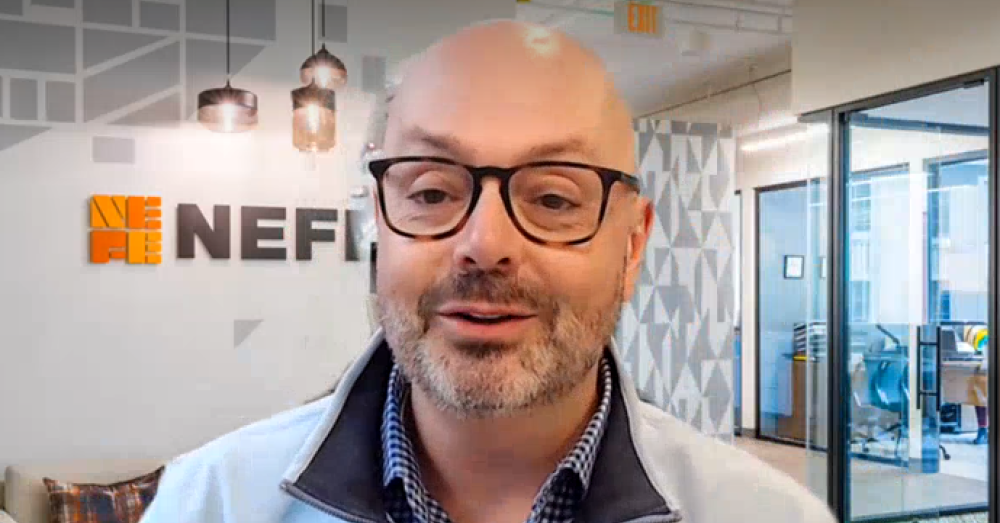
“It starts with supporting teachers.”
Dr. Billy J. Hensley, the president and CEO of the Denver-based National Endowment for Financial Education (NEFE), spoke with the Oregon Financial Advisory Team at its Feb. 3, 2026, meeting.
A national expert in evidence-based research, policy and systems change, Hensley helped look ahead as Oregon schools are working to implement the state’s new personal finance requirement, which goes into effect in the 2026-2027 academic year for most districts. He also discussed considerations for expanding financial learning beyond the classroom to adults and young adults.
“I appreciate the work going on in Oregon to bring personal finance course requirements to students and implementing the law as written so that students are guaranteed a standalone class,” Hensley said.
He also credited Oregon for developing the first state-based Financial Wellness Scorecard, which has been touted by NEFE as a good example of state-driven innovation, and because it illustrates how local data can drive positive solutions.
“We’ve promoted it across the country because we believe in it,” he said. “It also helps to have a treasurer so engaged in this work.”
Q: How do we know that financial education works?
A: The growing body of research on the impact of financial education helps us make the case.Here’s just one example: Students who graduate from a state with a graduation requirement for financial education have much higher credit scores, upwards of 40 points within five years of graduation, compared to a similar state with similar demographics that does not.
The public also knows that financial education matters. Americans overwhelmingly believe this is vital, core competency learning that must be taught in schools, as it is an essential preparation for life.
Our polling from spring 2025 found that 83% of respondents believe their state should require a semester- or year-long personal finance course to graduate, with 82% of respondents who attended high school saying they wish they were required to complete a personal finance class while they were in school. Additional NEFE polling from 2025 found that respondents value personal finance as a critical core subject alongside English and Mathematics.
Q: What should Oregon leaders keep in mind as Oregon prepares for its new personal finance class?
A: It starts with supporting teachers. Helping educators feel competent and confident in personal finance with things like professional training and vetted programs isn't just critical for their classrooms. It's also critical for their own financial well-being and research supports this.
Also, ask teachers what they need. We think we know what they need and we make decisions for them without asking them. The same is true for students. We want to see financial education requirements in every zip code, providing equitable access for all students and meeting them where they are. We must get this right or we risk losing yet another generation of young adults who are unprepared to manage their financial lives—and that's a cost we cannot afford.
Lastly, I would add that new graduation requirements like the one in Oregon improve in effectiveness over time. Not everything will be perfect with the first graduating class, but with a commitment to the principle of giving future generations this critical knowledge, the requirement can evolve and improve as time and data help evaluate what is working. This, again, is where we need to listen to the needs of teachers and students alike. It is imperative that we respect equally the development and delivery of financial literacy in Oregon schools, as we do all other subjects.
Q: What do you say to young people who are offered financial learning and nudges from social media figures, sometimes called “finfluencers”?
A: It’s great that people are seeking resources to boost their financial acumen, and many social media influencers are building communities to openly talk about money and finances. But everything needs to be understood as part of an overall strategy for your individual financial management (with an understanding of the Personal Financial Ecosystem.
While millions of people are getting advice in these forums, not all consumers can reasonably discern or verify everything that is seen as accurate or truthful. There's no way to sort through the noise unless you are grounded in knowledge, and have the sort of confidence that comes with effective financial education.
We know that young people are using social media and seeking out these sources for financial knowledge at a higher rate, so we must help teach them to be skeptical about the information they are receiving, not too different from how we were taught to research and evaluate sources. This further illustrates the importance of states implementing year-long or semester-long course requirements, which provide greater attention, context and evaluation of financial learning.
Although digestible and often “fun,” short bursts of information on social media are not an effective replacement for the learning that can be achieved through a comprehensive educational intervention by a trained educator.
Q: In Oregon, the Financial Wellness Scorecard shows that more than 40 percent of adults have never completed a personal finance class or program. What are some best practices for helping adults to benefit from financial education?
A: It’s highlighting a value that, yes, education is important, but you also have to have this notion of opportunity. Adults who have not had the chance to take a personal finance course likely went through K-12 schools where it was not a requirement, and our polling would suggest that many of them wish they had been required to take a course and believe it would benefit their financial well-being overall.
In fact, NEFE data finds that 70% who did not take a financial education class stated their current quality of life would be better if they had the opportunity to take it.
For these individuals, community workshops and state-led programming designed around things like housing assistance or tax preparation can be very valuable and align with the “Timely Personal Finance Instruction” component of NEFE’s Five Key Factors for Effective Financial Education.
Return to article selection