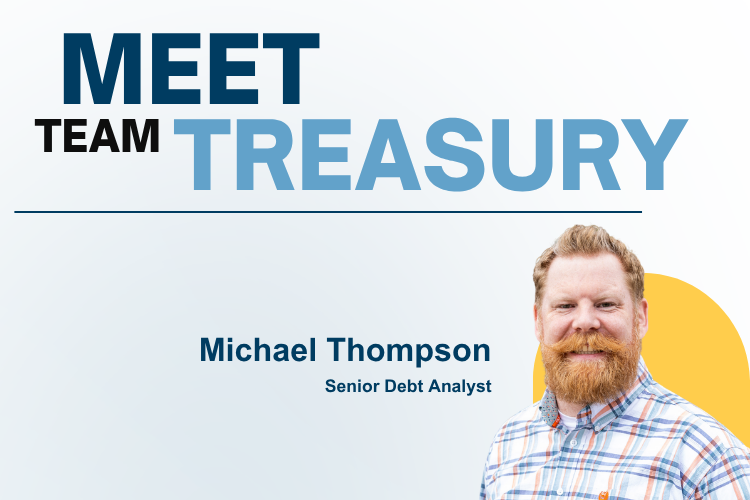
Michael Thompson joined Oregon State Treasury in 2023 as a Senior Debt Analyst. Through the Debt Management Division, Michael’s work directly supports critical infrastructure like roads and bridges, invests in schools, maintains state parks and natural habitats, and provides services for veterans statewide. Bringing both technical expertise and a deep commitment to public service, for Michael the most rewarding part of the job is simple: knowing his work will help people and communities across Oregon for years to come.
What is your professional background and what brought you to this role?
I was drawn to the opportunity to bring meaningful improvements to our community and the greater northwest region. I’m a born and raised Oregonian who spent my childhood in the Eastern part of the State. I have my Bachelor of Science in Managerial Economics from Oregon State University (OSU) and my Master of Science in Finance from Portland State University (PSU). I have worked as an analyst in public service for a little over a decade at various levels of government (City, State, and Federal), and I joined Oregon Treasury in 2023.
My passion for public service began while serving as a specialist in the military. I continued into Federal service first as a Financial Analyst with the Bonneville Power Administration, then advanced to the City of Portland’s Debt Management Division. I briefly worked in the private sector before being given the opportunity to become a Senior Debt Analyst with Oregon Treasury.
Most people don’t think much about debt management, but it’s crucial to funding schools, roads and infrastructure. What do you wish more Oregonians understood about how state bonds work and why they matter?
Selling bonds allows the State to provide funding for projects and programs with many purposes across Oregon while financing these projects and programs over an extended period rather than all at once.
They help establish and maintain critical infrastructure, support and improve schools, state parks, and natural habitats, provide support for veteran services and encourage economic growth.
At Treasury, we strive to be good financial stewards by structuring this debt in a way that minimizes impact on the source (often the taxpayer) and maintains compliance with our debt limitations. This stewardship enables the state to maintain borrowing power with high credit worthiness and rating.
Bonds allow the state to take care of the financial commitments of today while planning with flexibility for tomorrow. As borrowing rates correlate with the US Federal Funds Interest Rate, we review economic factors and forecasts to make sound financial decisions about cost and benefits when issuing debt. Because of the ability to structure the bonded debt, we can manage some of the potential volatility that could affect the sources of funds, minimize costs and allow more funds to flow through to projects and programs.
What is the most rewarding part of helping state agencies secure the funding they need?
To me, the most rewarding part is knowing what I’m doing helps the people and communities across our state. I can directly connect my work to funding jobs, improving schools and parks, and building infrastructure to support Oregonians for many years to come. I really love it here and am grateful to be a part of building for the future for our state.
What advice would you give to someone interested in public finance or working in the public sector?
Working in the public sector is very fulfilling for me. Not only do I have a direct impact on my community, but I get a large sense of satisfaction in what I do. I can see the tangible changes my work brings and engage with like-minded people looking to improve their communities. I have a good work/life balance and know my contributions help other people.
For someone who is interested in public finance, my advice would be to take some additional accounting classes and make friends with your accountant coworkers. I’m not an accountant, but my degree offered an optional, more in-depth accounting path. I was urged by fellow analysts to take the extra classes, and they have paid off tremendously. I credit that knowledge with helping to solve issues and mix-ups by understanding how to follow the flow of funds. 
What book, podcast, or other resource(s) has influenced your thinking recently?
I consider myself a lifelong learner, and I have a passion for stories. I like to read about other cultures, specifically history, customs, and folklore. This provides a different perspective to my own and reminds me to consider other viewpoints that I may not know. It also reminds me how connected we really are as people.
One of my more recent reads was “Mythopedia: A Brief Compendium of Natural History Lore” by Adrienne Mayor. It explores myths and legends from around the world that are rooted in real natural events. A couple local examples are the volcanic eruption that changed Mount Mazama into Crater Lake and Japan’s “Orphan Tsunami” of 1700 that was recently linked to a large megathrust earthquake generated by the Cascadia Subduction Zone.
Return to article selection