Oregon State Flag An official website of the State of Oregon »

Information Technology Classification Redesign

The Chief Human Resources Office (CHRO) Classification Study team is working to modernize the information technology classification series. In 2025, management, AFSCME, and SEIU bargained for the CHRO to conduct an IT classification study. 

Updating the IT classification structure ensures state agencies can attract, retain, and grow a modern IT workforce that aligns with current industry roles and emerging technologies.


Project Updates

Check back later for updates on this project.


Project Timeline

Infographic outlining the timeline for the IT Classification Redesign Project and its 6 phases. 

  1. August - October 2026: Data collection
  2. January 2027: SME meetings begin
  3. September 2027: SME meetings conclude
  4. October 2027: SME presentations compiled
  5. November 2027: Job evaluation completed
  6. December 2027: Study report sent to Labor Relations Unit

About the Project


​The Information Systems Specialist (ISS) classification series was originally developed in 1997. Over time, the series has become outdated as technology, security requirements, and workforce expectations evolved. The series no longer accurately reflects the work in state agencies and throughout Enterprise Information Services.​​

​The Information Systems Specialist (ISS) classification series, through the process of this study, wil​l be modernized to include domains and disciplines. Agencies are completing a workforce survey to provide high-level information that will inform us which domains and disciplines should be created that meet the State's business need. In this process, we will also learn about the different levels of work.

The goal is to create structures that ensure clearer career pathways and align state IT roles with industry practices. This modernization effort ultimately laid the foundation for the IT Redesign Study.​

​The CHRO recently worked on the Business Analyst and Business Systems Analyst classifications. The Oregon Management Project (TOMP) created the Information Technology management classifications in 2022. Positions that have duties in more than one domain or discipline (aka hybrid or mixed duty jobs).​​

​The IT Classification Study follows a phased approach to ensure accurate, consistent, and equitable results. These phases will be applied to all domains and disciplines.​

Phase 1: Data Collection and Analysis

  • Gather job surveys, position descriptions, organizational charts, and employee/manager input.
  • Review market data and industry standards of practice.

Phase 2: Specification Development

  • Conduct job analysis to understand duties, responsibilities, skills, and competencies.
  • Develop draft class concepts, typical essential functions, knowledge and skills, supervision received, interactions with others, and levels.
  • Hold SME and IT management focus groups to validate role expectations.
  • Align roles with industry standards and career pathways.
  • Validate drafts with agency HR partners, IT leadership, and labor partners.

Phase 3: Job Evaluation

  • Complete job evaluations (Central Evaluation Team (CET) presentations and evaluations).
  • ​Draft allocation guidance.

​This comprehensive class study will engage Chief Information Officers, Human Resources leadership, Human Resources analysts, labor partners, and subject matter experts (employees and management).​​

​The updated IT classification structure will include multiple domains and disciplines, each with its own level progression. Because the new structure consolidates some ISS levels and reorganizes roles, a simple crosswalk from current ISS levels to new levels may not be possible. CHRO will develop and provide allocation guidance to HR analysts and post all materials on the CHRO Class Study website.

​Under ORS 240.190, employees will not experience any reduction in wages as a result of this study.​

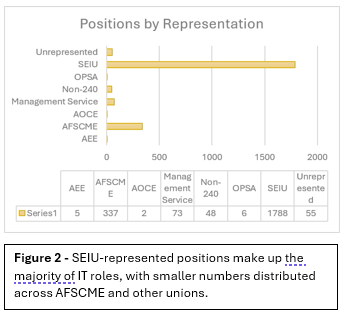
A bar graph detailing how many employees are represented by different unions. The majority of IT roles are represented by SEIU.

To support accurate classification decisions, managers should ensure position descriptions clearly reflect the actual work performed, including duties, decision-making authority, level of responsibility, and reference materials or resources used. This is especially important for positions where roles tend to be more distinct. Managers are responsible for keeping position descriptions current, accurate, and signed by appointing authorities.

The authority to conduct a study is provided in 240.215 (1) Classification plan which states “The Personnel Division (i.e., CHRO) of the Oregon Department of Administrative Services shall adopt a classification plan which shall group all positions in the classified service in classifications based on their duties, authority and responsibilities; and which shall set forth for each classification, a class title, a statement of the minimum qualifications, duties, authority and responsibilities thereof. Each classification of positions may be subdivided and classes may be grouped and ranked in an appropriate manner."​​​


Reminders

  • No layoffs. Jobs are not at risk because of this project.
  • No reduction in pay. If any current employee’s pay happens to be above the future salary ranges, the employee will be red‑circled, meaning pay is protected until the new range catches up.
  • Implementation will occur after bargaining. There are no immediate changes for employees. A project of this size takes time and we expect the study to take one to two years, followed by bargaining.
  • No duties changes. Employees’ positions will not change because of the study. It is recommended for managers and employees to ensure position descriptions accurately reflect work performed.
  • Visit our Classification Studies page for more information on classification studies.