 The Oregon Department of Energy's
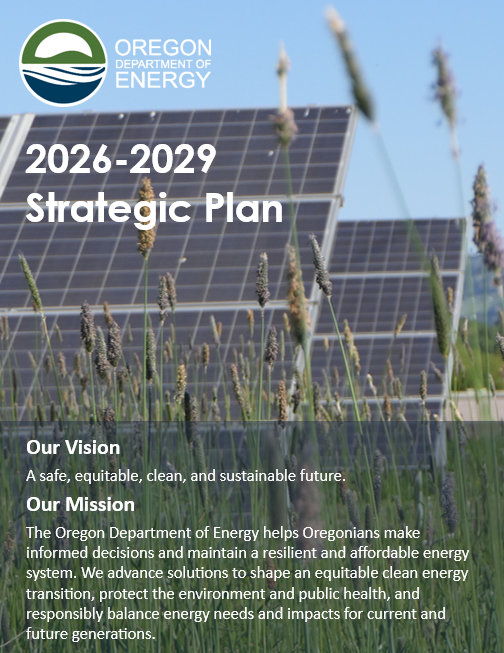
2026-2029 Strategic Plan identifies the five key Pillars, or focus areas, that serve as the foundation for our success that carries us forward as an agency.
The Oregon Department of Energy's
2026-2029 Strategic Plan identifies the five key Pillars, or focus areas, that serve as the foundation for our success that carries us forward as an agency.
 Strategic planning enables an organization to: set its direction; establish goals; prioritize its work; measure progress; and allocate limited time, resources, and attention – all while fostering organizational cohesion, shared purpose, meaningful engagement, partnerships, and common values.
We are grateful to ODOE staff as well as many individuals and organizations that provided input through surveys, interviews, and work sessions to help shape this strategic plan, including the Energy Advisory Work Group.
Download our 2026-2029 Strategic Plan
English | Spanish | Chinese | Vietnamese | Russian
Mission, Vision, Values, and What We Do
Our Mission
The Oregon Department of Energy helps Oregonians make informed decisions and maintain a resilient and affordable energy system. We advance solutions to shape an equitable clean energy transition, protect the environment and public health, and responsibly balance energy needs and impacts for current and future generations.
Pillars
Pillars are the foundational elements that make our agency successful and help us achieve our mission and vision. This plan strengthens these pillars by identifying goals, actions, and progress indicators that will bolster our work over the next four years.
- Addressing Oregon's Greatest Energy Challenges
- Proactive, Inclusive Collaboration and Communication
- Accessible, Effective Services and Programs
- Aligned, Well-Supported People and Operations
- Reliable, Responsive Data and Analysis
Pillar 1: Addressing Oregon's Greatest Energy Challenges
The Oregon Department of Energy has many responsibilities that inform and influence our state's decisions, actions, and outcomes in energy and other critical areas. We contribute to and rely on guidance from robust data analysis, external engagement, consultation with technical experts and other state agencies, policy examination, and studies and reports to continually reassess priorities and identify solutions for Oregon's greatest energy challenges and opportunities. Recent legislatively authorized plans and strategies have outlined efforts and needs that will demand significant time. ODOE must focus daily work, programs, and projects on these areas of greatest need, while continuing to respond to emerging ideas, best practices, and shifting external circumstances. This will involve coordination with other state agencies to ensure alignment of recommendations, information, and programs across the state enterprise to most effectively and efficiently address Oregon's greatest challenges.
Pillar 1 Goals:
- Prioritized and aligned resources that support ODOE's role in implementing the
Oregon Energy Strategy and advancing its five energy pathways.
- Prioritized and aligned resources that support ODOE's role in addressing Oregon's greatest needs in energy security, nuclear safety, climate action, and natural climate solutions.
- Flexibility to respond and strategically adapt to new legislative direction, best practices, and external circumstances.
Review existing Key Energy Indicators and ensure alignment with the Oregon Energy Strategy, Energy Security Plan, and ODOE climate report recommendations. Where necessary, develop new KEIs to help the state monitor and assess advancement of objectives outlined in these guiding documents, progress on energy-related statutory and administrative targets, non-energy related benefits such as job creation and economic development, and general status of Oregon's energy systems.
| - Updated and aligned Key Energy Indicators that have been reviewed by peer agencies, the Energy Advisory Work Group, and other interested parties.
- Identification of data sources and development of consistent collection methods.
|
Conduct agency-wide planning and oversight for priority initiatives, such as the Oregon Energy Strategy, Energy Security Plan, and ODOE climate report recommendations. Track progress at the agency level to align priorities and better coordinate and allocate resources.
| - Selected and approved priority initiatives.
- Oversight planning process created and aligned with project management approach.
- Establishment of a regular portfolio review cycle for priority initiatives.
|
Align ODOE's legislative approach and proposed budget development with Oregon's greatest energy challenges — consistent with revenue constraints and Governor's instructions — while maintaining support for statutorily obligated programs.
| - Submission of Agency Request Budgets and legislative concepts that advance the goals of Pillar 1.
- Proposals incorporate feedback from Energy Advisory Work Group members and other interested parties.
|
Expand on and leverage knowledge and understanding of trends, technologies, new ideas, and emerging best practices in the energy industry so Oregon can be more proactive and strategically adapt to address its greatest energy challenges.
| - Proactive discussions with Energy Advisory Work Group on energy industry trends as well as new ideas and best practices and their potential value for Oregon.
- Development and publication of relevant articles and reports for Oregon leaders on emerging ideas, best practices, and evolving data.
|
Pillar 2: Proactive, Inclusive Collaboration and Communication
ODOE works with diverse communities, organizations, and industries that contribute to and rely on constantly evolving policies, services, and resources. Engaging people with a range of perspectives builds mutual understanding and creates a more inclusive and coordinated discourse about challenges and solutions. Developing and using well-informed technical analysis as part of engagement and discourse can support collaboration. ODOE can strengthen our efforts to conduct inclusive and purpose-driven engagement, convene groups, effectively communicate ODOE services, develop connections, and problem-solve strategically across the state.
Pillar 2 Goals:
- Trusted, open, and durable relationships that encompass diverse perspectives.
- Collaborative partnerships that identify shared goals and advance solutions to address Oregon's energy and related priorities.
- Constructive discourse — convening various parties and guided by active listening — that promotes progress on important issues.
- Clear, engaging, and accessible messaging and communications approaches and deliverables.
- Efficient and streamlined ODOE staff coordination to enhance effectiveness of outreach, engagement, and collaboration.
Informed by the Engagement Framework, develop a consistent process for internal coordination that occurs before convening and facilitating external discussions.
| - Implementation and internal use of a centralized Engagement Framework.
- Identification of technology or platforms to support coordination.
|
Review and improve agency Communications Approach to clarify expectations and guidance for program communications and engagement, including how engagement opportunities are identified, planned, and resourced to align with program priorities.
| - Updated Communications Approach that identifies best practices for the agency.
- Annual customer service surveys show positive feedback and scores for engagement and communications-related questions.
|
Develop guidelines and methods for consistently assessing and managing reading levels for ODOE deliverables to the target audience, including accessibility, plain language, translation, and a reading level of eighth grade or below whenever possible.
| - Increased readership and coverage of ODOE materials, such as reports and studies.
- Materials and communications meet accessibility requirements and are developed in plain language whenever possible.
- Materials and communications are translated or translatable where possible and appropriate.
|
Develop a shared Microsoft Teams use framework and support ODOE divisions and sections in aligning their existing Teams channels to improve communication, collaboration, and cross-team awareness.
| - Inventory communication and collaboration tools to understand unique value of Microsoft Teams in our work.
- Publication of internal guidance on structure and norms for using Teams.
- Increased consistency in use across Teams channels.
|
Pillar 3: Accessible, Effective Services and Programs
Many of the people, communities, and businesses that most benefit from ODOE's programs — from energy efficiency to nuclear safety to building codes — are not technical experts or part of the energy industry. At the same time, ODOE is a key resource for researchers, energy and fuel companies, and interest groups who expect advanced levels of information, analysis, and support. We must design and implement each service and program to meet the specific needs of its intended user and actively reach out to those who can benefit from the services and programs.
Pillar 3 Goals:
- Strong understanding of how participant needs are considered while working within regulations and program requirements.
- Intentionally designed services and programs — and associated information resources — that are relevant and tailored to serve their intended users.
- Accessible services and programs to support participation of currently and historically underserved individuals, communities, and organizations.
Develop an Engagement Framework to help ODOE determine the appropriate level of engagement and collaboration efforts for each program and project. This framework will focus on supporting participation of key constituencies, including currently and historically underserved individuals, communities, and organizations in ODOE program implementation and policy development.
| - Implementation and internal use of a centralized Engagement Framework, with early focus on collaboration with the nine federally recognized Tribes and consumer-owned utilities.
- Surveys, including annual customer service surveys and after-event surveys, show positive feedback and scores for engagement-related questions.
- Efforts also support Pillar 2 action on internal coordination.
|
Improve understanding and clarity of the Energy Facility Siting Council process for multiple participants, including the public and developers, to support an efficient and meaningful energy facility siting process.
| - Completion of public-oriented resources that explain and increase interaction with the energy facility siting process.
- Completion of developer-focused resources to help navigate the siting process and standards-based requirements.
|
Build on Strategic Program Evaluations from previous Strategic Plan by identifying and addressing opportunities to make programs more effective and accessible. Consider target user needs, methods of sharing program information, and efforts to streamline processes and collect data on program effectiveness.
| - Identification of improvement opportunities.
- Documented steps to make programs more accessible and effective.
|
Pillar 4: Aligned, Well-Supported People and Operations
ODOE's ability to deliver on its mission depends on a dedicated, skilled workforce and effective processes and technologies across all functions. By building on existing strengths, supporting clear roles and priorities, and continuously refining how we plan and execute our work, the agency can sustain high performance, manage workloads effectively, and ensure consistent, results-focused delivery of programs and services.
Pillar 4 Goals:
- Clear roles and workflows that support effective planning, efficient execution of agency work, and streamlined coordination among ODOE teams.
- Intentional development of staff capability that supports effective performance and professional growth by aligning expectations, priorities, and roles.
- Disciplined alignment of work, capacity, and priorities to maintain focus on the most critical mandates and work that is aligned with ODOE's strategic priorities and capacity.
Establish a flexible project management approach for the agency that scales based on complexity and scope of work, and that supports successful project completion.
| - Established project management best practices and templates that can be scaled based on needs.
- Increased share of projects that employ project management tools.
- Priority projects are delivered on schedule and within defined scope.
|
Complete and implement the agency Operations Center tracking system to support procurement, contract administration, and related finance operations while reinforcing shared understanding of roles, workflows, and expectations.
| - Implementation of Operations Center that is consistently used by staff.
- Reduction in ad hoc inquiries related to contract status and related finance operations.
|
Identify and document critical processes across the agency to support continuity, efficiency, and effective execution.
| - Guidance and template developed for identification and documentation.
- Critical processes are identified and documented in each division.
- Reduced instances of process exceptions, escalations, or workarounds.
|
Assess how advanced technologies, like artificial intelligence, could streamline and make our work more efficient where appropriate and while considering impacts and risks.
| - Areas of ODOE's work where there may be opportunities to apply advanced technology are inventoried.
- Completion of advanced technology pilot approaches in development of Biennial Energy Report and in Energy Facility Siting Council project evaluation processes.
- Establishment of safeguards and plan to continuously evaluate them to mitigate impacts and risks that are aligned with statewide Department of Administrative Services guidance and requirements.
|
Foster a culture of continuous professional growth by integrating meaningful development discussion into performance management and identify growth opportunities aligned with agency priorities and operational needs.
| - Inclusion of growth and opportunity development opportunities in documented annual performance discussions with all employees.
- Increased focus by managers to support role-appropriate growth opportunities that enhance skills, broaden experience, and build organizational capacity.
|
Pillar 5: Reliable, Responsive Data and Analysis
ODOE has a statutory responsibility to serve as a centralized repository of energy information and to provide useful, objective insights into Oregon's energy and related environmental, safety, and security needs and trends. Meeting this responsibility in a rapidly changing landscape relies on data quality, analytical accuracy, clarity of roles, and intentional use of tools and resources. By strengthening how data is managed, analyzed, and applied, ODOE can ensure its information remains credible, accessible, and useful to support programs, services, policy development, and decision making.
Pillar 5 Goals:
- Data used and produced by ODOE is accurate, secure, organized, and managed in alignment with agency priorities and statutory responsibilities. It is used to inform energy and related programs, services, policy development, and decision making.
- Roles and protocols for data collection, management, analysis, and stewardship are clear, understood, and applied consistently.
- ODOE sustains a culture of innovation that encourages problem solving and trying emerging methods, increasing collaboration across teams, and exploring advanced technologies.
Build on ODOE's skill set to use new tools and better enable staff to acquire and analyze data, develop applied data sets, and produce information based on the data that follows established governance rules and processes.
| - Established baseline and gap analysis of the agency's current skill set.
- Creation of training approach for advancing skills to close gaps.
|
| Evaluate and implement data management and analytics technology to create a centralized ODOE data store that supports automated reporting. | - Existing tools and environments for data management and analytics are inventoried.
- Centralized self-service data store and toolset established.
- Technology solutions are selected and procured within budget and other constraints.
|
Evaluate, define, and use ODOE-generated and externally sourced data sets that are needed for the agency to remain a trusted source and serve as a centralized repository for energy information.
| - Updated inventory and gap analysis of current data.
- Completion of a pilot project using a data store approach that follows governance procedures.
|
Clarify and strengthen agency-wide processes and accountability for managing, using, and stewarding priority data and analytical products.
| - Expanded scope and clearer focus for Data Governance team that emphasizes responsive and effective data management, analysis, security, and risk mitigation.
- Published protocols and procedures for a new data store approach for the agency.
|
Next Steps and Implementation
ODOE's Leadership Team will be responsible for monitoring strategic plan implementation progress. Specific team members will be accountable for actions and progress indicators in each pillar. There will be regular implementation reporting to the
Energy Advisory Work Group as well as updates for the public on this webpage to help ensure transparency and accountability.
Many thanks to our consultant,
Pivotal, which helped us develop this plan.