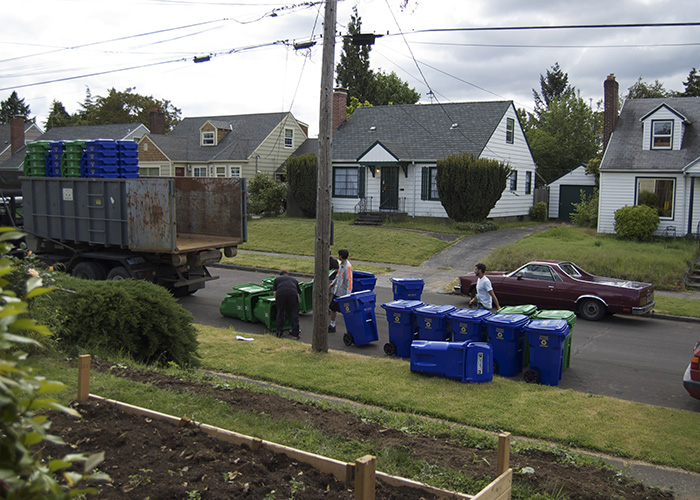
Sometimes we take for granted the public facilities and services that are a crucial part of our day-to-day lives. Built and planned into the urban fabric of the world around us, they include:
- Water and sewer services,
- Energy and communication services,
- Police and fire protection,
- Health services,
- Recreation facilities such as parks and community centers, and
- Services provided by the local government like building permitting or engineering design.
Statewide Planning Goal 11: Public Facilities and Services outlines the requirements for public facilities plans to regulate facilities and services across Oregon. Public facilities plans must determine:
- The existing conditions of each public facility,
- For example, whether the city’s existing sewer system has any deficiencies related to sewer lines or treatment plants
- What future additional needs exist for that public facility,
- For example, where new or expanded sewer lines must go, or if an existing treatment plant must be expanded to serve new residents or businesses
- The costs of these needs, and
- What revenue sources the city may have available to pay those costs.
Goal 11 requires each city with a population greater than 2,500 to create a public facilities plan that meets its current and long-range needs. A county must also develop and adopt a public facility plan if they are home to a community that is not incorporated as a city but has urban facilities such as public water and sewer service.
Goal 11 also limits public facilities that cities and counties can provide outside of urban growth boundaries or unincorporated communities. A city cannot include, as part of its public facilities plan, the intent to serve areas beyond its urban growth boundary except in very specific and limited circumstances. Outside an urban growth boundary, public facilities should not, as a matter of practice, be provided. For example, public sewer service is only allowed outside of an urban growth boundary to alleviate an existing health hazard, and public water service is only allowed if it is not used as justification to increase existing levels of allowed rural development.
Original Adoption: 12/27/74; Effective: 1/25/75
Amended: 2/17/88; Effective: 3/31/88
Amended: 10/28/94; Effective: 12/5/94
Amended: 7/16/98; Effective: 7/28/98
Amended: 2/3/05; Effective: 2/14/05
Read full text version of Goal 11
Administrative Rules that implement Goal 11:
OAR 660-011 – Public Facilities Planning
Related:
Urban and Rural Reserves