DOGAMI OPEN-FILE REPORT SERIES
Publication Preview
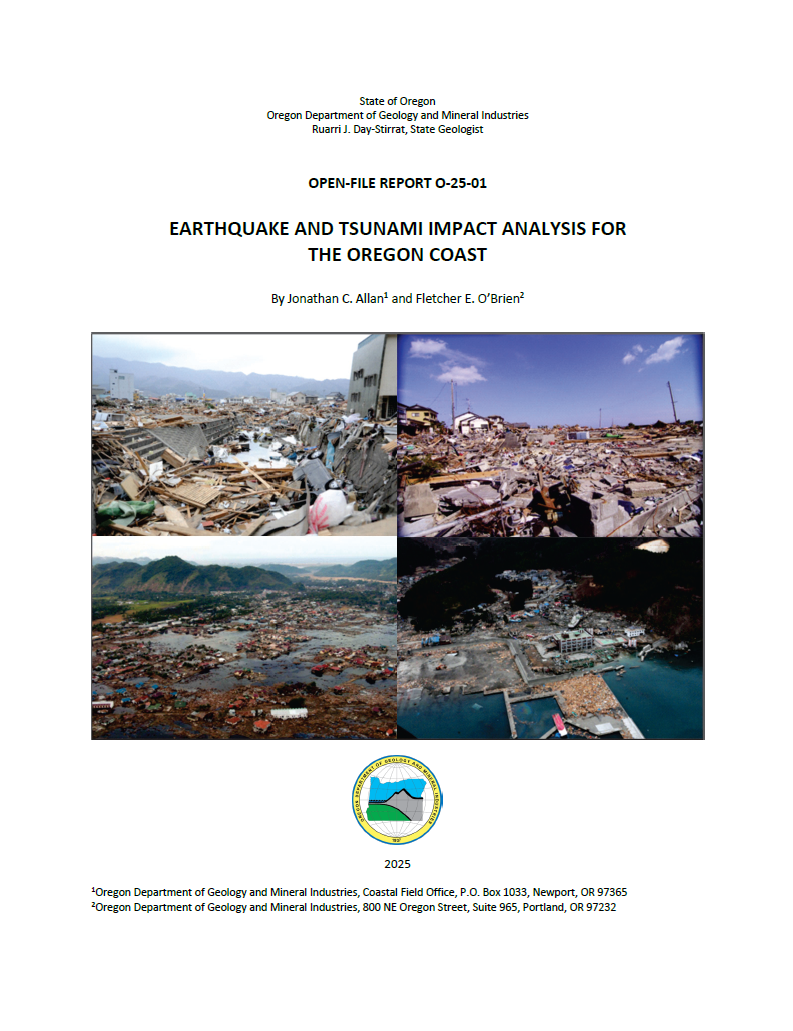
Open-File Report O-25-01, Earthquake and Tsunami Impact Analysis for the Oregon Coast, by Jonathan C. Allan and Fletcher E. O'Brien; 92 p. report, including data tables and community-specific profiles.
WHAT’S IN THIS REPORT?
The objective of this work is to understand the degree of potential destruction, including building losses, debris generated, fatalities and injuries, and estimated numbers of the displaced populations caused by a full-margin Cascadia Subduction Zone earthquake (MW 9.0) and accompanying tsunami (M1, L1, and XXL1 scenarios) affecting the Oregon Coast. This revision updates previous work undertaken for the Oregon Coast by including updated USGS earthquake scenarios, improved DOGAMI geology and soil classification classes, and 2020 census data. The goal is to help coastal communities prepare for this inevitable disaster.
PUBLICATION DOWNLOADS
-
Report only, (92 p., 32.2 MB PDF)
-
Community profile sheets, (7 PDFs, 163.8 MB .zip file)
-
Spreadsheets only, (Excel spreadsheet, 924.5 KB .zip file) - contains all the data that are the basis for this report's tables and figures
-
Supplemental figures, (219 p., 534.6 MB .zip file)
-
Complete publication bundle, (report, community specific profiles, spreadsheets, additional figures, 731.5 MB .zip file)
EXECUTIVE SUMMARY
This report is the final in a series of evaluations of the potential impacts of a Cascadia Subduction Zone (CSZ) earthquake and accompanying tsunami affecting communities and parks along the length of the Oregon Coast. The analyses presented here update previous countywide studies completed by the Oregon Department of Geology and Mineral Industries (DOGAMI) between 2020 and 2023. This important update includes latest U.S. Geological Survey (USGS) megathrust (moment magnitude (MW) 9.0) earthquake scenarios, improved DOGAMI geology and soil classifications, and the most recent U.S. census data (2020). The information presented in this report provides a comprehensive assessment of the number of people, businesses, and critical facilities located in three CSZ tsunami inundation zones (M1, L1, and XXL1) and the associated damage and impacts from both the earthquake and accompanying tsunami. We used previously developed physical models of a CSZ earthquake and tsunami, evacuation modeling results undertaken by DOGAMI over the past decade, and the Federal Emergency Management Agency (FEMA) Hazus Earthquake and Tsunami models, to produce standardized damage loss estimates for every coastal community (including federal, state, and local parks), debris produced, estimates of injuries, fatalities, and the displaced population. Our population model provides spatially detailed estimates of resident and visitor populations. The tsunami injury and fatality modeling assume a nighttime (2 a.m.) evacuation scenario, such that people are in their homes/hotels/campgrounds at the time of the event. We maximize visitor occupancy in our User Defined Facilities (UDF) by assuming all hotels/second homes/campgrounds are at 100% capacity. Our major findings include the following:
Population Characteristics and Exposure:
- The total resident population on the Oregon Coast within a tsunami inundation zone ranges from 24,351 (M1) to 61,896 (XXL1). We estimate the potential for an additional ~62,760 (M1) to ~118,450 (XXL1) visitors on the Oregon Coast staying in hotel/motels, vacation homes and campgrounds. These data indicate that the visitor population recreating on the Oregon Coast (particularly in summer) may be as much as approximately two to three times greater than the resident population.
-
Of the seven coastal counties, Clatsop County has the highest risk due to having the greatest number of residents in a tsunami inundation zone: 12,171 (M1), 16,568 (L1), and 20,930 (XXL1) residents, respectively. In addition, Clatsop County may have as many as ~18,700 (M1) to ~32,000 (XXL1) visitors who overnight in a tsunami inundation zone. Both Tillamook County and Lincoln County are also exposed to considerable human risk with many thousands of residents and visitors potentially located in a tsunami inundation zone.
- Combined, Clatsop, Tillamook, and Lincoln counties account for ~80% (M1) to ~65% (XXL1) of the total coastal resident population located in a tsunami inundation zone. In addition, the three counties are likely to have up to 80% of the total number of visitors to the Oregon Coast in the tsunami inundation zone.
Building Exposure, Damage, and Content Losses:
- We identified ~175,400 buildings along the Oregon Coast. Our Hazus modeling indicated that 92% of these buildings would be damaged following a MW 9.0 CSZ earthquake. Of these, 24% are estimated to be destroyed, 29% could experience extensive damage, 27% could experience moderate damage, and 19% would be subject to minor damage.
- The number of buildings destroyed by the earthquake was found to be highest in Curry County, due to their close proximity to the subduction zone.
- We estimate 73% (M1) to 87% (XXL1) of buildings in the tsunami inundation zone are likely to be destroyed, initially by the earthquake shaking followed by the large forces associated with the tsunami currents and flow depth.
- Total losses on the Oregon Coast from a MW 9.0 CSZ earthquake and the three tsunami inundation scenarios was found to range from ~$35.4 billion (M1) to greater than $45 billion (XXL1). These numbers exclude the expected massive economic impact associated with this event, that is likely to produce losses in the hundreds of billions.
Debris Produced:
- We calculate the amount of debris produced by the earthquake and tsunami could range from ~1.6 million (M1) tons to greater than 4.4 million tons on the coast. We note that these numbers are almost certainly at the low end since they exclude damage to roads, ground rip ups, vegetation, and many other potential contributors.
Earthquake Casualties:
- Minor earthquake-related injuries are likely to reach ~6,500 for the Oregon Coast. Of concern are the estimated 1,700 additional people who are likely to experience serious injuries (e.g., fractures, internal organ damage, crush injuries, and burns) that would require immediate hospitalization. Presently, the 11 coastal hospitals have capacity for no more than 480 people (OSSPAC, 2013), such that these facilities would be quickly overwhelmed. Furthermore, earthquake- and tsunami-related damage is likely to affect basic operations (power, water, sanitation) that could compromise the ability of coastal hospitals to respond following the disaster. Fatalities from the earthquake are expected to be low (~240) on the Oregon Coast.
Tsunami Casualties:
- Our Hazus modeling indicates ~740 (M1) to ~1,800 (XXL1) additional injuries to residents due to the tsunami; visitor-related injuries caused by the tsunami could range from ~2,400 (M1) to ~2,800 (XXL1).
- Fatalities caused by the tsunami will be devastating. We estimate ~4,550 (M1) to ~14,000 (XXL1) residents killed, and potentially another ~11,000 (M1) to ~31,700 (XXL1) visitors killed. The latter numbers assume 100% occupancy in hotel/motels, vacation homes, and campgrounds on the Oregon Coast, but ignore the number of day trippers that may be on the coast at the time of the disaster. Reducing the occupancy rates to even 50% indicates the potential for still many thousands of visitors killed. For comparison, the 2011 MW 9.0 Tohoku Japan tsunami killed ~18,500 people.
Displaced People:
- Following the earthquake and tsunami, local, state, and federal agencies will have to deal with many thousands of displaced residents and visitors who will require immediate short-term shelter and care (days to a few weeks after the disaster).
- We estimate as many as ~60,300 (M1) to ~80,170 (XXL1) displaced residents. These numbers equate to 27% (M1) to 41% (XXL1) of the total coastal population.
- Our casualty modeling suggests that coastal communities may have to deal with an additional ~66,400 (M1) to as many as ~96,000 displaced visitors who will require short-term care until they are evacuated from the coast.
- Given the likelihood of significant economic collapse along the coast in the months following the disaster, the coast is likely to be affected by a mass exodus of residents until such time that communities begin the process of rebuilding.
Summary information specific to every coastal community (town or park) and tsunami inundation zone is provided in Appendix A: Community Profiles. Although each community has unique circumstances and challenges, our results unequivocally demonstrate that in every community, injuries and fatalities from a tsunami can be minimized if people evacuate on foot toward safety as soon as possible and travel as fast as possible.