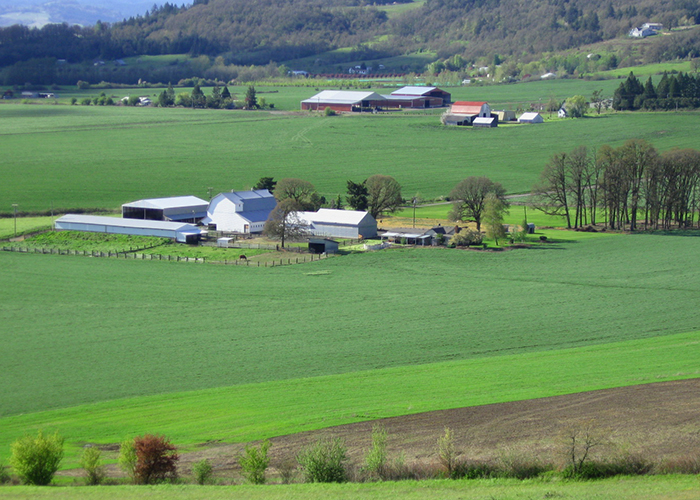
Oregon's statewide planning program conserves rural land for farming and forestry use, protects natural resources and wildlife habitat, and allows low-density development in appropriate places. The program encourages the conservation of the rural landscapes to maintain our working lands and other natural resources. The program encourages urban development. However, rural development is allowed under certain circumstances. Counties have mapped areas suitable for low-density development.
A county decides where new areas for rural development should be allowed by following what is called the "exceptions process." Allowable types of rural development in exception areas include residential, recreational, commercial and industrial development. All rural development is overseen by the counties.
The term "rural" means different things to different people. In Oregon's statewide planning program, "rural land" is land outside of areas that cities are planning to grow into. These areas for planned future urban growth are identified by urban growth boundaries or “UGBs”. (Even in very small or remote cities, land inside of an urban growth boundary is never considered "rural".)
Statewide Planning Goal 14: Urbanization limits new urban uses outside of urban growth boundaries. Urban growth boundaries have been a key component of the planning program as they contain urban uses and prevent sprawl across the rural landscape.
Statewide Planning Goal 11: Public Facilities and Services encourages the development of urban services like waste-water management inside urban growth boundaries. This decreases capacity for urban development in rural areas, outside an urban growth boundary.
Exception Areas
The land use planning program provides flexibility to accommodate unique situations by allowing counties to approve “exceptions” to the statewide planning goals. There are three types of exceptions:
- Reasons Exception: There is something special about a particular property or development proposal that merits waiving the statewide planning goals.
- Irrevocably Committed Exception: Development has occurred around an area in such a way that the land can no longer be used as it is zoned.
- Physically Developed Exception: Historical development of a property has made the land unavailable for the use it was originally planned for.
State rules for taking an exception and zoning of exception areas include:
OAR 660-004
OAR 660-014-0030
OAR 660-014-0040
Rural Residential Zoning
The rule for rural residential zoning,OAR 660-004-0040, establishes that "rural use" means one dwelling per 10 acres. Goal 14, Urbanization purposely limits development outside urban growth boundaries to protect working lands. Rules specify the level of rural residential development a county may allow without bringing the land inside an urban growth boundary or otherwise incorporating it. A minimum parcel size is used to establish new parcels.
Counties are prohibited from allowing the creation of new rural residential parcels smaller than two acres. Counties cannot allow zone changes of existing rural residential lands that would reduce the minimum lot size. For a new exception area that was previously zoned non-resource land, the minimum parcel size must be at least 10 acres, with allowance for clustering. Pre-existing parcels are allowed one dwelling regardless of size.
Unincorporated communities
The goals and rules for rural uses recognize that some Oregon communities have urban characteristics but are not incorporated as a city. Some of these “unincorporated communities” are indistinguishable from a small city, others are much smaller. The level and intensity of residential, commercial, and industrial development is allowed to be greater in an unincorporated community than on other rural land, but less than inside an urban growth boundary. Urban services such as sewer and water are allowed.
The rules that guide planning and zoning of unincorporated communities establish four types of communities: urban unincorporated communities (the largest examples), rural communities (smaller and predominantly residential), rural service centers (predominantly commercial or industrial), and resort communities (primarily for recreation). Planning and zoning requirements for each are different. Residential use is generally limited by the capacity of local public facilities and services such as sewer and water. The rule includes building-size limits for some commercial and industrial uses.
The rules for planning and zoning unincorporated communities can be found at
OAR chapter 660, division 22.
Destination Resorts
Resorts are seen as beneficial for tourism. They attract visitors for longer stays and generate tax revenue with low demand for public services.
To facilitate the development of destination resorts, provisions were added to statute (ORS 197.435–467) and Goal 8, Recreational Needs, to provide for the approval of new destination resorts in exclusive farm use and forest zones, without an exception to Goal 3 or Goal 4.
The state regulations are designed to ensure that developments are permitted only in areas compatible with farm and forest uses, adjacent uses, and important wildlife habitats.
Rural Industrial Lands
Many existing or former rural employment centers are exception areas with industrial zoning. The statewide planning goals encourage large, intensive uses to locate in urban areas. Oregon's land use policy regarding rural industrial land is contained in statute and rule.
Goal 14: Urbanization provides that "in unincorporated communities outside urban growth boundaries counties may approve uses, public facilities and services more intensive than allowed on rural lands." This means that county zoning provisions should limit uses in rural industrial zones to those that are less intensive than those allowed in unincorporated communities. There is an administrative rule that specifically addresses the level or intensity of uses allowed in rural industrial exception areas. However, it is only determined by inference from the "unincorporated communities" rules in
OAR chapter 660, division 22.
Statutes amend the limits set by goals and rules for some sites and geographic areas.
ORS 197.713 removes size limits if the industrial zone is not in the Willamette Valley or it is more than three miles from an urban growth boundary with a population of 20,000 or larger.
ORS 197.719 removes any size limits for "abandoned" and "diminished" mill sites and allows extension of urban facilities such as sewer service to the site.