
Oregon State Flag An official website of the State of Oregon »

Hemp Registry Guide

Round Hemp Registry Guide Icon

The Hemp Registry Guide applies to hemp items that are for sale to a consumer in Oregon that are intended for human or animal consumption or use. 

This includes direct to consumer sales (e.g. online) and brick and mortar sales at a retailer (e.g. smoke shops, gas stations, and grocery stores). 


OLCC and ODA (Oregon Department of Agriculture) may have additional requirements that are not covered in this guide so it is important to read and understand the rules. This guide is not a substitute for reading the laws and rules related to the hemp registry. 


About the Hemp Registry Rules
House Bill 4121 established the Hemp Registry. The Hemp Registry rules can be found in OAR 845-026-6000 - 6120.
Filed Rules (845-026-6000 – 6120 will appear on January 1, 2026 on Secretary of State’s Website

The rules in this guide do not apply to hemp items that:
  • Are being sold at OLCC licensed marijuana retailers; 
  • Do not contain cannabinoids;
  • Are intended only for topical use;
  • Are an industrial hemp grain or fiber product that does not contain added cannabinoids;
  • Are a commercial feed product intended for animals registered under ORS 633.006 to 633.089; or
  • Are transported through this state en route to a final destination in another state.

Some examples of what the rules do apply to include but are not limited to: 
  • Hemp flower pre-rolls
  • Hemp beverages containing cannabinoids like THC, CBD, or CBG
  • Hemp tinctures containing cannabinoids like THC, CBD, or CBG. 


​As part of the registration process, appl​icants must submit a label for the hemp item they are registering. It is important to understand the difference between containers (or packages) and labels. A container is a physical structure that holds and protects the product. The label is all of the text, graphics, pictures, and logos printed on or affixed to the package. Containers and labels are two distinct things.

A label is any written, printed, or graphic matter affixed to, applied to, attached to, blown into, formed, molded into, embossed on, printed on, or appearing upon or adjacent to a container containing a hemp item for purposes of branding, decorating, identifying, or giving any information with respect to the item or to the contents of the container. If a container contains multiple stickers or has some information printed directly on the container and the rest of the information on a sticker, all of the information is considered part of one label.​

CONTAINER
The Mylar bag on its own without any design or text elements
​​


​LABEL
Includes the printed design, the logo, and all of the text anywhere on the container


All containers must be properly labeled. This includes any container that holds hemp item as well as any container used to display a hemp item for sale to a consumer. For information on small or tiny container labels, read the Small and Tiny Container Labeling section.

 
​IMPORTANT! 
The container holding the item must be properly labeled no matter how small it is. Additionally, any outer container must also be properly labeled. 
​​The label information required on each label depends on the type of product and the size of the container.


Each hemp item product type has specific requirements that must be included on the label. The label requirements for each product type can be found in OAR 845-026-6000 – 6120. All labeling requirements outlined in the rules are considered required information that must be included on the label. Failure to include required information on a label may result in the denial of a registration or compliance action. For a checklist of the specific requirements for each product type, go to the Label Checklist section. If a container is too small to fit all of the required information, a small or tiny container label may be utilized. See the Small and Tiny Container Labeling section. Regardless of the product type, all labels must follow the same general requirements.

All the required information on a label must:
  1. ​Be in typed, legible font that is at least 1/16th of an inch in height based on the uppercase “K”;
  2. Be in a font that is easy to read and contrasts sufficiently with the background;
  3. Be in English, but the information can be included in other languages;
  4. Be unobstructed and conspicuous, meaning that all required information must be visible on the outside of the package; and 
  5. Be printed on or securely affixed to the container, meaning that the label will not fall off or be removed during transportation or normal use of the product. 
Additionally, every label must contain:
  1. ​A principal display panel as defined by OAR 845-026-6000. (See the Principal Display Panel Section for more information);
  2. A hemp symbol (specific requirements are discussed below); and
  3. All of the information required by rule for the specific product type (usable hemp, edible, concentrate, extract, tincture, or “other”).

Non-required information can be in any font or size. Although there is a font size requirement for all required information, any additional information that is not required by rule may be in any font type and size as long as that text complies with the rest of the rules.

A container may have more than one label panel attached or affixed to it.


Label information can be printed directly on the container, affixed to the container (e.g. with glue or as a sticker), or embossed into or printed directly on the container. For example, printing some required information directly onto a mylar bag and including the rest of the required information as a sticker is compliant under the rules. Both the sticker and the information printed directly on the bag will be considered to be two parts of one label.

If your product falls into one or more categories that item must comply with the labeling requirements for both categories. For example, a concentrate that can also be consumed like an edible must have the labeling requirements for both concentrates and edibles, with the exception of the "DO NOT EAT" warning because the product is intended for human consumption and the "BE CAUTIOUS" warn​ing if the effects of the product are customarily felt immediately.

Listing THC and CBD on the label. Under OAR 845-026-6030, when listing the potency on a label, the amount of THC and CBD must be the value calculated by the laboratory that tested the batch according to ORS 571.339. A label may not have a THC value that exceeds the applicable maximum concentration limit by over 10 percent as specified in OAR 845-026-0410. For more information about labeling THC and CBD, see the Potency section below.

Under OAR 845-026-6030, if the potency value for THC or CBD is reported by the laboratory as less than the limit of quantification, the value on the label must be listed as “<LOQ”. ​​

Principal Display Panel
 The principal display panel is defined as the part of a label on a container that is most likely to be displayed, presented, shown or seen under customary conditions of display for sale or transfer, generally the front of the container that contains logos and branding. A container may have more than one principal display panel and, if so, all principal display panels must be properly labeled.


Example of a container with two Principal Display Panels​​

​​​
​​​​​​​​​​​
​In the previous example, the container contains branding on the front and the top of the container.  Both are considered principal display panels and both must be labeled properly.

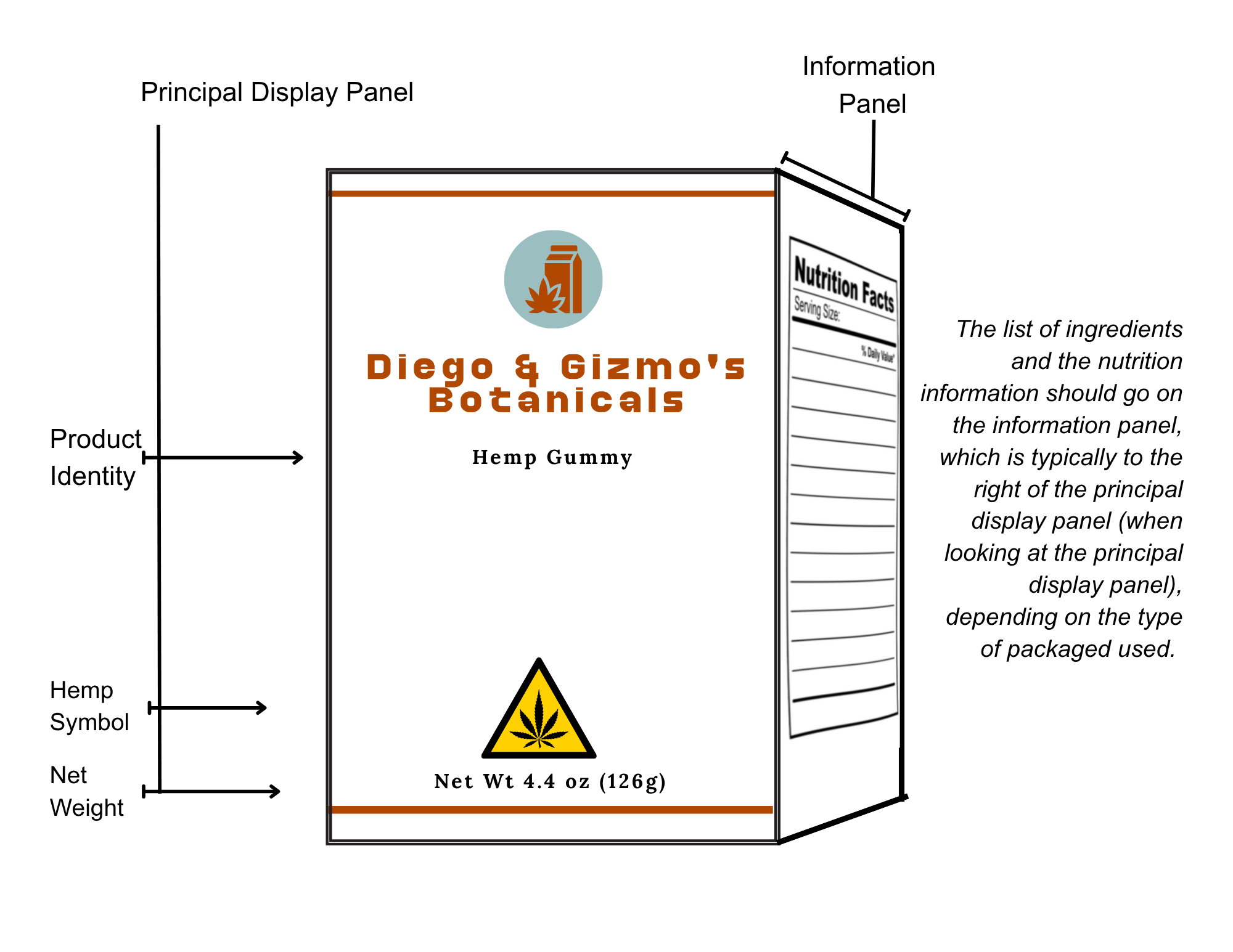
For most labels, three items must appear on the principal display panel: (1) the hemp symbol; (2) the net weight or volume; and (3) the product identity. All three items must be visible on the container at the same time. ​

​​​
In the example above, the principal display panel is not labeled co​rrectly. When the label is affixed to the container, only the product identity and net weight are visible on the principal display panel. To fix this label, the hemp symbol must be moved so that the hemp symbol is a part of the principal display panel.

​Product Identity
The product identity is the common or usual name of the product. This is a descrip​tive name for the product and not a fanciful name or the brand name of the product. For example, on a package of Starburst®, the name “Starburst” is the brand name of the candy, and the term “fruit chews” is the product identity.

 ​
​The product identity must:
  • Be in bold type; 
  • Be in a size reasonably related to the most prominent printed matter on the principal display panel; 
  • Be parallel to the base on which the package rests as it is designed and displayed; and
  • ​Clearly identify that the item is derived from hemp. 

Net Weight or Volume (Net Quantity of Contents)
The net quantity of contents means the amount of product being sold in the container. It can be expressed on the label as either the net weight or the net volume. 

The net weight is the gross weight of the final product minus the weight of the packaging and is expressed on the label in both ounces and grams (or milligrams for weights under one gram). A label should include the net weight if the product is a solid, semi-solid, or viscous product. A standard net weight declaration looks as follows: Net wt 1.0 g (0.035 oz).

The net weight is the weight of the final product. For pre-rolls, the net weight is the weight of the finished pre-roll, which includes the dried hemp leaves and flowers, the rolling paper, and the filter or tip.

The net volume is the fluid measure of a liquid product expressed as milliliters and fluid ounces (fluid ounces are different than ounces). A label should include the net volume if the product is a liquid.​


​​​​​


The net quantity of contents provided on the principal display panel must be the average quantity of contents in all of the packages in the batch. The net quantity declaration must be:
  • ​A distinct item separated from other printed label information on all sides by at least a space equal to the height of the lettering used in the declaration; 
  • ​In bold type;
  • In the bottom 30 % of the principal display panel;
  • In lines generally parallel with the base of the container; and
  • Listed in both the US Customary Units and the International System of Units (SI Units). 

US Customary
​SI Units
​Weight (dry) displayed in ounces 
Volume (liquid) displayed in fluid ounces

​Weight (dry) displayed in grams or milligrams​​
Volume (liquid) displayed in milliliters


​The net quantity of contents should be displayed as a number between 1 and 1000. When choosing a unit, use the following examples. If using a decimal, use no more than three decimal places.

Examples:
500 mg, not 0.5 g
1.96 g, not 1960 mg
750 mL, not 0.75 L

Net weight or volume should not be expressed in mixed units.
Example:
1.5 g, not 1 g 500 mg

Rounding Rules (reference from the NIST Handbook 130 2025​)
  • When the first digit dropped is less than 5, then the last remaining digit is unchanged
    • ​Example: 2.44 to 2.4; 2.429 to 2.4
  • ​When the first digit dropped is 5, or more than 5, followed by at least 1 digit other than 0, then the last remaining digit is increased by 1
    • Example: 2.46 to 2.5; 2.451 to 2.5
  • ​When the first digit dropped is 5 followed by zeros, then the last remaining digit is unchanged if even or increased by 1 if odd
    • Example: 2.450 to 2.4; ​​2.550 to 2.6


​​

Hemp Symbols
A label must feature one of two hemp symbols depending on the amount of THC in the product. If the hemp item is an “adult use cannabis item, ”the label must use the American Society for Testing and Materials International Intoxicating Cannabis Product Symbol D8441/D8441M (“ASTM Symbol”). If the hemp item is not an adult use cannabis item, the ASTM or the Blue Hemp Symbol established by the OLCC must be used. A label should not feature both symbols.


  • ​The ASTM symbol can be downloaded here
  • The Blue Hemp Symbol can be downloaded here.
The ASTM symbol must be at least 0.5 inches wide by 0.5 high and the Blue Hemp Symbol must be at least 0.48 inches wide by 0.35 high. Aside from the size, which cannot be below the minimum requirements, neither hemp symbol may be modified. This includes changing the color or adding additional text in the symbol.


Warnings and Statements
Depending on whether the product is an adult use cannabis item or a non-adult use cannabis item and the specific product labeling requirements, warnings and statements may be required. The labeling rules allow a degree of flexibility in some warnings and statements, however, these may not be altered in such a way that similar facts are not expressed or the warning or statement would be considered untruthful and misleading.

See each product’s labeling requirements in OAR 845-026-6040 – 6080 for what warnings and statements are required.


Potency
All hemp item labels must list the amount of THC, CBD, and any other cannabinoids present in the product. If the hemp item is for human consumption or use, the amount of THC and CBD must be the value calculated by the laboratory that tested the batch according to ORS 571.339 (OAR 845-026-6030); see the “Testing” section for requirements around testing hemp items for human consumption or use.

​If a label features an optional “target potency”  for a specific cannabinoid, such as THC or CBD, and the specific cannabinoid’s target potency value is within 10 percent of value calculated by the laboratory that tested the batch, a label may omit the lab calculated values for that cannabinoid. 

For example, the front of the label states there a​re 10 mg of CBD in the container and the actual laboratory calculated value is 9.2 mg, the label would not be required to display the actual values for CBD. It would be required to list the actual values for THC because there was no target potency for THC. 

Claims that a product has “0 mg THC” or is ”THC Free” may be considered untruthful and misleading. See the “Untruthful or Misleading Claims” section.

If the potency value for THC or CBD is reported by the laboratory as less than the limit of quantification, the value on the label must be listed as “<LOQ” (OAR 845-026-6030). This requirement does not apply when a target potency is used and the laboratory results fall within the variance outlined in the previous paragraph. For hemp edibles, hemp tinctures, and hemp capsules, if the delta-9-THC is less than 90% of the total THC, the label must separately identify the quantity of delta-9-THC and THCA. See OAR 845-026-6030​

A label may not have a total THC value that exceeds the applicable maximum concentration limit by over 10 percent as specified in OAR 845-026-0410. For example, a hemp edible can have up to 22 mg THC in the container and be compliant with OLCC rules. 

Concentration Limits & Adult Use Cannabis Items
The OLCC sets the potency limits per container and per serving for hemp items for sale to consumers in Oregon. OAR 845-026-0410 sets the concentration limits for adult use cannabis items; see Table 1. When a category includes both a concentration limit (e.g. 0.3%) and milligram limits (e.g. 2 mg per serving and 20 mg per container), the product needs to comply with all applicable limits. For example, a 10 gram serving of hemp edible with a concentration of 0.05% THC is well under the 0.3% THC limit, but is still prohibited for sale to Oregon consumers because it contains 5 mg of THC – more than double the limit of 2 mg THC per serving.

“Adult use cannabis items” can only be sold to persons 21 years old and above. There are very specific requirements as to what products are considered “adult use cannabis items.” In order for a product to be eligible for sale to persons under 21 years of age:
  • The product must contain less than 0.5 mg total THC in the entire unit of sale;
  • The compliance testing must have been sensitive enough to demonstrate that the product contains less than 0.5 mg total THC; and
  • The product must not contain any artificially derived cannabinoids (see the “Artificially Derived Cannabinoids” section)
If a product does not meet all three of those conditions, it is an adult use cannabis item. Hemp items that are adult use cannabis items have different labeling requirements, including different requirements for the hemp symbol and different warnings on the label.

Testing
The Oregon Department of Agriculture (ODA) sets the testing rules for hemp products being manufactured or sold to consumers in Oregon for use or consumption. Those rules can be found here: ODA Hemp Laws and Rules. 

Hemp must be tested to the same standards as marijuana as established by the Oregon Health Authority. The OLCC and ODA created a hemp testing and potency fact sheet that helps illustrate hemp testing requirements. Some of the testing requirements include:
  • ​If the product was manufactured in Oregon, the required testing must be conducted by an OLCC-licensed laboratory.
  • If the product was manufactured outside of Oregon, the required testing may be conducted by a laboratory accredited to “the same or more stringent standards” as an OLCC-licensed laboratory, or by an OLCC-licensed laboratory.
  • In any case, the testing must be done in accordance with Oregon’s testing requirements. That includes testing every batch of products, presenting the testing lab with the entire batch for lab staff to select representative samples for testing, and testing for all of the analytes required by Oregon at the action levels required by Oregon. Testing a single sample, or self-selecting samples for testing does not meet Oregon’s compliance testing requirements. “Quality control” or “R&D” testing are distinct from compliance testing and do not satisfy the compliance testing requirement. The testing must also include all of Oregon’s required analytes.


Small Jars & Principal Display Panel
If the package or container is a jar and is 1.75 inches or less in height and has a lid with a width of two inches or less, then the principal display panel must be on the top of the lid. This requirement applies to all label types. The most common example is a small jar for an extract or concentrate. See OAR 845-025-6030​.

Label ID
Labels approved by the OLCC are automatically assigned a unique label identification number (“Label ID”). This number must be prominently displayed on the label of the outermost container or made available on the address of a publicly accessible website displayed on the outermost container, enabling a reasonable person to reliably locate the label identification number for the specific hemp item in the container. For example, the QR code on the label could open a web portal that lists the Label ID and allows a consumer to find the COA (see the “Link to a Certificate of Analysis” section below).

When you submit your label, you can find this under the Variants section in the label application. Your approved labels will show the Label ID under your Dashboard, then Labels. The suggested format is “Label ID: 0000”. The zeroes are placeholders and final labels must have an accurate Label ID number. See the following example of where to find the Label ID in your license dashboard. 


The Label ID is not the same as the file nu​mber:


Activation Time
Activation time is the amount of time it is likely to take for an individual to begin to feel the effects of ingesting, inhaling, or using hemp item. Activation time may be expressed in words or through a pictogram. If a user will begin to feel the effects right away, the activation time can be listed as immediate. If the product has a delayed reaction, the manufacturer must determine what the activation time is for their particular product. To show activation time on a label, you may simply state, “Activation Time: 30 minutes” or you may use a pictogram (see example on right), as long as the pictogram is clear and easily understood.  
​​
 
Pictogram Example


Batch Number
Labels must have a batch number, which is defined in rule as: “any distinctive combination of letters, numbers, or symbols, or any combination of them, from which the complete history of the manufacture, processing, packing, labeling, holding, and distribution of a batch or lot of a hemp item can be determined.” See OAR 845-026-6000 for the definitions of “Batch” and “Batch number.”

Link to a Certificate of Analysis
Labels must have the address of a publicly accessible website that would enable a reasonable person to reliably locate the certificate of analysis for the specific batch of the hemp item in the container, which can be done via QR code. 

An example that complies with this rule would be a QR code on label that links to a web portal where a consumer could enter the batch number on the label to locate the specific certificate of analysis for the product in the container. 

Hemp Items Intended for Animal Use or Consumption Only
The hemp registry’s requirements apply to products intended for animal use or consumption. The requirements do not apply to industrial hemp products that are a commercial feed product for animals registered under ORS 633.006 to 633.089.

If the hemp item is intended only for animal use or consumption, in addition to the specific labeling rule requirements, the label must also feature the statement “Intended for non-food producing animals only.” See OAR 845-026-6030.

The Oregon Department of Agriculture regulates animal products for sale in Oregon. More information can be found here.

Business or Trade Name
All labels require the business or trade name of the manufacturer of the hemp item, and if applicable the Oregon Department of Agriculture hemp grower or handler license number. In some instances, the rules require the manufacturer’s mailing address as well. This information should be listed together on the label (this also applies when a packager’s information is required). Providing the business or trade name as part of a logo or other branding is not sufficient to meet this requirement. The label must be clearly marked with the identifying information for the licensee or registrant responsible for the product.

Additional Labeling Requirements  
National Institute of Standards and Technology (NIST) Handbook 130 (2025)

The NIST Handbook has been incorporated by reference into the labeling rules. The NIST Handbook provides uniform packaging and labeling regulations. You can find the NIST Handbook here: https://www.nist.gov/document/2025-nist-handbook-130 

Serving Size
Based on the product type, some labels must provide a serving size and the number of servings in the container. The serving size is the amount of product that is suggested for a consumer to use. The serving size is NOT the potency of the product. Instead, the serving size should explain to the consumer the amount of product they should use to reach a specific potency. The serving size is determined by the applicant, but the label must follow the rules regarding concentration limits. For example, if product being sold was a cookie that contained 20 mg THC, the serving size could be at most 1/10th of the cookie because the THC limit per serving for a hemp edible is 2 mg. 

If the product being sold was a concentrate or extract, the applicant would decide how much a consumer should consume at one time and list that amount on the label. For example if the container held one gram of concentrate, the applicant could decide that the serving size should be 0.03 grams or 30 milligrams. The label would say, “Serving Size: 30 milligrams or an amount equal to a grain of rice, Number of Servings per Container: 33.”


All containers that hold a hemp item must be properly labeled. Under OAR 845-026-6030, if the container holding the hemp item is too small to fit all of the required label information, you may put at a minimum the following information on a label that is securel​y affixed to the small container:
  1. ​Principal display panel that includes the net weight, hemp symbol, and product identity;
  2. Manufacturer business or trade name, and if produced by an Oregon Department of Agriculture hemp handler or grower, their license number;
  3. Batch number;
  4. Concentration of THC and CBD; and
  5. Required warnings:
    • ​​​​For a hemp item that is an adult use cannabis item, the following warning is required on the label: “For use only by adults 21 and older. Keep out of reach of children and pets.”
    • For a hemp item that is not an adult use cannabis item, the following warning is required to be on the label: “This product contains cannabinoids. Keep out of reach of children and pets.”
I​​​mportant: If the package or container is a jar and is 1.75 inches or less in height and has a lid with a width of two inches or less, then the principal display panel must be on the top of the lid. This requirement applies to all label types. See OAR 845-026-6030.

​​The remaining required information must be included on an outer container or on a hangtag attached to the small container. If an outer container is used, all of the information required by rule must be on the outer container, even if some of the information is already included on the inner container. In other words, if a small container is packaged inside a larger container, the outer container must have a full label. If a hangtag is used, the hangtag must be securely attached to the small container and contain the rest of the required information that is not already listed on the small container label (for example: serving size, made on date, etc.). Small containers can utilize accordion or peel back labels but the information required on a small container label must be visible on the outside of the accordion or peel back label.


​Small Container Label Exa​mples 

Small Container Label on​​ Bottle


Hangtag for small container


Full Label on Bag (not to scale)


​​
Cartridge Labeling
All cartridges and vaporizing devices containing hemp concentrate, extract, or product intended for use with an inhalant delivery system must be labeled with the hemp symbol. The size of the hemp symbol cannot be below what is outlined in OAR 845-026-6030. The hemp symbol can either be printed directly on the cartridge or it can be attached to the cartridge as a sticker. Cartridges are not required to have a small conta​iner label.
​​


​Syringes do not fall under this rule and must have a small container label attached to them. In order to fit all of the required information, a flag label (shown below) may be used. For more information about small container labels, please see the Small Container Labeling section.


​​


For hemp edibles, it is required that the following information be placed on the label:

​​1. ​List of all ingredients in descending order of predominance by weight or volume used to process the hemp edible. The list of ingredients must include any substance used in processing, preparing, manufacturing, packaging, or holding the hemp edible product is present in the final product, including any cooking or release spray. The list of ingredients must correctly identify the type of hemp ingredient used to make the product. For example: “hemp extract” or “hemp concentrate.”

​​​This includes all ingredients and sub ingredients. For example, in a chocolate chip cookie recipe, the ingredient list may be as follows: ​​Ingredients: Enriched Flour, Brown Sugar, Chocolate Chips, Cottonseed Oil, Baking Soda, Salt. 

However, both enriched flour and chocolate chips are composed of other sub-ingredients.  For this example, the chocolate chips are made of cane sugar, chocolate liquor, cocoa butter, milkfat, and soy lecithin and the enriched flour is made of wheat flour, malted barley flour, niacin, iron, thiamin mononitrate, riboflavin, and folic acid. Because these two ingredients have ingredients of their own, you must list all of the ingredients and sub-ingredients in one of two ways:

First, you can list the names of the ingredients and then list any sub ingredients in parenthesis: Ingredients: Enriched Flour (Wheat Flour, Malted Barley Flour, Niacin, Iron, Thiamin Mononitrate, Riboflavin, Folic Acid), Brown Sugar, Chocolate Chips (Cane Sugar, Chocolate Liquor, Cocoa Butter, Milkfat, Soy Lecithin), Cottonseed Oil, Baking Soda, Salt.

Second, you could list out each ingredient in descending order of predominance by weight or volume: Ingredients: Wheat Flour, Malted Barley Flour, Niacin, Iron, Thiamin Mononitrate, Riboflavin, Folic Acid, Brown Sugar, Cane Sugar, Chocolate Liquor, Cocoa Butter, Milkfat, Soy Lecithin, Baking Soda, Salt.

The amount of calories, sodium, protein, added sugars, cholesterol, total carbohydrates, and total fat per serving.  A hemp edible shall use one of the nutrition information formats  provided by the Commission to display the amount of calories, sodium, protein, added sugars, cholesterol, total carbohydrates, and total fat per serving, the serving size and number of servings per container, and the list of ingredients and potential allergens. Even if the amount per serving is zero, it must still be listed on the label.
The nutrition templates can be found here. 

The rules do not require a specific type of analysis to determine the nutrient amounts displayed in the Nutrition Facts Panel but you may use one of the following methods to determine those values:

A. Database analysis. Using a list of ingredients and specific processing information for your product, you can use a food ingredient database to determine the specific nutrient amounts for your product. This method may be a better predictor of nutrient values across multiple batches versus a single laboratory test from one batch. However, how the analysis is performed affects the validity of the results. You must be extremely detail-oriented and have a general knowledge of food and nutrient values, be able to understand and account for processing changes, and be able to keep detailed records. 

B. Lab analysis. A lab can determine the nutrient values for the sample submitted to the lab. The results will only be specific to the sample tested so you may want to consider testing your product throughout the year to get the most accurate results. Lab analysis may be more beneficial if you are using unique ingredients that do not have nutrient information available or when the specific process you are using to make the edible is going to change the nutrient composition of the product in an unpredictable way.

C. A combination of database and lab analysis. You can verify a claim or cross check results using both methods.


2. ​If the edible is perishable, a statement that the edible must be refrigerated or kept frozen. If the edible is not perishable, no statement is needed.


3​. List of potential major food allergens.  
  • ​The label must list major food allergens if the edible contains: 
    • ​Milk, egg, fish, crustacean shellfish, tree nuts, wheat, peanuts, soybeans, or sesame as an ingredient; or
    • Any ingredient that contains protein derived from: milk, egg, fish, crustacean shellfish, tree nuts, wheat, peanuts, or soybeans.
When labeling allergens, always use the specific food name for nuts, fish or crustacean shellfish and not the category of allergen. For example, use the word “almonds” instead of “tree nuts” in the Contains statement. Major food allergens must be labeled in one of two ways.

The first option is to include the name of the food source in parenthesis following the common or usual name of the major food allergen in the list of ingredients whenever the name of the food source of the major allergen does not appear elsewhere in the ingredient statement. For example: Ingredients: Enriched flour (wheat flour, malted barley, niacin, reduced iron, thiamin mononitrate, riboflavin, folic acid), sugar, partially hydrogenated soybean oil, and/or cottonseed oil, high fructose corn syrup, whey (milk), pecans, eggs, vanilla, natural and artificial flavoring) salt, leavening (sodium acid pyrophosphate, monocalcium phosphate), lecithin (soy), mono-and diglycerides (emulsifier)

In the example above, the major food allergens are in bold to highlight their location. However, the allergens do not need to be in bold on an edible label.

The second option is to use the word "Contains" followed by the name of the food source from which the major food allergen is derived, immediately after or adjacent to the list of ingredients, in a font size that is the same font size used for the list of ingredients. 

For example, after the list of ingredients, the following statement would appear: Contains: Wheat, Milk, Pecans, Egg, and Soy

4. Source of Hemp. Ingredient lists must accurately list the source of or hemp used in the product. For example: “hemp extract,” “hemp concentrate,” or “hemp flower.”


Gluten-Free
Gluten is the protein that occurs naturally in wheat, rye, barley, and crossbreeds of these grains. Although certain grains may contain gluten, some grains can be made gluten-free. An ingredient that has been derived from a gluten-containing grain can be labeled as "gluten-free" if it has been processed to remove the gluten and use of that ingredient results in the presence of less than 20 parts per million (ppm) gluten in the food. The "gluten-free" claim is a voluntary one, however, licensees and registrants who decide to use this term are responsible for using the claim in a truthful and not misleading manner, and for complying with the requirements established by the U.S. Food and Drug Administration.  

Gluten-free means that the food either is inherently gluten free or does not contain an ingredient that is: (1) a gluten-containing grain (e.g. Spelt wheat); (2) derived from a gluten-containing grain that has not been processed to remove gluten (e.g. Wheat flour); or (3) derived from a gluten-containing grain that has been processed to remove gluten (e.g. Wheat starch), if the use of that ingredient results in the presence of 20 parts per million (ppm) or more gluten in the food. Any presence of gluten in the food must be less than 20 ppm.


Organic 
There are strict requirements for labeling hemp items using the term “organic.” First, if you want to make a claim that a product or its ingredients​​ are organic, the product or certain ingredients need to be certified as organic. If it is not certified, you cannot make any organic claim on the principal display panel or use the USDA organic seal anywhere on the package. Doing so will be considered misleading and could result in a denial of the registration. ​


"Made with organic ***" statement
To label a hemp item with the "Made with organic ***" statement, the product must contain at least 70 percent certified organic ingredients​ (not including salt or water). These products may contain up to 30 percent of allowed non-organic ingredients. (See National list of Allowed and Prohibited Substances) All ingredients must be produced without GMOs or other prohibited substances and the product must be certified. If a product meets these requirements, its label may include a statement such as "made with organic wheat" that lists the specific organic products. The generic statement, "made with organic ingredients" is not allowed. The organic ingredients also must be identified in the ingredient list. Additionally, the label must identify the USDA-accredited certifying agent on the information panel.​​​

Specific Ingredient Listings
If the product contains less than 70 percent organic contents, the specific organic ingredients may be listed in the ingredient statement. You may only, on the information panel, identify the certified organic ingredients as organic and the percentage of organic ingredients. Licensees, registrants, and hemp certificate holders cannot include the USDA organic seal anywhere or use the word "organic" on the principal display panel.
To learn more about the USDA Organic Program, check out the USDA Organic website: https://www.usda.gov/topics/organic.

“Farm Bill Compliant”
It is not clear what it means for a finished product to be “Farm Bill Compliant.” The 2018 Farm Bill primarily deals with the legal requirements to grow a hemp crop. For finished products, the 2018 Farm Bill makes clear that the Federal Food, Drug, and Cosmetic Act still applies, and the Food and Drug Administration (FDA) has been clear that THC or CBD are adulterants in foods and dietary supplements.

A label claim that a hemp food or dietary supplement is “Farm Bill Complaint” may render the label untruthful and misleading. Whereas a claim that the hemp crop used to make the product is “Farm Bill Compliant” would not be considered untruthful and misleading.

Health Claims
Health claims describe a relationship between a substance and a reduced risk of a disease or health-related condition. OAR 845-026-6030 prohibits the use of a health claim that is not supported by the consensus of publicly available scientific evidence (including evidence from well-designed studies conducted in a manner which is consistent with generally recognized scientific procedures and principles), and for which there is significant scientific agreement, among experts qualified by scientific training and experience to evaluate such claims. A statement claiming that the product or an ingredient in the product can cure, mitigate, or treat any disease or health-related condition cannot be made or implied. Any statement that makes such a claim would be considered a misleading statement and could lead to a denial of a registration.

Claims Related to THC Content
Claims that indicate the product has no THC, such as “THC Free” or “Zero THC,” may be considered untruthful and misleading unless the label also includes an actual falsifiable claim about the level of THC detected by a laboratory. For example: “Lab testing has shown this product contains less than 1 ppm THC.”

A “THC Free” or “Zero THC” claim may also be considered misleading if the laboratory results for the batch of the product in the container are above the laboratory’s limit of detection (LOD) for delta-9-THC or THCA. Results below the limit of detection are typically listed as “Non-detect” or “ND” on the certificate of analysis. Additionally, a “THC Free” or “Zero THC” on an adult use cannabis item may mislead a consumer into thinking the item is not an adult use cannabis item.

Additionally, blanket statements of “<0.3% THC” may render the label untruthful and misleading if the product contains greater than 0.3% Delta-9-THC, THCA, or Total THC based on the laboratory results for the batch of the product in the container.

Target Potency
A target potency is defined as the “intended potency included on the label for the amount or concentration of a cannabinoid, including but not limited to total THC, total CBD, or total amount of cannabinoids.” A target potency is not the actual potency of the product, the label still must list the THC and CBD values calculated by the laboratory that tested the batch. A target potency may only be placed on the principal display panel. A target potency that differs from the value calculated by the laboratory that tested the batch by more than 10 percent is untruthful and misleading. For example, the principal display panel of a hemp cookie states there is 20 mg of THC in the container and the THC value calculated by the laboratory is 16 mg. This is untruthful and misleading. See OARs 845-025-6000 and 845-026-6030.


Inhalable hemp cannabinoid products with non-cannabis additives (ICPs) are hemp cannabinoid products that are meant for human inhalation and have been combined with non-cannabis ingredients like non-cannabis terpenes (or “botanical terpenes”) or flavorings. The most common example is a vape cartridge with non-cannabis derived terpenes. Here are the relevant definitions from OAR 845-026-6000:

“Inhalable hemp cannabinoid product” means a hemp cannabinoid product that is intended for human inhalation.

“Non-cannabis additive” means a substance or group of substances that are derived from a source other than industrial hemp.

(a) “Non-cannabis additive” includes but is not limited to purified compounds, essential oils, oleoresins, essences or extractives, protein hydrolysates, distillates, or isolates.

(b) “Non-cannabis additive” does not include plant material that is in the whole, broken, or ground form.

There are very distinct labeling requirements for ICPs, which are labeled according to OAR 845-026-6080. These include, but are not limited to:
  • ​The product identity must contain the words “non-cannabis additive”. For example, “Hemp Extract with Non-cannabis Additives”.
  • The ingredients must use the words “non-cannabis additive” and list all ingredients in the additive either alphabetically or in descending order of predominance by weight or volume. For example, “Ingredients: Hemp extract, Blue Dream Non-cannabis Additive (a-pinene, linalool, myrcene)”.
  • The ingredients can either be listed on the exterior label, or included as an insert as long as the insert makes it clear that the listed ingredients are in the ICP.
Additionally, the registration must also include documentation from the manufacturer of the non-cannabis additive, that among other things, includes all ingredients in the product and a statement that the product is meant for human inhalation (see OAR 845-026-6100 for the full list of requirements). The Non-cannabis Additive Documentation must also be included in the registration. Any change in additive supplier, ingredients, or new additives must be resubmitted and pre-approved before they can be compliantly used (see OAR 845-026-6100​).

Inhalable hemp cannabinoid products that contain any of the following non-cannabis substances are considered adulterated by the OLCC: squalene, squalane, vitamin E acetate, triglycerides, including but not limited to medium-chain triglyceride (MCT) oil, and propylene glycol.
 
This OLCC bulletin,​ while tailored to marijuana licensees, has examples of labels and required documentation.


Artificially derived cannabinoids (ADCs) are cannabinoids that are derived from cannabis through chemical reactions. For example, taking hemp-derived CBD and using an acidic catalyst to convert it into delta-8-THC or delta-9-THC. ADCs are also sometimes known as semisynthetic cannabinoids. 

Whether a substance is an ADC depends entirely on how it was made. Some cannabinoids that occur naturally in hemp in small quantities are also sometimes made synthetically from CBD. Substances that are frequently made as ADCs include CBN, delta-9-THC, delta-8-THC, HHC, H4-CBD, THCV. If you are unsure whether a particular cannabinoid in your product was artificially derived, you will need to work with the supplier of that cannabinoid to find out how it was made. Businesses must know whether the cannabinoids are artificially derived in order to determine whether a product is eligible for sale to Oregon consumers and, if so, how to properly label it.

Products containing ADCs are only eligible for sale to Oregon consumers in very specific circumstances, described in OAR 845-026-0415. The ADC cannot be intoxicating at the intended concentration in the product. The ADC must also meet all the ordinary requirements for any other novel substance to be included in a food or dietary supplement, by either making a “Generally Recognized as Safe” (GRAS) determination or submitting a successful New Dietary Ingredient Notification (NDIN) to the FDA. See the rule for complete requirements.

If a product contains ADCs and is eligible for sale to Oregon consumers, the product identity on the label must clearly identify that the hemp item contains an artificially derived cannabinoid and include the words “artificially derived cannabinoid.” Additionally, the ingredient listing must identify any artificially derived cannabinoid by its full name and the words “artificially derived” (e.g. “artificially derived cannabinol”). Lastly, the registration application must be accompanied by a completed version of the Artificially Derived Cannabinoid Label Application Form​.


For labeling purposes, infused pre-rolls and moonrocks are considered “other hemp cannabinoid products” and are labeled according to OAR 845-026-6080. The label must display an ingredients list in descending order of predominance by weight. The ingredients should be described according to their rule definitions (OAR 845-026-6000) and must use the word “hemp”. For example, “Ingredients: usable hemp, hemp extract, hemp concentrate.” ​


  • Prior to selling, offering for sale, transferring, or delivering a hemp item to a consumer or retailer in Oregon, a “responsible party” must submit a registration application to the Commission, and receive Commission approval. 
    • ​Responsible Party means any person within or outside this state that is responsible for the manufacturing, packaging, or distribution of a hemp item that is sold, transferred, or delivered to a consumer or retailer in this state.
  • Registration must be done online, through the OLCC’s Cannabis and Alcohol Management Program (CAMP). Review the CAMP Packaging and Labeling User Guide​ for more information on how to use the system and make sure you are in compliance.
  • A person is not required to submit to the OLCC a registration for a hemp item if another person has submitted the information for the hemp item, the hemp item is on the list of OLCC approved registrations, and the hemp item continues to be consistent with the previously submitted information. See the “Consistent Registrations” section below for more information.
The OLCC may review the submission materials and notify the applicant whether or not the registration has been approved. If the application was not approved, the OLCC will provide a description of all of the deficiencies. 

An applicant may submit multiple variants for approval on the same registration for a product that may have different flavors, colors, or sizes as long as the product and are otherwise identical. For example, an edible hemp gummy with five different flavor variations. Registrations may not combine adult use cannabis items and non-adult use cannabis items.

Fees & Amendments
The fee for a registration is $400. The fee for a registration renewal is $400. The fee for making changes to an active registration is $25. These fees are non-refundable. 

If you would like to make changes to the label(s) on your registration that are not “consistent” (explained below) with the previously submitted information, you may use the amendment process in CAMP. The CAMP Packaging and Labeling User Guide provides more information. 

Consistent Registrations – Relying on an Active Registration & Making Changes
A person is not required to register a hemp item with the OLCC if the hemp item is “consistent” with an actively registered hemp item. Essentially, this allows others to rely on another person’s active registration. For example, the manufacturer of a line of hemp beverages could register the products with the OLCC and downstream distributors and retailers could rely on that registration without submitting a new registration of their own. This also limits the changes to label that an applicant may make without having to resubmit.

Due diligence should be taken to verify that the registration is active and changes have not been made to the label that would require resubmission of the registration (more on this below). The OLCC maintains a publicly accessible search for hemp item registrations on the CAMP Customer Portal. If you have questions about the status of a registration, you can also email marijuana.packaging@olcc.oregon.gov.

To be “consistent” with a registration, only a limited amount of information can change on the label. The following information can be changed on the label and still be “consistent” with the registration:
  1. ​Harvest or processing date; 
  2. Strain name; 
  3. Test results, including potency and testing information; 
  4. Net weight or volume;
  5. Batch number;
  6. Manufacturer’s or packager’s business or trade name or place of address; or
  7. Oregon Department of Agriculture hemp handler or grower license number.
​If any non-mandatory label information is deleted or there is an addition, deletion, or change in the UPC or 2D mobile barcode, website address, phone number, fax number, or zip code the registration does not need to be resubmitted. Additionally, if any of the label information is repositioned, the registration does not need to be resubmitted as long as the repositioning is consistent with the labeling rules. See OAR 845-026-6100 for the rule.

If any other change is made that is not outlined above, the registration is no longer consistent with the active registration and the registration must be updated if you would like to stay in compliance. This can be done via the amendment process in CAMP or a new registration may be created. 

Required & Supporting Documents
Every hemp item registration must be accompanied by a Certificate of Analysis (COA) for a batch of the hemp item being registered. If the product is intended for human consumption, the COA must comply with the testing requirements in ORS 571.339. The COA must only be submitted during the initial registration, additional COAs are not required to be submitted during renewal or an amendment.
 
Based on what product type is being registered, additional documents may be required to be submitted as part of the registration process. CAMP provides links to specific forms.

Renewal
To maintain an active registration, a hemp item registered with the OLCC must be annually renewed. A renewal application and fee specified by OAR 845-026-6010 must be received no later than 395 days after the date the registration was previously approved by the OLCC to be renewed. 

A hemp item will be removed from the list of OLCC approved registrations if a complete renewal application and fee is not received within 395 days from the date the registration was previously approved by the Commission.

CAMP will send multiple reminders about renewal dates and these dates are available to view in CAMP at any time.

Registration Consultations
The OLCC will review registration materials before they are submitted in CAMP. Any person that would like feedback can send questions or images of their registration materials, including labels and COAs to marijuana.packaging@olcc.oregon.gov. You will receive a response with feedback regarding whether you should make any changes to your registration. Please note that the feedback you receive during a consultation is not approval, and you will need to register through CAMP. Additionally, label consultations should not be used as a method to circumvent CAMP review requirements.

Still have Questions?

*Note that there are different labeling requirements if the hemp item is an adult use cannabis item or a non-adult use cannabis item. Follow the “Non-Adult Use Cannabis Item Checklist” for products that are not adult use cannabis items.*

The labels are only examples. ​The names and information are fake.


USABLE HEMP


HEMP EDI​BLE


HEMP CONCENTRATE AND EXTRACTS


HEMP TINCTURE ​AND CAPSULES


​OTHER HEMP CANNABINOID PRODUCTS - INFU​​SED PRE-ROLL


SMALL CONTAINER LABELS
OAR 845-026-6030 provides that if a container is too small to fit all of the information required that container may have a label that includes at a minimum the information in the “Small Container” checklist below. 

Important: If the package or container is a jar and is 1.75 inches or less in height and has a lid with a width of two inches or less, then the principal display panel must be on the top of the lid. This requirement applies to all label types. See OAR 845-026-6030​.

All other required label information not listed in the tables below must be contained on an outer container or package, inside a peel-back or accordion label, or on a leaflet or hangtag that accompanies the hemp item.  If an outer container is used, all labeling information, including the information listed in the table below, must be on the outer container.


SMALL CONTAINER LABEL EXAMPLE
​​


​*Note that there are different labeling requirements if the hemp item is an adult use cannabis item or a non-adult use cannabis item. Follow the “Adult Use Cannabis Item Checklist” for products that are adult use cannabis items.*

The labels are only examples. The names and information are fake.


USABLE HEMP


HEMP EDIBLE​


HEMP CONCENTRATES​​​ AND EXTRACTS


HEMP TIN​CTURE AND CAPSULES

​​​


OTHER HEMP CANNABINOID PRODUCTS - INFUSED PRE-ROLL


SMALL CONTAINER LABELS
OAR 845-026-6030 provides that if a container is too small to fit all of the information required that container may have a label that includes at a minimum the information in the “Small Container” checklist below. 

Important: If the package or container is a jar and is 1.75 inches or less in height and has a lid with a width of two inches or less, then the principal display panel must be on the top of the lid. This requirement applies to all label types. See OAR 845-026-6030​.

All other required label information not listed in the tables below must be contained on an outer container or package, inside a peel-back or accordion label, or on a leaflet or hangtag that accompanies the hemp item.  If an outer container is used, all labeling information, including the information listed in the table below, must be on the outer container.

SMALL CONTAINER LABEL EXAMPLE