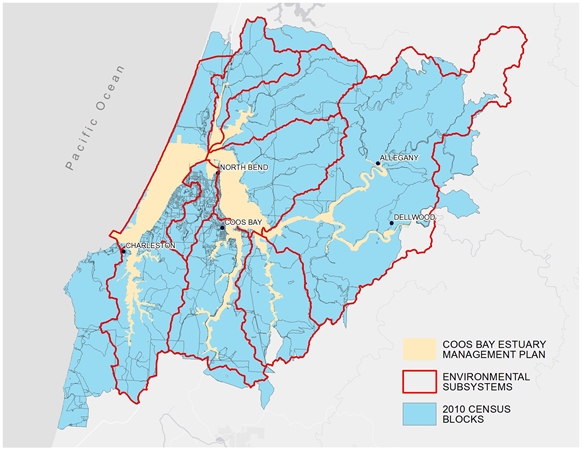
 The Partnership for Coastal Watersheds (PCW) is a collaborative effort among public-and private-sector citizens in the Coos Bay community to develop locally-driven approaches to responsible development, and to help prepare for climate-related changes on Oregon's south coast.
The Lands & Waterways Data Source highlights the environmental factors and natural resources found in the Coos estuary and its lower watersheds.
The chapters below are broken into three components: Chapter Summary (which lists information sources, data gaps, and data limitations); Climate Change Summary (which discusses anticipated effects of climate-related changes associated with the chapter topic); and one or more Data Summaries (which uses all available data to describe status, trend and background information on each major sub-topic).
Physical Description
This section includes the following
data summaries: Geographic Features, Meteorology, Hydrology,
Geology, Land Use/Land Cover,
and Human Infrastructure — which
describe physical properties of the
Coos estuary and lower Coos watershed.
Water Quality
This chapter includes four data summaries: Physical Factors, Nutrients,
Bacteria, and Other Pollutants –
each describing the most current
research on the status and trends
(where the data allow) of water
quality in the Coos Estuary.
Sediment
This section includes the following
data summaries: Sediment Composition, and Sediment Contamination— which describe the condition
of Coos estuary sediment in the
lower Coos watershed.
Stream Habitat
This Chapter includes a single data
summary: Stream and Riparian
Habitat in the Lower Coos Watershed– which describes the most
current status and trends of important stream and riparian habitat
attributes including pool area and
residual pool depth, large woody
debris (pieces, volume, and key pieces), gravel and sediment in riffles,
road-related sediment and bank
stability, and riparian cover type
and percent shade.
Vegetation
This chapter includes four data
summaries: Rare and Endangered
Plants, Seagrasses and Algae, Tidal
Wetland Vegetation, and Terrestrial Vegetation— which describe
the status and trends (where data
allow) of tidal wetland and upland
vegetation in the lower Coos watershed.
Fish
This section includes the following
data summaries: Salmonids, Lamprey, Sturgeon, and Other
Fishes— which describe the status
and trends (where the data allow)
of fish in the Coos estuary and
major freshwater tributaries in the
lower Coos watershed.
Clams and Native Oysters
This section includes two data summaries: Recreational Clams and
Native Oysters— which describe
the status and trends (where the
data allow) of bivalve populations
in the Coos estuary
Crabs
This chapter includes three data
summaries: Dungeness Crabs, Red
Rock Crabs, and Other Crabs –
each describing the most current
research on the status and trends
(where the data allow) of crab populations
in the Coos Estuary.
Birds
This chapter includes three data
summaries: Aquatic Birds, Terrestrial Birds, and Birds of Special
Concern— which describe the status
and trends (where the data allow)
of birds in the Coos estuary and
associated uplands.
Mammals
This section includes two data
summaries: Small Mammals, and
Large Mammals— which describe
the status and trends of important
mammalian species the lower Coos
watershed.
Invasive Species
This section includes the following data summaries: Vegetation,
Aquatic Invertebrates, Terrestrial
Invertebrates, and Vertebrates—
which describe invasive and other
non-native species in the Coos estuary and lower Coos watershed.