Accessible parking spaces must be addressed when a project alters a parking lot or on-street parking that is metered or marked.
If sidewalks and pavement are altered, the parking access aisle must also be addressed.
Standards
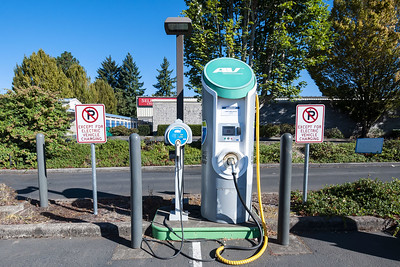
Electric Vehicle Charging Stalls
EV charging stalls must be accessible to people with disabilities at public places of use including state or local government offices, parks, parking lots, on street parking, rest stops, government provided housing, and for federal fleet charging stations.
EV chargers are often installed in parking lots, however, there are significant differences in functionality. EV charging stalls are treated differently than parking spaces. Accessibility standards and best practices are provided in the US Access Board’s EV Charging Technical Assistance Document released in July of 2022.
The Oregon Structural Specialty Code (OSSC) considers EV chargers installed on an afected building site to be a common use element of that affected building site. All common use elements must meet specific Chapter 11 accessibility requirements of the OSSC in Oregon. Accessible EV chargers services requires:
- A connection to an accessible route to the affected building.
- A clear ground space at the charger.
- Accessible designed controls and operating mechanisms meeting the reach range requirements.
The technical requirements for the accessible route, clear ground space, and operating controls are specified by the OSSC and referenced ICC/ANSI A117.1 design standards.
The new 2025 OSSC became effective October 1, 2025 and is mandatory statewide beginning on April 1, 2026. Where installed, the 2025 OSSC requires 5% of the EV chargers on a single site, and at least one EV charger of each type to be accessible when installed.
Dedicated EV charging stall spaces identified or marked as accessible, are not required for voluntarily installed EV chargers.
External References