Oregon State Flag An official website of the State of Oregon »

OR 229 Landslide Closure and Rebuild

OR229 slide aerial

Contacts

Jim Doll
Transporation Project Manager
📞 541-286-8358
james.p.doll@odot.oregon.gov 


Mindy McCartt

Public Information Officer
📞 503-507-6045
mindy.m.mccartt@odot.oregon.gov


Highway 229

OR 229 is closed after a major landslide that destroyed a section of the highway near milepost 14. 

Reopening the road will require stabilizing the slope and rebuilding the road, not just clearing debris. Based on current information fully rebuilding OR 229 is expected to take several years. The exact timeline depends on site stabilization, environmental review, design and securing funding for the permanent rebuild project. 

In the meantime, we’re looking at whether a short-term emergency access option could safely provide limited local access. We understand how disruptive this is and are working to find practical solutions for the community.

The area remains unsafe for full on-the-ground access due to saturation and ongoing settling. The slope is still unstable, and crews are evaluating the risk of additional movement around the edges of the slide.

We will update this webpage with the latest safety updates, strategies and timelines when they are known.

View photos of the landslide and response efforts in our OR 229 Landslide Flickr album. We'll add new images as work continues. 


On Dec. 12, 2025, a large landslide occurred on OR 229 (Siletz Highway) at milepost 14.

Initial movement was reported around 3 a.m., followed by full slope failure between 4 and 5 a.m.

The landslide impacted approximately 1,000 feet of highway. It originated at least 200 feet above the road on private property before moving downslope and destroying the roadway.​

Based on early evaluations, the landslide is expected to remain unstable through the winter and rainy season. There are no immediate repair options due to ongoing instability.​

Water is one of the biggest challenges at the site and is a key factor affecting the timeline to reopen the highway. Saturated ground conditions limit safe access and increase the risk of additional movement.

The landslide is complex. In some areas, large blocks of soil and rock shifted. In other areas, the slide behaved more like a debris flow due to high water content. 

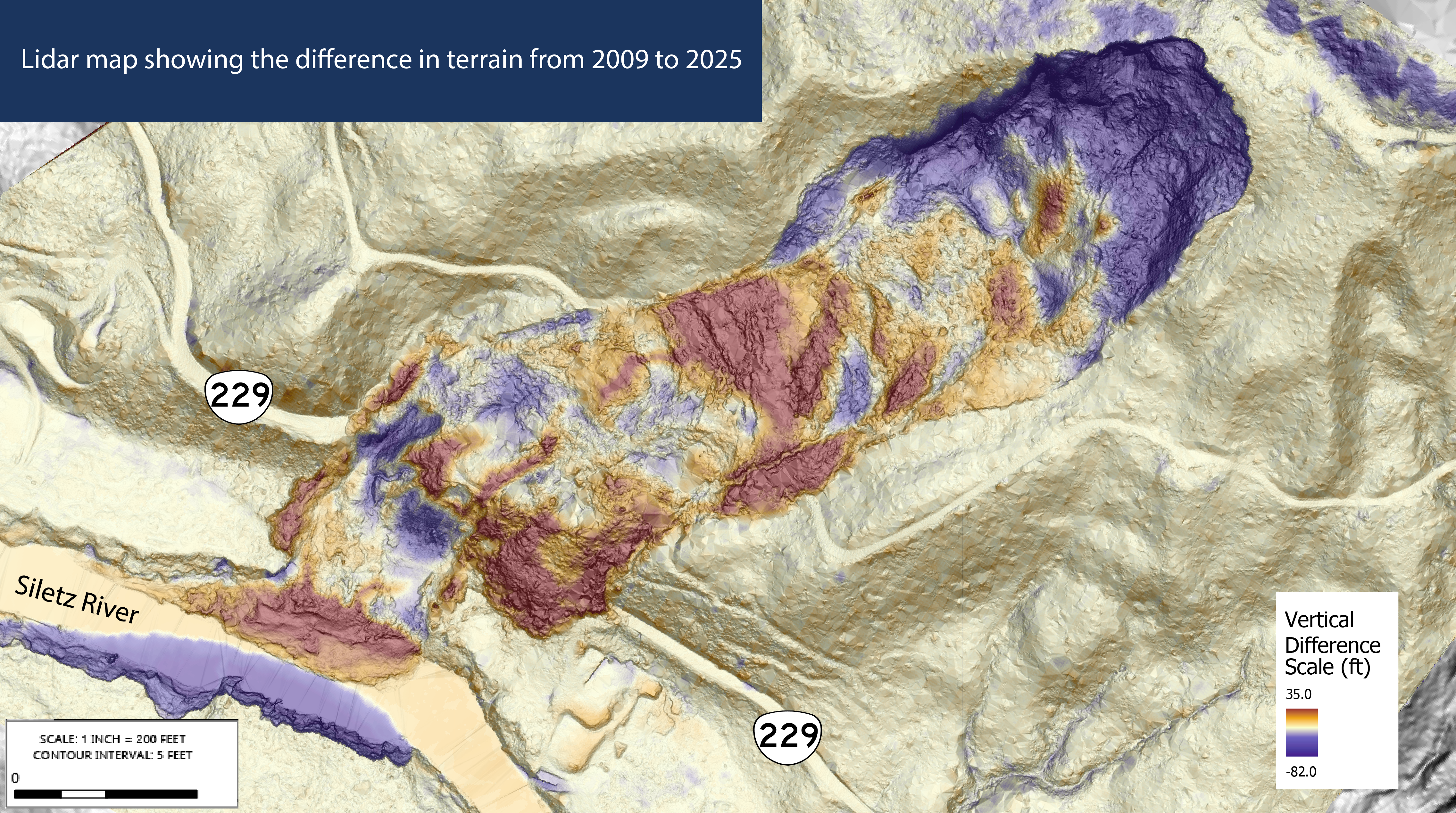
Lidar map of the OR 229 slide area

Lidar is a technology that uses laser pulses to measure distances and create detailed 3D maps of the ground and objects.

Before traffic can fully return, we must complete: 

  • Detailed site investigations. 
  • Stabilizing the slope to prevent additional movement. 
  • Installing drainage to manage groundwater and surface water. 
  • Removing and relocating landslide debris. 
  • Environmental review and permitting. 
  • Engineering design plan. 
  • Securing funding for permanent rebuild  
  • Full reconstruction of the damaged road. 

We're working with technical experts to conduct site investigations. This spring, they will prepare a preliminary landslide assessment report. The report will outline potential short-term emergency options, if feasible, and a long-term repair strategy.​

There is currently no local detour. We have developed a long-term detour plan and are evaluating potential short-term solutions.

Travelers should plan for longer travel times and use caution on alternate routes. 

Detour map showing traffic using U.S. 20 and U.S. 101 to get around the OR 229 closure​​​​

The Governor declared a state of emergency on Dec. 30, 2025. This allowed us to request Emergency Relief funding from the Federal Highway Administration, which was approved on Feb. 4, 2026. 

We are working with the Federal Highway Administration to review damaged sites and determine total Emergency Relief funding needs related to the Dec. 2025 storms. Those storms caused heavy flooding, erosion, pavement failures and landslides between Dec. 16, 2025, and Jan. 6, 2026, along with related emergency traffic control costs. 

Emergency Relief funding will help cover eligible costs related to studying the site and evaluating temporary local access options. Separate funding will be required for the permanent rebuild. ​

We are monitoring the landslide to better understand slope movement and site conditions.

Current monitoring focuses on surface observations, including visible ground movement and changes to the slope.

Once the slope stabilizes enough to allow safe installation, we plan to use subsurface monitoring instruments. These tools can measure how soil and rock layers are shifting below ground and track groundwater levels. Water is a significant factor in slope instability at this site.

We are working with the Oregon Department of Geology and Mineral Industries and Oregon State University. Oregon State University is supporting monitoring efforts through an existing research partnership with us.

Monitoring helps engineers understand slope behavior over time. It does not indicate the area is stable or safe for public access.

Oregon’s landscape includes steep terrain, layered soils and heavy seasonal rainfall. These natural conditions increase the risk of landslides along highways, particularly in western parts of the state. 

We continually assess and track unstable slopes statewide. We currently have more than 4,100 identified unstable slopes along Oregon highways, affecting about 7% of the state highway system, or roughly 495 miles of road. 

These include approximately: 

  • 70 debris flows 
  • 2,200 landslides 
  • 1,800 rockfalls 

We prioritize sites based on risk. Currently: 

  • 26 are classified as Critical State 
  • 120 as Immediate Need 
  • 774 as High Priority 
  • Additional sites are categorized as medium or low priority 

All unstable slopes present some level of risk. 

Climate change and earthquakes can increase the likelihood of slope movement. Our focus is on monitoring conditions, responding when needed and keeping roads as safe and reliable as possible for travelers. 

Learn more about how we identify and manage unstable slopes statewide on our Unstoppable Slopes, Landslides, Debris Flows, and Rockfalls webpage.