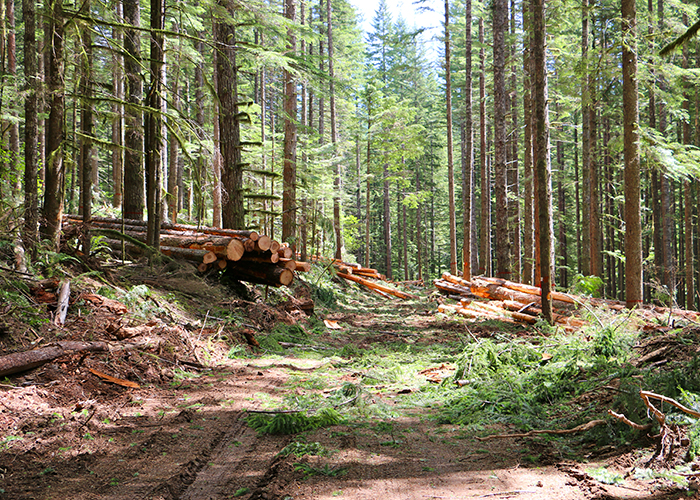
Oregon has established strong protections to ensure its forest resources remain available for timber harvest, wildlife habitat, and recreation.
Statewide Planning Goal 4: Forest Land and supporting
administrative rules promote growing and harvesting trees as the primary use of forestland. The goal and rules limit uses that are not compatible with forestry operations. Plans and ordinances adopted by local governments must incorporate these state forest protection standards.
Oregon’s forest industries are a major economic contributor in many rural areas. Oregon is a leader timber production, and engineered wood products. Engineered wood products can be used as the primary material in tall buildings and are introducing new possibilities for architecture.
In 2023, the forest sector was responsible for generating over $28 billion in output, over 103,000 jobs and almost $13 billion in Oregon gross domestic product.
Oregon's forests are used for recreation by residents and visitors. This tourism contributes to local economies and helps support small businesses. Oregon's forests also provide significant carbon storage.
What is forestland?
Forestland is a zoning designation that counties apply to non-federal land suitable for timber operations. Suitability is often determined based on the soil quality for production of tree species. Other factors considered in classifying land as forestland include its suitability as wildlife habitat, presence of fish bearing streams, or role in promoting soil and water quality.
How does statewide zoning protect forest land?
The program calls for counties to:
- Inventory forestland;
- Adopt policies to preserve and protect it in the comprehensive plan
- Zone it for forest uses.
Forest zoning is intended to retain forestland for commercial forest operations and natural functions such as wildlife habitat. This is accomplished by establishing large minimum lot sizes, which are typically 80 acres. A forestland parcel smaller than 160 acres generally cannot be divided into smaller units. Large lot sizes help prevent the division of forestlands into smaller parcels which cannot sustain commercial forest activities.
State law allows counties to grant tax breaks under certain conditions to encourage continued forest use.
Forest zoning also helps prevent the establishment of uses that are incompatible with forest operations. Forest practices such as harvesting, spraying pesticides, and burning are critical for tree stock. Development of residences and other non-forestry uses may result in complaints about forest practices and increase the risk of wildfires. Some uses that are not related to forestry can be developed in a forest zone such as campgrounds, hunting and fishing accommodations, and fire stations. It is necessary to evaluate whether these uses will significantly change or increase the cost of forest practices.
Oregon law spells out the standards and processes to approve development in forest zones (ORS 215 and
OAR Chapter 660, Division 6).
Forest Fire Mitigation
Administrative rules that increase fire safety are found in OAR 660-006-0029 to 0040. The rules cover:
- Fuel-free buffers
- Road design
- Roof materials
- Chimney spark arresters
- Access to fire services
- Access to water
- Maximum slope of building sites.
Learn more on the
Firewise website.
Resource Documents
2022-2023 Farm and Forest Report