Preparing communities.
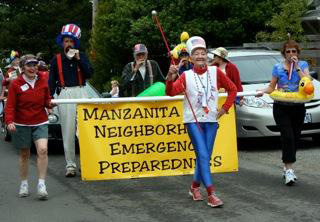
1. Nehalem Bay
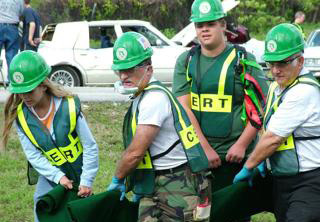
2. Rockaway Beach
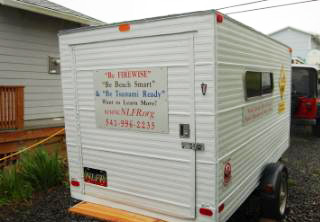
3. Southern Lincoln County
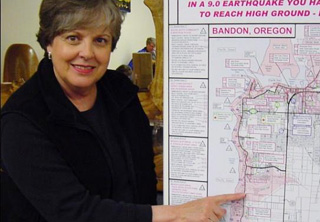
4. Bandon
Earthquake and Tsunami Community Disaster Cache Planning Guide
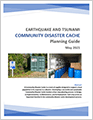 Read more about Earthquake and Tsunami Community Disaster Cache Planning Guide
From Oregon OEM and DOGAMI. A Community Disaster Cache is a stock of supplies designed to support a local population in its response to a disaster. Disaster caches take many forms and can be designed to accomplish different purposes. Along the Pacific Northwest (PNW) coast, numerous groups have developed disaster caches in various forms and have lessons to share. The goal of this Planning Guide is to distill such information to assist communities as they prepare for the next great earthquake and tsunami that will strike the PNW coast of Oregon and Washington. This Guide provides a four-step planning process: 1) Design, 2) Implementation, 3) Maintenance, and 4) Deployment, as well as case studies, strategies, templates, and sample budgets and operations plans.
FEMA Community Rating System Fact Sheet
Tsunami Preparedness & the Community Rating System (PDF)
Tsunami Evacuation Drill Guidebook: How to Plan a Community-Wide Tsunami Evacuation Drill
Read more about Tsunami Evacuation Drill Guidebook: How to Plan a Community-Wide Tsunami Evacuation Drill
This guidebook is intended to help communities along the coast plan and implement community-wide tsunami evacuation drills. Whether your community is planning its first walk-out drill or preparing for more complex evacuation exercises, the following pages offer guidance and recommendations based on best practices and the experience of coastal communities and emergency management professionals.
- Oregon Office of Emergency Management
"Beat the Wave" maps
Read more about "Beat the Wave" maps This ongoing series of maps shows the same green safety areas as on DOGAMI's tsunami evacuation maps, with the addition of arrows that indicate the most efficient routes.
Up and Out: Oregon Tsunami Wayfinding Research Project
Tsunami readiness consists of preparation, evacuation, and response. Preparation can be made now through increased awareness and education. Evacuation is the time when individual and community preparation is put into operation and where survivability will be decided in a matter of minutes. Evacuation success depends on how prepared individuals and communities are and is guided by ongoing public outreach including the clarity of routes, signs, and symbols that help people evacuate as quickly as possible. In these reports, through a partnership between Oregon Emergency Management (OEM) and the Portland Urban Architecture Research Laboratory (PUARL), innovative wayfinding schemes are examined to help coastal communities build community resilience before, during, and after a catastrophic tsunami event.
South Clatsop County Resilience Guide - Guidelines for Achieving Community Resilience, January 2015
Read more about South Clatsop County Resilience Guide - Guidelines for Achieving Community Resilience
The South Clatsop County Resilience Guide, prepared by the Oregon Partnership for Disaster Resilience, provides information about community resilience and a structured approach that can be used by communities to improve resilience to natural hazards. The guidelines include resilience assessments and goals. Although the guidelines were developed in partnership with north coast communities, they are a good source of information for use by any community considering planning for community resilience.
Preparing for a Cascadia Subduction Zone Tsunami: A Land Use Guide for Oregon Coastal Communities, January 2014
Read more about Preparing for a Cascadia Subduction Zone Tsunami: A Land Use Guide for Oregon Coastal Communities
The Land Use Guide, prepared by the Oregon Department of Land Conservation and Development (DLCD), provides coastal communities examples of comprehensive plan language and development code provisions that can serve to help communities reduce their risk to tsunami hazards. These examples are intended to provide general guidance allowing communities to tailor land use policies and regulations appropriate to their individual circumstances.
National First Responder Training
Follow this link to access federal first responder training resources.In collaboration with the Department of Homeland Security (DHS), Federal Emergency Management Agency (FEMA), and the National Preparedness Directorate (NPD), the National Training and Education Division (NTED) serves the nation's first responder community.
NTED provides first responders with high-quality training that enhances their skills for preparing for, preventing, protecting, responding to, and recovering from manmade and natural catastrophic events. NTED hosts the following services:
- More than 285 courses to help first responders build critical skills
- Support for state, local, Tribal, and territorial (SLTT) entities in 19 professional disciplines
- Various course levels instructing SLTT and the broader community in awareness, performance, management, and planning
- Multiple course delivery methods: instructor-led, virtual, train-the-trainer, web-based, and conferences and seminars
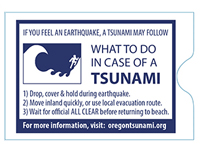 Oregon Coast Visitor Tsunami Awareness projectRead more about Oregon Coast Visitor Tsunami Awareness project
Funded by the National Tsunami Hazard Mitigation Program (NTHMP) and hosted on the Oregon OEM site, the the Oregon Coast Visitor Tsunami Awareness project exists to improve the visitor?s awareness of the tsunami hazards and to support the hospitality industry on the Oregon coast in becoming more prepared for tsunami events.