
40 years of plutonium production at Hanford created large amounts of radioactive and chemically hazardous waste.
The most hazardous liquid wastes were pumped into underground storage tanks. The remainder - an estimated 440 billion gallons of contaminated liquid - was dumped into the soil in ponds, trenches, and ditches, and sometimes injected directly into the groundwater. Leaking storage tanks and unplanned spills added to the contaminated liquids in the soil. As a result, there is extensive contamination of groundwater beneath the Hanford site.
Some of the contaminated groundwater reaches
the Columbia River, causing localized contamination where groundwater plumes enter the river. Thankfully, there is minimal effect on water quality downriver. However, because the
Hanford Site is just 35 miles from the Oregon border, our focus is to ensure cleanup efforts are protective of the river.
Hanford's Groundwater
Groundwater is found underground in the cracks and spaces in soil. It is stored in, and typically moves slowly through, layers of soil, sand, and fractured rocks called aquifers. Aquifers contain large connected spaces that allow water to flow. The speed at which groundwater flows depends on the slope of the water table, the size of the spaces in the soil or rock, how well the spaces are connected, and the rate at which new water enters the aquifer.
Hanford's sub-surface is very complex. Ice-age floods repeatedly deposited layers of soil and rock, so the direction and speed of groundwater flow around Hanford can vary widely.
Hanford's central plateau, where 177 underground waste storage tanks are located, sits about 200 feet above the groundwater, roughly 7-12 miles from the Columbia River. The tanks in the central plateau hold most of the liquid waste. Groundwater from this area takes several years to reach the river. In other areas of Hanford, groundwater contaminants can reach the river in just weeks or months.
A Mix of Contaminants
Hanford's groundwater includes chemicals such as carbon tetrachloride, chromium, and nitrate. It also includes radioactive materials such as uranium, strontium 90, technetium 99, tritium, and iodine 129.
More than 70 square miles of groundwater is contaminated above regulatory standards. Of the contaminants, chromium, nitrate, uranium, technetium, tritium, and strontium have all reached the Columbia River. These materials can be harmful to people and the environment.
The Tri-Party Agreement, which sets milestones for Hanford cleanup actions, includes target dates and deadlines related to groundwater cleanup.
Treatment Methods
Hanford has operated groundwater pump-and-treat systems since 1994, and has greatly increased capacity since then. These systems pump contaminated groundwater out of the ground, and remove contaminants using different treatment processes. The cleaned water is then injected back into the ground.
Five pump-and-treat systems are operating at three of Hanford's reactor areas along the Columbia River. There is also a very large treatment facility in Hanford's central plateau. These pump-and-treat systems have greatly reduced the size and concentration of many of the groundwater plumes, and have reduced the amount of contaminants that are getting into the river.
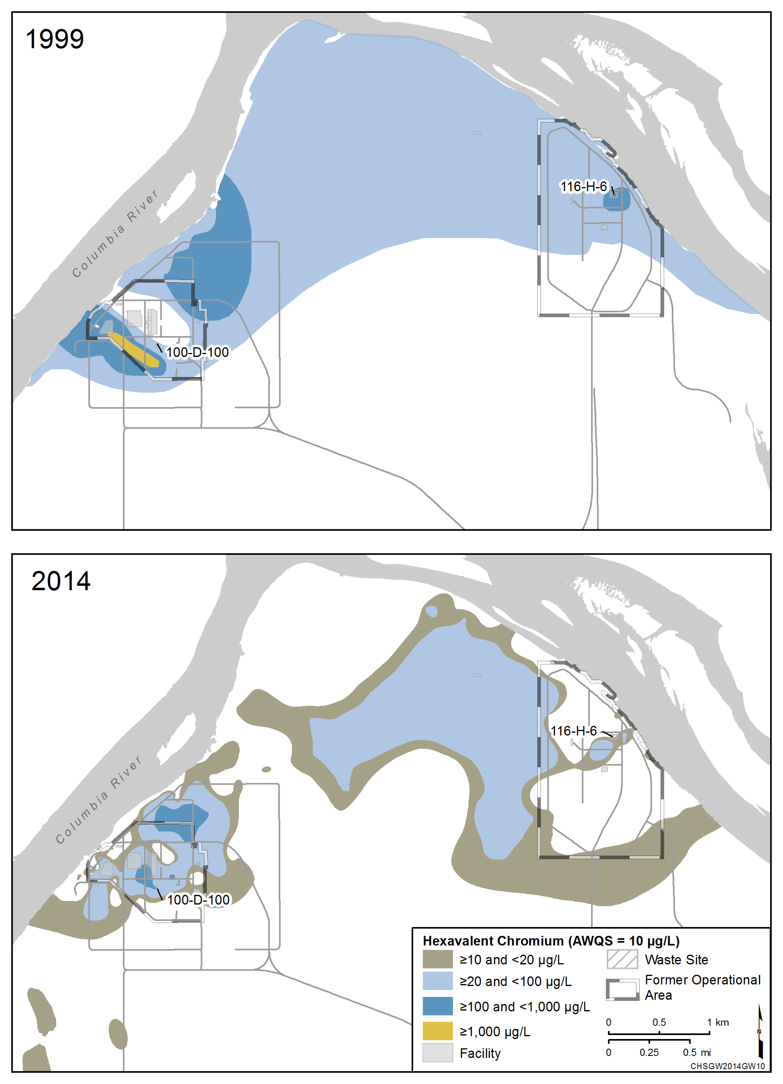 One particular contaminant of concern is hexavalent chromium, which was used extensively at Hanford's nine reactors to purify the water used to cool the reactors. Huge amounts of hexavalent chromium - which is toxic to fish - was leaked in each of the reactor areas, in close proximity to the Columbia River. The pump-and-treat systems in the reactor areas are designed primarily to remove the hexavalent chromium from the groundwater. Hanford workers also chased chromium contamination in the soil at two of the reactor areas, digging 85 feet deep to groundwater and removing tons of contaminated soil.
Between 1999 and 2014, the plumes of hexavalent chromium have shrunk thanks to various treatment efforts (click photo at right to enlarge).
Hanford has also experimented with a number of other technologies
Chemical Barriers
An underground chemical barrier was created near Hanford's D Reactor to convert hexavalent chromium into a less mobile and less toxic form as water flowed through the barrier. Part of the barrier is working to reduce the chromium hazards, but another part of the barrier has failed. Hanford is using a pump-and-treat system to augment the part of the barrier that isn't working.
A calcium phosphate barrier was formed near Hanford's N Reactor. As radioactive strontium in groundwater flows through the barrier, it binds to the calcium phosphate. This barrier shows promise, and Hanford plans to expand the barrier when more funds are available.
Biostimulation
Hanford also tried a process called biostimulation, using molasses and vegetable oil to feed tiny microorganisms (bacteria) in the soil, which consume oxygen in the groundwater. This alters the chemistry of soil and groundwater, changing chromium to a less mobile and less toxic form.