Oregon State Flag An official website of the State of Oregon »

Oregon Health Authority logo

About the Center for Health Statistics


An outline of the state of Oregon containing the text "6.5 million vital records"

Since 1903, the Center for Health Statistics (CHS) has kept permanent records of major life events for Oregonians such as births, deaths, marriages, divorces, registered domestic partnerships, and more. These are known as vital records.
CHS is responsible for:

A group of five simple icons: a school bus, an ID card, a will, a person holding a baby, and an outline of the state of Oregon
Accomplishing this takes a team of highly trained staff at CHS, as well as the partnership of those who collect the data such as birth facility staff, medical professionals, county clerks, courts, and funeral directors.


Why Are Vital Records Important?

Personal Use:

Vital records are the primary documents used to establish a person's identity, legal relationships, and the facts of their birth, life, and death. Without these records Oregonians cannot complete the essential things needed to conduct their lives.
Birth Certificates are needed to:
  • Get a Social Security card

  • Enroll a child in school or sport
  • Apply for a job
  • Get a driver's license or passport
  • Apply for government benefit

Death Certificates are needed to:
  • Settle the affairs of a loved one (by providing proof of death)
  • Submit insurance claims
  • File legal paperwork for wills
  • Transfer property or bank accounts
  • Submit to Social Security Administration

Data for Health Research:

Vital records data is made anonymous and collected into statistics that are foundational for research and to help government agencies and local communities understand the health of their population and how it can be improved. Health disparities can be examined by race, ethnicity, marital status, gender, and education.
Government Programs Rely on Vital Records Information:
Vital records data is necessary for the operation of many public health programs. This includes programs that help infants get hearing screenings, improve maternal health, and connect families to resources in their community.
Government programs also use vital records data to serve Oregonians more efficiently. Examples include Paid Leave Oregon, Social Security, Medicaid, Division of Child Support, and Child Welfare.

    ​Registering Records


    When a birth, death, marriage, or other vital event happens it's important that the record is registered quickly so that a certificate can be used for establishing insurance, changing names on identification, or resolving finances.


    Vital records information is provided to CHS by medical professionals, county clerks, courts, and funeral directors. Registration staff then follow up to make sure that records are complete, accurate, and meet state and federal standards. They enter hand-written data into the electronic vital records system and link records to prevent fraud.


    Changing Records


    Changes to vital records, also known as amendments, affect legal rights and responsibilities and can alter a person's identity. Each change is reviewed by a specialist who makes sure that complex legal requirements are met to prevent fraudulent changes. This can include reviewing court orders, sworn statements, and original evidence documents. 


    Requirements vary based on many factors such as the age of the record and what information is being changed. Each change is documented and if there is a physical record it must be altered. Some examples of changes include adoptions, adding a parent to a record, changing a person's name or sex, and correcting errors and changing medical/cause of death information on death records.

    ​​

    ​Issuing Certificates


    CHS staff issue an average of 540 vital record certificates each day. We provide several options to order such as in-person, by mail, and online or by phone through our authorized vendor VitalChek. This allows Oregonians to choose the option that works best for them based on how quickly they need the certificate, the price of services, and what format is most convenient to them.​


    Vital records in Oregon are confidential, and access​ to them is limited to those who have an eligible relationship to the person who is the subject of the record. Staff review each order to make sure the applicant has proven their identity and eligible relationship. This is critical to prevent fraud, identity theft, and unauthorized disclosure of confidential information which includes Social Security numbers and protected health information.​​​


    Description

    Statistics and Data


    CHS staff continuously check for missing, incomplete, or inconsistent​ data and follow up with data providers to resolve issues and increase the overall quality of our vital records data. they also provide expertise to organizations that use vital records data to make sure they understand the strengths and limitations of the information. Staff ​review each request for data thoroughly so that data is provided only to those who have an authorized, legitimate need and who have signed an agreement to maintain confidentiality. They publish quarterly and annual statistical reports which are available as dynamic dashboards.

    Vital records statistics are foundational to understanding the health of a population. Examples of data examined include mothers' access to prenatal care, low birth weight babies, life expectancy, leading causes of death, emerging infections, and information about vulnerable populations such as those who are houseless.


    The following dashboards allow the user to view data interactively based on various selections such as year, county, age range, and race and ethnicity.


    Birth and Pregnancy Dashboards

    ​Death Data Dashboards 


    Description Supporting ​our Partners


    An efficient vital records system requires many groups working together – hospitals, birthing centers, funeral directors, doctors, medical examiners, courts, county clerks, county vital records offices, and more.


    CHS Staff support our partners by:

    • ​Providing training

    • Publishing monthly newsletters

    • Conducting site visits and compliance reviews

    • Hosting regular workgroups​

    • Creating and maintaining all CHS web pages, forms, manuals, and resources


    ​Administrating County Vital Records


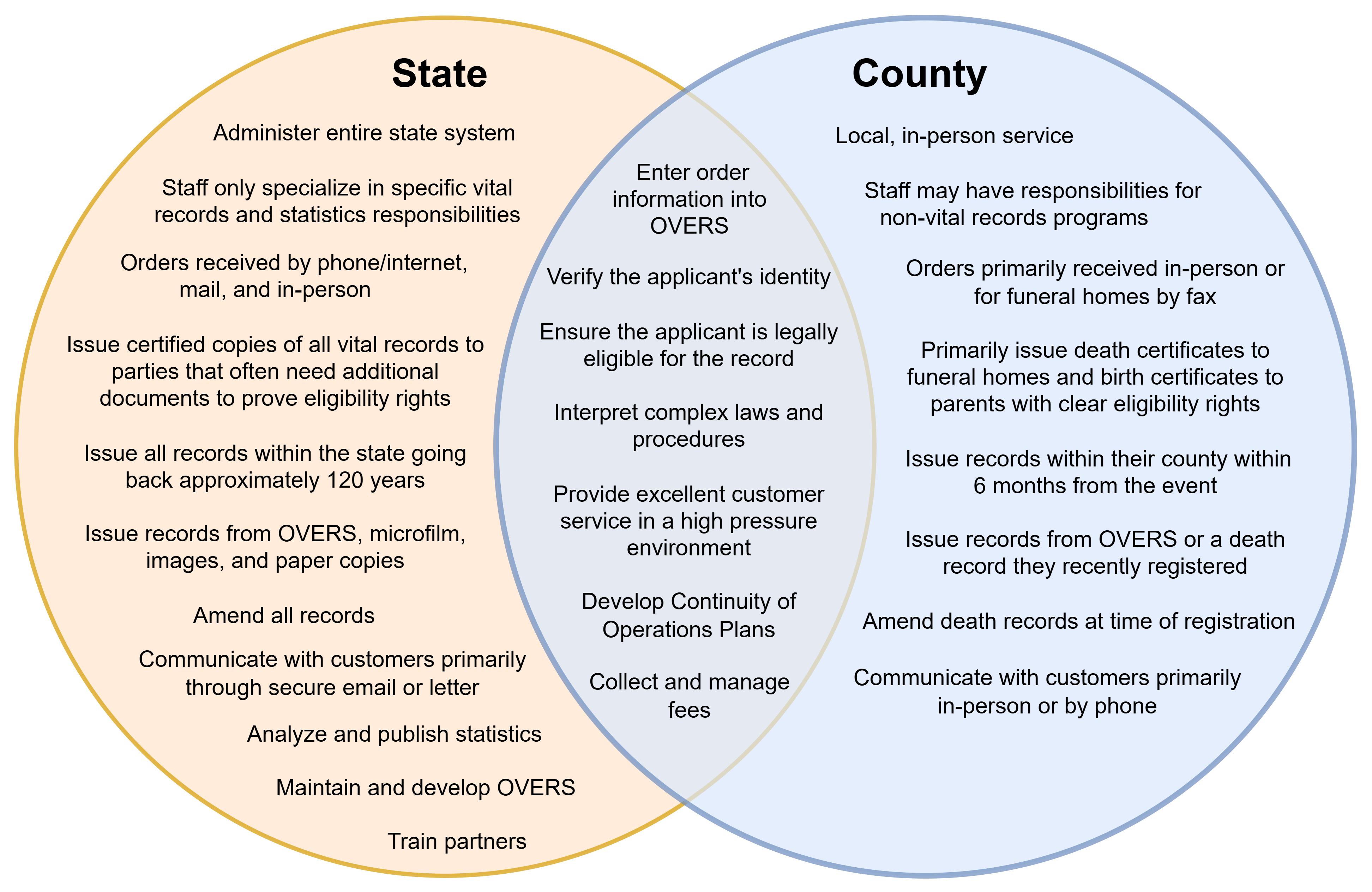
    ​​County vital records offices provide a way for their community to access vital records services locally. Staff can issue birth and death certificates for events that occurred in their county for six months from when the birth or death took place. County offices keep the fees they collect for these services.


    County staff are granted authority by the State Registrar to do their work. CHS provides guidance, training, and expertise to county vital records staff. Every three years, each county vital records office is reviewed to make sure they are following Oregon law related to vital records​.


    Description Maintaining and Supporting the Oregon Vital Events Registration System (OVERS)


    Oregon has an electronic vital records system known as the Oregon Vital Events Registration System (OVERS). This web-based system is used for all vital records operations in the state – from the creation of vital records, changes to those records, to the production of certified copies and statistical reporting. Since 2008, all birth records and most death records are registered directly in OVERS. Most older records that are stored on paper or microfilm have had key information added to OVERS so that basic facts about nearly every event can be accessed electronically. 


    CHS Staff support nearly 12,000 OVERS users across the state by:

    • Answering questions that come into the OVERS Help Desk Monday through Friday, 8:00 a.m. – 5:00 p.m.

    • Managing user enrollment and access

    • Testing and implementing software updates

    • Working with the software vendor to improve the system​


    Description

    ​Funding


    The Center for Health Statistics does not receive any general taxpayer funding.


    • The majority of our funding comes from fees for vital records certificates. ​​​​​​​Vital records fees are set in law and were last updated in 2018.

    • Most of our remaining funds come from government agencies who use vital records for their programs.

    • Ten percent of our funds come from federal grants.


    Funding is used for staff who:​​


    Funding also maintains the electronic vital records system.​


    Fees collected by county vital records offi​ces:


    Vital records are also issued by county vital records offices​​ for the first six months from the date a birth or death takes place. County offices keep the fees they collect for these certificates.

A button with a simple icon of a document with the caption "Learn more about the life cycle of a vital record"


A large flowchart titled "Life Cycle of a Vital Record: Overview"


A button with a simple icon of a bullseye and the caption "Explore the strategic plan of CHS"

A chart titled "Center for Health Statistics Strategic Plan 2023 to 2028"


The motto of CHS: "We are vital and we count".