Guideline 11: Substance Use Screening
Purpose
Evidence directly links prenatal exposure to drugs, alcohol, and tobacco with negative impacts on the developing fetus, the pregnancy outcome and child growth and development. The effects of alcohol, tobacco, and opiate use are fairly well described, and clients are strongly discouraged from using these substances.
However, for many other substances, an association between drug use and adverse pregnancy outcomes is complex and less well-described. For instance, cannabis is composed of many different chemicals and can be mixed with other drugs; women may use multiple substances and may also exhibit other risky behaviors; and, it is difficult to effectively measure and monitor substance use.
Because we often cannot be certain what outcomes are related to which substances and behaviors, we are not able to determine the dose relationship; therefore, women are discouraged from using any quantity of anything not prescribed by the prenatal care provider.
Substance use in any parenting person, even outside of the prenatal period, may increase risk of developmental delays, child abuse or neglect and magnify the impacts of Social Drivers of Health, including difficulty providing necessary household resources. It is important to provide caregiver screening during the perinatal period and beyond.
Process
Assessment, Diagnosis and Planning:
- As early as possible after establishing rapport, screen for substance use according to program guidelines.
- Use a validated tool to screen all clients for use of alcohol, drugs including prescription drugs, and tobacco. Examples of validated tools are below, but this is not an exhaustive list. Note: Nurse-Family Partnership uses a program-specific tool.
- Alcohol: SBIRT, AUDIT, Abbreviated AUDIT-C, or a single question such as “How many times in the past year have you had 5 (for men) or 4 (for women) or more drinks in a day?"; others screening tools include the CAGE-AID, CAGE, T-ACE, and ASI.
- Alcohol and Drugs: 4 P's Plus; Screening to Brief Interventions (S2BI); CRAFT (age 26 or younger); Brief Screener for Alcohol, Tobacco and Drugs (BSTAD); and NIDA Quick Screen.
- Assess cognitive status, especially changes in mood, that might be a sign of preexisting or coexisting conditions such as multi-substance use, depression, or mental health concerns. Just eliminating one substance may not solve the problem.
- Document any screening results, and communicate to pregnancy care provider if not within normal limits. Determine need for further assessment, and ensure access to care, by pregnancy care provider.
- Determine with provider need for screening of STIs/HIV, hepatitis B and C, and tuberculosis, especially if there are signs of co-existing conditions.
- If the screening results suggest substance use, share concerns with the client and develop a plan of care to:
- Continue to establish a supportive relationship.
- Educate the client on effects of substance use during pregnancy: Ask the client to describe their understanding of the situation, link substance use to any signs or symptoms client has (there may be none), describe impact on the pregnancy and developing fetus and the importance of stopping, explain what could happen with continued use.
- Educate on possible treatment options such as pharmacotherapy and behavioral therapy like skill-building and problem-solving (medically supervised withdrawal is not recommended at this time due to association with high relapse rate).
- Plan interventions based on need (see below).
Interventions
- It is important to meet clients where they are. Determine client goals related to substance use and consider harm reduction strategies. Per the Harm Reduction Coalition, harm reduction incorporates a spectrum of strategies from safer use, to managed use to abstinence to meet drug users "where they are," addressing conditions of use along with the use itself.
- Depending upon the substance, the level of use, and the outcome of the communication with the prenatal or primary care provider, assist the client in accessing drug and/or alcohol cessation and/or rehabilitation supports. Treatment with methadone or buprenorphine may be recommended by physician, as patients treated with opioid antagonists demonstrate significant reduction in relapse rate compared to only behavioral treatment.
- Engage all clients in a conversation providing education, feedback and guidance on the potential harmful effects of substance use to themselves and their child(ren). Some clients may need more intensive motivational interviewing, or Brief Interventions conversation (see the MIECHV Substance use risk Profile – Pregnancy Scale tool or the NFP Visit-to-Visit Guidelines, as allowed by program area). Refer to the recovery dialect handout below to understand appropriate language to use in discussions about substance use.
- For clients using tobacco or liquid nicotine, implement the 5As framework for counseling (Ask, Advise, Assess, Assist, Arrange); provide education and refer as appropriate; continue to monitor and support the client in achieving cessation.
The CDC website has education resources for this purpose.
- Provide emotional support to clients who seek to decrease or stop substance use during pregnancy, as they may struggle with strong feelings related to exposing the fetus to potentially harmful substances.
- Opiates, alcohol, and nicotine can be passed to infants through breastmilk. Advise pregnant people of these risks and discourage breastfeeding people from using substances. The American College of Obstetricians and Gynecologists and the American Academy of Pediatrics supports breastfeeding by people who are prescribed opioids while enrolled in substance use treatment. Please review
The Academy of Breastfeeding Medicine,Protocol 21 on substance use and breastfeeding. Encourage clients that meet the following criteria to breastfeed:
- Engaged in substance treatment; plans to continue postpartum
- Abstinence 90 days prior to delivery demonstrated in outpatient setting
- Toxicology testing of urine negative at delivery
- Engaged in prenatal care and following recommendations
- Methadone or Buprenorphine -maintained (regardless of dose) and closely monitored by physician
- Reduce nicotine intake; do not smoke or vape around infant; understand
- impact of 3rd hand smoke.
- Wait 90-120 minutes after drinking alcohol to breastfeed whenever possible
- Cannabis use: reduce use; not enough data to support recommendation against breastfeeding, but urge caution. Infrequent use is L2 (safer) risk level; moderate use is L3 (moderate safe) risk level. Use Harm Reduction Counseling strategies similar to nicotine use to minimize exposure to smoke and to delay feedings at least 60 minutes after smoking cannabis to minimize exposure to THC and other cannabinoids.
- Oregon law does not consider substance use during pregnancy to be child abuse under child- welfare statutes, and there is not a requirement for health care professionals to report suspected prenatal drug use. Oregon's mandatory child abuse and neglect reporting law can be found
here. Subtance related statues include:
- Permitting a person under 18 years of age to enter or remain in or upon premises where methamphetamines are being manufactured.
- Unlawful exposure to a controlled substance, as defined in ORS 475.005 (Definitions for ORS 475.005 to 475.285 and 475.752 to 475.980), or to the unlawful manufacturing of a cannabinoid extract, as defined in ORS 475B.015, that subjects a child to a substantial risk of harm to the child's health or safety.
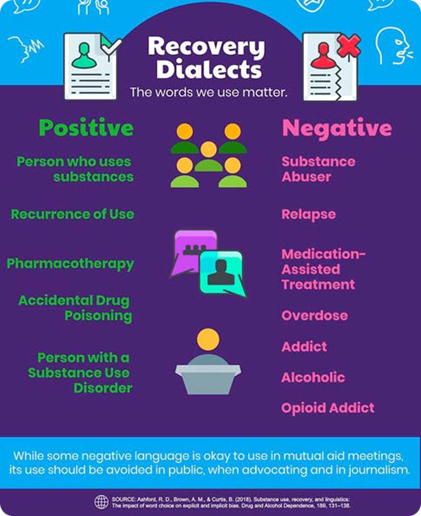
[Image description: This image shows on the left side positive language that should be used to discuss substance use versus the negative language that should not be used on the right side. Use "person who uses substances" instead of "substance abuser"; "recurrence of use" instead of "relapse"; "pharmacotherapy" instead of "medication-assisted treatment"; "accidental drug poisoning" instead of "overdose"; and "person with a substance use disorder" instead of "alcoholic", "addict", or "opioid addict"]
References
- Five Major Steps to Intervention (The "5 A's"). Content last reviewed December 2012. Agency for Healthcare Research and Quality, Rockville, MD.
https://www.ahrq.gov/prevention/guidelines/tobacco/5steps.html
- Assessing Alcohol Problems: A Guide for Clinicians and Researchers, 2d ed. NIH Pub. No. 03–3745. Washington, DC: U.S. Dept. of Health and Human Services, Public Health Service. Revised 2003.
- Chart of Evidence-Based Screening Tools for Adults and Adolescents.
https://nida.nih.gov/nidamed-medical-health-professionals/screening-tools-resources/chart-screening-tools, updated September 2017, accessed 12/27/2017.
- National Institute on Drug Abuse; National Institutes of Health; U.S. Department of Health and Human Services.
https://nida.nih.gov/research-topics/opioids#pregnancy
- Opioid use and opioid use disorder in pregnancy. Committee Opinion No. 711. American College of Obstetricians and Gynecologists. Obstet Gynecol 2017;130:e81–94
- Lipari, R.N. and Van Horn, S.L. Children living with parents who have a substance use disorder. The CBHSQ Report: August 24, 2017. Center for Behavioral Health Statistics and Quality, Substance Abuse and Mental Health Services Administration,
- Rockville, MD. Accessed 1_12_2021
https://www.samhsa.gov/data/sites/default/files/report_3223/ShortReport-3223.html
-
https://www.ahrq.gov/prevention/guidelines/tobacco/5steps.html
Feedback Form
Please let us know if you have suggestions, any links are broken, or if any information is outdated.