 Do you live in the Lower Umatilla Groundwater Basin Management Area (LUBGWMA) in Morrow or Umatilla County? You can find the answers to common questions and contact information for our partners below.
Frequently Asked Questions (FAQ)
If this your first test, we have multiple resources, like this brochure or this fact sheet, that explain more.
In 2023, the Oregon Health Authority (OHA), Oregon Department of Human Services (ODHS), and Morrow and Umatilla Public Health Departments began coordinating a program to help residents in your area get their well water tested with the support of local community-based organizations. Many private wells in the area have tested high for nitrate, so it's important to get your well water tested. Nitrate in drinking water above 10 milligrams per liter (mg/L) can harm your health and is especially dangerous for formula-fed babies.
If you have tested before, this is a follow up. The following information may be helpful to know: Yours is one of over 1,900 households that accepted the offer of free testing for nitrate and several other common well water contaminants. OHA and your local county health departments are now offering free retesting of wells to make sure water is safe, or that treatment systems are effective. This is important because levels of nitrate in groundwater can go up or down depending on weather and increasing nitrate contamination of the groundwater.
Wellhead photo by Umatilla County Public Health.
What is my water being tested for exactly?
While our main concern is high levels of nitrate, the
initial test will also look for these other contaminants:
-
Arsenic
-
Lead
-
Total coliforms (bacteria)
-
e. coli.
OHA also pays for 5 non-health related tests that can affect the performance of water treatment systems:
-
Hardness
-
Calcium
-
Iron
-
Magnesium
-
Manganese
You will receive all your results in a letter. If there are high levels of other contaminants present in your water, you will also be sent information about them.
Where are water samples collected?
The sample will be collected outside of your home, as close to the well as possible. It may be possible for you to self-sample. If you have a water treatment system installed, a plumber will collect a sample at your sink when filters are changed to ensure it is working properly.
What are the potential health impacts of drinking water with high nitrate levels?
Short-term, high levels of nitrate in drinking water can be dangerous for formula-fed babies and increase the risk of miscarriage for pregnant people. Long-term exposure may increase serious health risks for everyone, like thyroid issues or cancer. OHA has a one-pager in English and Spanish with more information about health impacts.
What activities are safe to do when my water has high levels of nitrate in it? Which are unsafe?
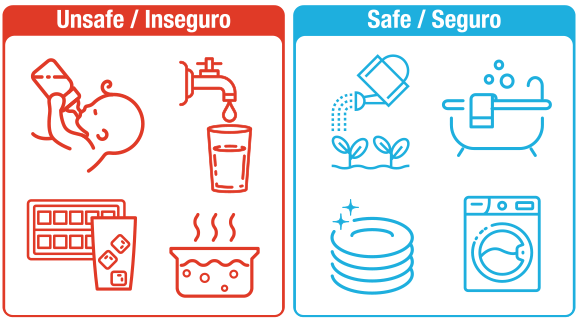
Examples of safe activities include bathing, doing dishes and laundry, and garden irrigation – as long as the water is not being swallowed.
Examples of unsafe activities include consuming the water in any form, including using it for baby formula. Do not boil water with high levels of nitrate. This does not make it safe for drinking.
I have animals who drink from the same well as I do. Do I need to worry about their health too?
For pets: There is not much research about safe amounts of nitrate for companion pets. The safest thing to do is offer your pet(s) treated or bottled water, especially tiny pets like guinea pigs, hamsters, and chinchillas. Please talk to your veterinarian if you have concerns about your pet's health.
For livestock: Talk to your veterinarian if you have questions about nitrate and livestock (horses, goats, cattle, etc.). A licensed veterinarian is the best source of information on your animals' health.
Need to find a veterinarian? The Oregon Veterinary Medical Association has an
online directory.
I received my test results. What additional resources am I eligible for?
The resources offered to households are based on the level of nitrate in your water:
-
0-4.99 mg/L: OHA is offering a free yearly laboratory test though self-sampling. Collect a sample any time between July-September.
-
5-9.99 mg/L: Your local county health department will collect a sample of your water quarterly (around every 3 months) and deliver it to a laboratory for testing. They will do this until they have completed one year of testing in every season of the year. This is to make sure the nitrate levels in your household's well water do not go over 10 mg/L at any point. After the first year, quarterly testing will continue unless the nitrate level in your water increases to 10 mg/L or above. You will be able to collect your own well water sample.
-
10-24.99 mg/L: If your household is in this category, you qualify for free drinking water delivery and will be offered a free reverse osmosis (RO) system to help reduce the nitrate in your drinking water. If a treatment system has already been provided, the plumbing company who installed it will test the water when they carry out maintenance tasks. This is to ensure your RO system is working and that your water is safe. Your household can also receive an annual laboratory test of your untreated well water. Collect a sample any time between July-September.
-
25 mg/L or more: Your household should be receiving free drinking water delivery that meets your needs. OHA is also offering households with nitrate levels above 25 mg/L the option of a free annual laboratory test though self-sampling. Collect a sample any time between July-September.
What can I expect during the retesting period? How often will this happen?
The frequency of retesting will be based on the level of nitrate in each household's well water. If your water has been tested multiple times, it will be based on your
highest result:
0-4.99 mg/L
| Once a year (test any time from July-September)
|
|
5-9.99 mg/L | Quarterly (every 3 months)
|
|
10-24.99 mg/L |
Once a year (test any time from July-September)
|
|
25 mg/L or more |
Once a year (test any time from July-September)
|
Households with the lowest (0-4.99 mg/L) and highest (25 mg/L or more) results: OHA offers a free annual laboratory test of your well water from July-September. You can take the sample yourself*. You will receive information on where to pick up your self-sample kit, instructions for collecting the water sample, and the locations of collection sites for sample drop off.
*If you require assistance collecting a water sample, staff with the local county health department can schedule an appointment. They will collect the water sample and drop it off at the drop off sample collection site.
Households with results between 5-9.99 mg/L: For the first year, your local county health department will contact you quarterly (every 3 months) to schedule an appointment. Their staff will collect a new water sample and deliver it to a laboratory for testing. They will do this until they have completed 1 year of testing in every season of the year - this is to make sure the nitrate levels in your well water do not go over 10 mg/L at any point. After this, you can continue to test your well for free each quarter (self-sample) unless nitrate levels increase to 10 mg/L or more.
Households with results between 10-24.99 mg/L: Testing of treated drinking water will be done directly by the licensed plumbers who either have or will install your treatment system. They will take a sample of your water after installation and whenever filters are changed (usually once a year). This is to make sure your system is working as it should be.
OHA also offers a free annual laboratory test of your untreated well water from July-September. You can collect the sample yourself*. You will receive information on where to pick up your self-sample kit, instructions for collecting the water sample, and the locations of collection sites for sample drop off.
*If you require assistance collecting a water sample, staff with the local county health department can schedule an appointment. They will collect the water sample and drop it off at the drop off sample collection site.
What treatment systems are being offered? Why?
Reverse osmosis (RO) systems are water treatment systems that can help make drinking water safer. If nitrate levels in your well are between 10 and 24.99 milligrams per liter (mg/L), OHA can install a free RO system in your home. These systems are certified to remove nitrate up to a certain amount. If nitrate levels are higher than 25 mg/L, a RO system will not be effective enough to provide safe drinking water.
The systems that OHA installs are point-of-use systems. This means that they are installed at one place in the home (like a kitchen faucet). We are not able to install whole-house systems. RO systems create extra wastewater, which can put stress on older septic systems. A damaged septic system can contaminate drinking water wells along with nearby rivers, streams, or lakes. A point-of-use system is safer than a whole-house (also called point-of-entry) system because it creates less wastewater.
What is the process for retesting after the installation of a RO system?
Plumbers provide testing after installation, offer maintenance services like filter changes, and collect samples during yearly maintenance for retesting. When samples are taken, they will be delivered to the lab by the plumbing company. Call the plumber to have your filter changed when you notice the stream of your water decreasing (Kinetico system) or the indicator light on your faucet changing to red (Culligan system).
A plumber took a sample of my water but I have not heard back about the results. Should I be worried?
No. The plumber will take a sample to make sure your system is working correctly - they will only call you to report the results if there are concerns. If you want to know your results, you can follow up with them using the contact information provided by the company.
Why hasn't an in-home water treatment system been offered to me when someone else in my community is getting one installed?
The resources offered to each household are based on the level of nitrate in your drinking water. OHA is providing households with test results between 10-24.99 mg/L with free bottled water and, where effective, in-home RO systems. These water treatment systems are certified to remove nitrate up to 25 mg/L. If your test results show nitrate above that level, your household will need to use bottled water until long-term solutions are in place.
If you don't receive an additional letter within 30 days of your nitrate test, please contact the Domestic Well Safety Program (Domestic.Wells@odhsoha.oregon.gov or 541-952-9254).
You can also reach out to your county public health department - they will receive a copy of your results and can share them with you:
Morrow County Public Health: (541) 481-4200 ext. 5403
Umatilla County Public Health: 541-278-6394
Wellhead photo by Umatilla County Public Health.
Do businesses, non-profits, or facilities qualify for free services?
Unfortunately, we are only able to offer testing, water delivery, or treatment system installation to eligible households with private wells. Businesses and facilities should reach out to OHA's Drinking Water Services for support by emailing info.drinkingwater@odhsoha.oregon.gov or calling 971-673-0405.
I do not live in the LUBGWMA, but I am concerned about my well. What resources are available?
Free testing services are unfortunately not available to households outside of the LUBGWMA. OHA has an toolkit for well users that you may find helpful. You are also welcome to contact the Domestic Well Safety Program (Domestic.Wells@odhsoha.oregon.gov or 541-952-9254) with any questions.