Guideline 7: Social Drivers of Health Screening
Purpose
Social drivers of health (SDOH) (Medicare, 2024) , also known as social drivers of health, are nonmedical factors that have a profound impact on the physical and mental health of children and adults. The CDC and World Health organization define these as, “the conditions in which people are born, grow, work, live, and age. These forces and systems include a wide set of forces and systems that shape daily life such as economic policies and systems, development agendas, social norms, social policies, and political systems" (CDC, 2024) . SDOH exist on the community level and are generally grouped into 5 categories: healthcare access and quality, education access and quality, social and community context, economic stability, and neighborhood and built environment (CDC, 2024) . SDOH strongly influence a community's health and life expectancy and also contribute to health disparities, affecting people before, during, and after they interact with a health care system (Medicare, 2024) .
Further, we know there is a strong correlation between SDOH and adverse childhood experiences (ACEs). The research on ACEs and early brain development has demonstrated that physical and psychosocial stressors are “toxic" to the developing brain and metabolic systems of the young child, increasing risk of chronic disease, behavioral health conditions and developmental delay. While ACEs can affect and happen to all individuals, some communities are disproportionately exposed to ACES due to SDOH. The state of Minnesota has declared that “Structural racism is a SDOH, and it shapes all the SDOH factors. Structural racism is when decisions are made on a system-wide level that benefit white people and create chronic adverse outcomes for Black, Indigenous and other people of color (BIPOC). Poverty, ACEs, intergenerational trauma, and intergenerational substance use are all SDOH influenced by structural racism. The health inequities experienced by BIPOC communities, as a result of SDOH and structural racism, have resulted in disparities in ACEs between different racial groups." (Health, 2024) . “The Pair of ACEs" (see Figure below) is used to further represent the interconnectedness between ACEs and what is referred to as Adverse Community Environments.
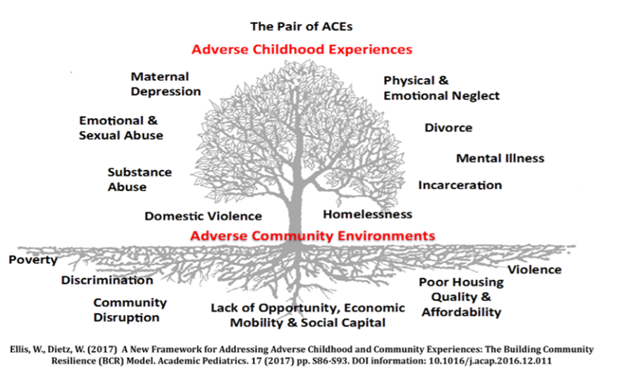
[Image description: The "Pair of ACEs Tree" image represents the connection between adverse childhood experiences (ACEs) and adverse community environments (ACEs). The tree is planted in poor soil, symbolizing the negative effects of systemic inequities that prevent communities from thriving. The tree's leaves represent the symptoms of ACEs, such as food insecurity or housing instability. These leaves are withered due to the lack of necessary nutrients from the soil, which reflects the compounded issues like violence, discrimination, and limited opportunities in the community. The tree illustrates how these conditions create a vicious cycle, hindering growth and resilience]
As we learn more about ACEs, we have also learned about Positive Childhood Experiences (PCEs). Research shows that PCEs can help mitigate the long-term harmful health effects of ACEs. Home visitors are uniquely positioned to address these challenges with individuals by assessing SDOH. By directly focusing on these needs, home visitors can buffer the impact of stressors on children through promotion of strong, responsive, nurturing relationships with caring adults.