For adults (18 and older)
If you live
in your own home or
with family, you have two options
A
services coordinator can provide case management services through your local community development disabilities program (CDDP).
To learn more about these services,
contact the CDDP in your area.
A
personal agent can provide case management services through a support services brokerage.
To learn more about these services,
contact a brokerage in your area.
If you live in an
adult foster home or
24-hour residential group home
A
services coordinator will provide case management services through your local community developmental disabilities program (CDDP).
To learn more about these services,
contact the CDDP in your area.
Oregon Needs Assessment (ONA)
What is the ONA?
To get certain I/DD in-home supports, the federal government requires that people have a needs assessment.
In Oregon, we use the Oregon Needs Assessment — also called the ONA — to learn about your needs, any risks, and the level of care you need.
We use the ONA to decide which
service group you will be in, based on your support needs. Your service group has a range of hours you can use for in-home supports each month. People in the same service group have similar needs.
Who gets an ONA?
People who use certain I/DD in-home supports will have an ONA.
Not everyone needs an ONA.
Your services coordinator or personal agent will tell you if you need an ONA.
When will I have an ONA?
If you need an ONA:
- You will have it when you first start case management services.
- After that, you will usually have an ONA once a year.
- Your services coordinator or personal agent will tell you if you need to do an ONA more than once a year.
Note: If you get foster care services, you will also have a Support Needs Assessment Profile (SNAP). This does not change what services you get. It helps figure out how much your providers are paid.
Who does my ONA?
An ONA assessor, your services coordinator, or your personal agent will do your ONA.
You can invite other people to help answer questions during your ONA.
What questions do they ask?
During your ONA, we will ask about different parts of your life including:
- How you like to communicate
- Things you do every day
- Things you do to take care of your home and money
- Your behavior supports
- Your safety and medical needs
Can I get a copy of my ONA?
Yes. Each time you have an ONA, the person who does your assessment has 14 days to give you a copy.
You can also ask for a copy at any time.
What if I have questions or don't think the results reflect my needs?
Talk to your services coordinator, personal agent, or ONA assessor about your concerns.
You can also
file a complaint. If you want, your services coordinator, personal agent, or ONA assessor can help you fill out the complaint.
What is a service group?
A service group determines a range of hours you can use each month for the following in-home services:
- Hourly attendant care
- Hourly skills training
- Day support activities for adults
There are 14 service groups. Each group includes people of similar ages and support needs.
Service groups do not determine the
type of services you get.
You chose your services when you make your
Individual Support Plan.
Learn about your service group
Find the handbook for your service group below. If you get in-home supports, learn more using the chart below.
Learn about your service group in these handbooks. Find your group below.
Infant / Toddler age 0 to 3 support needs
Infant/Toddler
Children age 4 to 11 support needs
Child 3, Very Low to Low
Child 4, Moderate
Child 5, High to Very High
Adolescents age 12 to 17 support needs
Adolescent 1, Very Low
Adolescent 2, Low
Adolescent 3, Moderate
Adolescent 4, High
Adolescent 5, Very High
Adult age 18+ support needs
Adult 1, Very Low
Adult 2, Low
Adult 3, Moderate
Adult 4, High
Adult 5, Very High
This chart shows the range of in-home hours you have for your planning.
EnglishEspañolاللغة العربيةРусский简体中文SoomaaliTiếng Việt
- Find your age group on the chart.
- Then in your age group, find your service group and the range of hours for your group.
- If you don't know your service group, ask your services coordinator or personal agent.
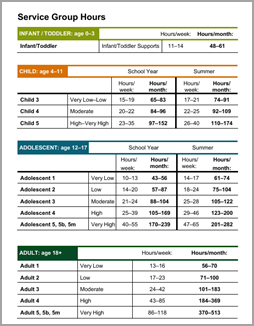
Most people can meet their needs with the hours in their service group. Your services coordinator/personal agent will help you plan how to meet your needs and live the life you want with the hours you have in your service group.
Some people will need more hours than are in their service group.
If you can’t meet your needs with the hours in your service group:
- You can ask for your Oregon Needs Assessment (ONA) to be reviewed.
- If your ONA is correct and you still can't meet your needs with the hours, you can ask for an exception.
- After you ask for an exception, your services coordinator or personal agent has 14 days to complete your request.
- You will get a decision within 45 days from when your exception is received.
-
Learn more about asking for an exception.
There are three main reasons you can get an exception.
1. Intermittent needs
You have a need that happens throughout the day. You need a lot of help to meet this need. Support for this need cannot be scheduled. You cannot know when you will need support. You cannot meet your needs with the number of hours in your service group.
If this need is not met when it happens, you would probably get hurt or sick.
If you need a lot of help with one of these things, you might have intermittent needs:
- Using the bathroom or elimination support
- Getting around your home safely
- Getting out of your bed, out of chairs, or on and off the toilet safely
- Seizures that happen frequently or are dangerous
- Using insulin for diabetes on a slideing scale
- Suctioning to help you breath or stay healthy
- Using a ventilator or CPAP/BiPAP
- Have a challenging behavior that would hurt you or others
2. Need takes longer than usual
You have a need that takes longer to support than other people who have similar needs. You cannot get all of your needs met. The extra time to meet that need is more than the number of hours in your service group. If it takes a lot of time to meet these needs, you might have a need that takes longer than usual.
- Using the bathroom or elimination support
- Getting around your home and community
- Getting out of your bed, out of chairs, or on and off the toilet safely
- Getting dressed
- Taking baths or showers
- Completing grooming like shaving, brushing teeth, and styling hair
- Eating meals and snacks
- A health need that takes a lot of time
3. Social isolation
You are not able to go out into the community because your needs use all of the hours. You need help when you go out in the community. You cannot go into the community at least 20 hours a week to do shopping, errands and other activities.
When you ask for an exception:
- Your services coordinator or personal agent has 14 days to complete your request after you ask for an exception.
- ODDS will send you a postal letter with your decision. We have 45 days to send you this letter from when your services coordinator or personal agent submits your request to us.
- If we need more information to decide about your exceptions request, we will send you letter called a Notification of Pending Status.
- If we deny your request, we will send you a letter called a Notification of Planned Action.
Learn more about asking for an exception.
If you have questions about your in-home hours:
- Talk to your services coordinator or personal agent. They are there to support you.
- Email ODDS.
Resources
The Self-Advocate Guide to Intellectual and Developmental Disabilities (I/DD) Services
This workbook takes you through process of planning I/DD services.
Individual Support Plan
This is the plan you make for your services.
In-home supports
This page includes resources to help you plan.
Request an exception
You can ask for an exception if you can't meet your needs with the hours in your service group.
Reports used to develop the ONA
We used these reports to help us to develop the ONA.