Asian
OHA acknowledges that people of Asian and Native Hawaiian and Pacific Islander origins and descent represent unique groups of peoples with rich cultural and geographic etiologic backgrounds. Our goal moving forward is to provide information separately for each of these communities. Please check back soon for our progress!
According to the CDC, although Asian and Native Hawaiian and Pacific Islander people currently comprise about 5% of the U.S. population, they represent more than 50% of persons chronically infected with hepatitis B (HBV). Nearly 70% of Asian and Native Hawaiian and Pacific Islander people living in the United States were born or have parents who were born in countries where HBV is endemic. They were infected as infants or young children. Ninety percent of infants exposed to HBV will develop chronic HBV unless they receive vaccination shortly after delivery.
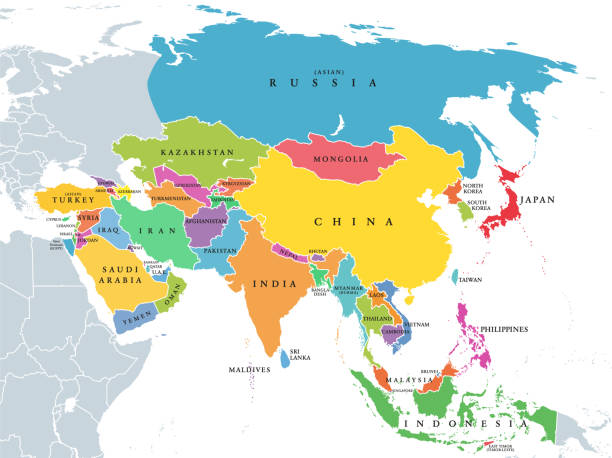

The highest rates of chronic HBV infection in the world are found in Africa and Eastern and Southeastern Asia. Five countries accounted for 47% of the cases: Vietnam (19%), China (17%), Philippines (5%), South Korea (3%) and Taiwan (3%).
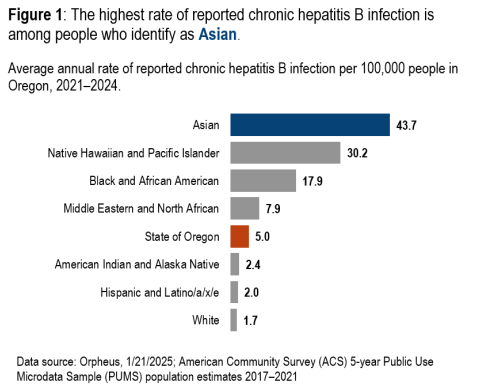
In Oregon, detailed data on Asian, Native Hawaiian, and other Pacific Islander subgroups have not been collected until recently. This visual shows that people of any Asian descent have a higher annual rate of chronic hepatitis B infection than other groups in the years 2021-2024.
More detailed data show distinct differences in hepatitis B prevalence among Asian subgroups in Oregon. While these differences are striking, we need to remember that hepatitis B, is an equal opportunity infection, and can infect anyone at birth if their mother has chronic HBV. This reality highlights the need to follow trusted national guidance on
viral hepatitis B screening of all pregnant people during each and every pregnancy and to provide
hepatitis B vaccine at birth.
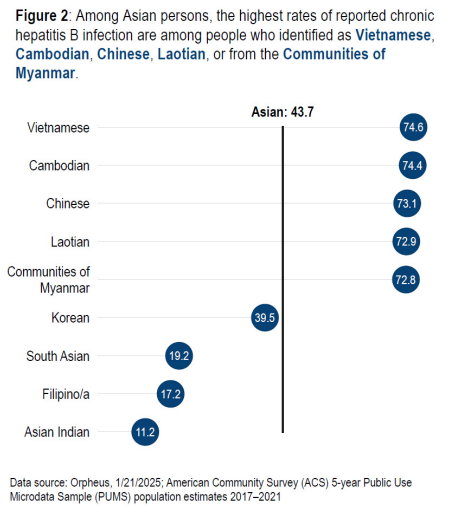
Between 2017 – 2021 among Asian persons, the highest rates of reported chronic hepatitis B infection were among people who identified as Vietnamese, Cambodian, Chinese, Laotian, or from the Communities of Myanmar, respectively. Of note, is that between 2009 – 2013, more than half (52%) of chronic HBV laboratory reports in Oregon among Asian and Native Hawaiian and Pacific Islander people occurred in females, while only 32% of cases in all other races combined occurred in females during this same time period.
Cancer Risk
The risk of HBV-associated hepatocellular carcinoma (HCC) in Oregon is 32 times higher in Asian and Native Hawaiian and Pacific Islander communities compared to white persons. Sixty percent of cases of HCC occurred in Asian and Pacific Islander people between 2008–2013. Oregon mortality data show that Asian people disproportionately die from chronic HBV and
liver cancer. Twenty-three percent of deaths from HBV occurring in 2009–2013 were in Asian and Pacific Islander people. Working together in culturally responsible and respectful ways, OHA and the communities disproportionately impacted by HBV-related liver cancer deaths can reverse this trend.