Background
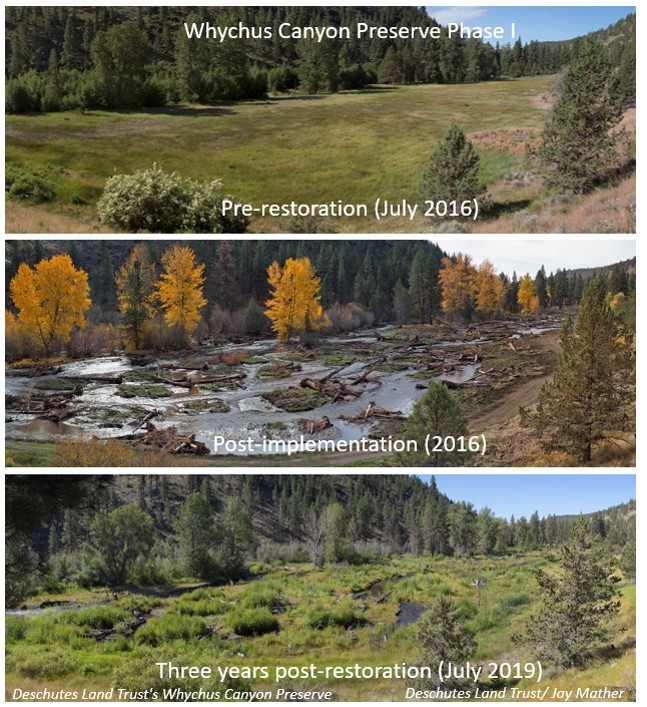 The OWEB Board’s Monitoring Committee and staff have identified stream restoration efforts to restore a stream channel to Stage 0 a priority area to investigate via programmatic effectiveness monitoring. “Stage 0 restoration” is a valley-scale, process-based (hydrologic, geologic and biological) approach that aims to reestablish depositional environments to maximize longitudinal, lateral, and vertical connectivity at base flows and facilitate development of dynamic, self-formed and self-sustaining wetland-stream complexes.
Photo Credit: Jay Mather/Deschutes Land Trust
Project Summary
In July 2019, the board made a funding decision to invest in effectiveness monitoring of two Stage 0 restoration projects in Oregon that OWEB has funded in the past and information sharing associated with Stage 0 restoration approaches.
Effectiveness monitoring of Stage 0 projects in the a) South Fork McKenzie River, Upper Willamette Basin, and b) Whychus Creek in the Upper Deschutes Basin. Monitoring activities include biological, geomorphic, physical habitat, and water quality monitoring. The monitoring utilizes a mix of field based methods and remote sensing approaches. Monitoring in the Upper Willamette and Upper Deschutes basins were initiated with these funds in 2020 and expect to continue for another 3-4 years.
This investment also includes convening a workshop to bring together practitioners, researchers, regulators and other stakeholders to discuss current topics and data gaps related to implementing and monitoring restoration projects intended to achieve a Stage 0 condition.
Contact
Please direct questions or comments to
Ken Fetcho, Effectiveness Monitoring Coordinator, 971-345-7018.