Making working with OHA simple, getting you answers in a timely manner, and showing how our work is making a difference for the things that matter most to you.
OHA is taking several steps to increase transparency in the agency. As part of TABI, the three projects outlined below are specifically aligned to the Transparency pillar.
Milestone Highlights Roadmap
Last updated April 2025
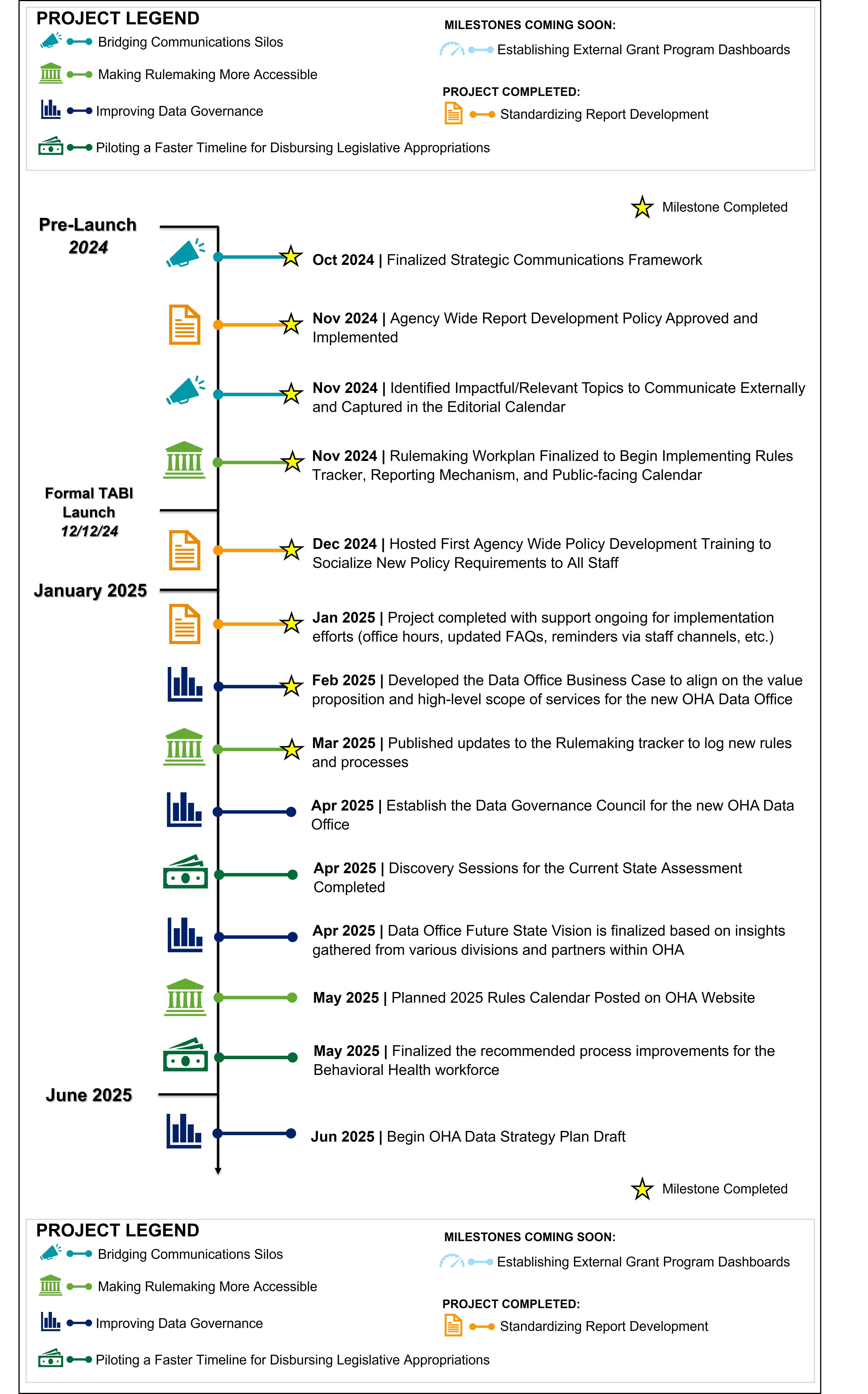
The roadmap below highlights key milestones from projects under the Transparency pillar.
October 2024
Finalized Strategic Communications Framework.
November 2024
Agency-wide report development policy approved and implemented.
Identified relevant topics to communicate externally and captured in the editorial calendar.
Rulemaking workplan finalized to begin implementing rules tracker, reporting mechanism and public-facing calendar.
December 2024
Dec. 9: Formal public launch of the Transparency, Accountability and Belonging Initiative.
Hosted first agency-wide policy development training to socialize new policy requirements to staff
March 2025
First editorial calendar planning meeting to refine next quarter's topics held.
April 2025
Rules Calendar Posted on OHA Website.
All Transparency Project Milestones
To achieve the major milestones highlighted above, there are a number of supporting activities and milestones involved. The graph below summarizes progress against all milestones under the Transparency pillar.
Since November 2024, the TABI projects have completed 22 project milestones.

Bridging Communications Silos
Project Goals
Increase public awareness of OHA deliverables, events, and program announcements and strengthen Agency alignment on strategic messaging. Implement more proactive and strategic messaging from top to bottom and develop an editorial calendar.
Most Recent Project Update
The project team is working on developing a strategic communications framework to help OHA provide accurate and timely communications to the people of Oregon. The framework will include the refinement of an editorial calendar launched this summer that will help the agency highlight priority areas and topics in a proactive manner.
Making Rulemaking More Accessible
Project Goals
Administrative rules are created by most state agencies to implement and interpret their statutory authority. Recognizing that the rulemaking process can be confusing and opaque, OHA is revising and standardizing its internal processes to make rulemaking more transparent and understandable – including by establishing an annual rulemaking calendar and erecting a public-facing page centralizing all rulemaking updates.
Most Recent Project Update
OHA and ODHS have created a joint workgroup to develop and implement process improvements for rulemaking activities. Recently, the workgroup established a standardized tracking and reporting process for all rulemaking activities. A template to publish public comments on proposed rules on the website is currently in development to enhance transparency and accessibility. Additionally, the team is developing a centralized rulemaking webpage to display information such as a calendar of planned rulemaking activities, community engagement opportunities, and public comments.
Standardizing Report Development
Project Goals
Develop, implement, and train on a revised Agency-wide policy for report development, review, and publishing to ensure all external reports are published in a timely and transparent manner.
Most Recent Project Update
The Report Development policy was completed in fall of 2024 and implemented agency-wide. This policy ensures that major research and reporting happening at OHA is shared with the public in a timely, transparent manner.
Improving Data Governance
Project Goals
Establish a Centralized Data Office, to support cross-divisional agency data needs, Data Office Service Catalog to track and inventory agency data, Data Stewardship Structure to outline roles and responsibilities, and its associated staffing. Prepare an Agency-wide Data Strategy Plan to outline how the agency will use data to better inform agency and program goals, including a Data Governance Plan and Data Inventory Plan, which will outline the processes to receive, house, and track data and data sources.
Most Recent Project Update
Data analytics helps organizations make informed decisions, improve efficiency, and drive strategic growth. OHA is establishing the OHA Data Office to improve data governance throughout the agency. The Data Office enables more whole person, care informed data analytics to better serve the state, optimize use of funds, and creates a better, more informed experience for the member/system user. The project team completed deep-dive engagement sessions with various divisions, teams, and partners across OHA to gather insights on unfulfilled data needs, opportunities for operational efficiencies, and the agency’s vision for the future OHA Data office.
Establishing External Grant Program Dashboards
Project Goals
To make dashboard development and publishing more streamlined and impactful, the project team’s current focus is building a “Best Practices” guide for use agency-wide.
Most Recent Project Update
OHA strives to enhance transparency into its investments and one way OHA is providing these insights is through dashboards that provide real-time, easily accessible visual representations of data, funding metrics, and the impact of these funds. In late 2024, OHA launched the
Behavioral Health Housing and Licensed Capacity Investments dashboard that displays data about OHA investments to increase behavioral health housing capacity in Oregon. The project team is working with other divisions and teams within OHA to identify other priority programs and investments to highlight externally.
Piloting a Faster Timeline for Disbursing Legislative Appropriations
Project Goals
Increasing transparency of the funding process with the public/grantees and refining funding processes to deliver funds in a way that is as expedient as possible without compromising the impact/outcomes of funds.
Most Recent Project Update
This project is exploring ways in which the agency can enhance its contracting/grants contracting and funding disbursement lifecycle, and where optimizing is not possible, the project team will bring transparency to the public on why the processes have been designed that way. The project team is reviewing current processes to identify opportunities to streamline them and increase transparency for the overall process. Over the next few weeks, the team will meet with different groups within OHA involved in the contracting and funding disbursement processes to develop process improvements and communications to help the public understand how OHA fosters good stewardship of public funds.