Background
On October 21, 2025, Oregon Governor Tina Kotek issued
Executive Order No. 25-26 (EO), with the goal of increasing coordination among state agencies to implement actions to mitigate and adapt to the impacts of a changing climate. Section I of the EO, Foster Resilient Lands, Waters, and Communities, directs the Oregon Watershed Enhancement Board (OWEB) and Oregon Department of Fish and Wildlife (ODFW) to define key resilience attributes for lands and waters using the existing plans and strategies and the best available science.
The
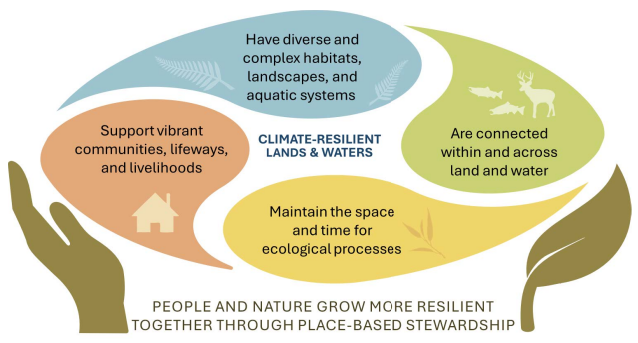
Climate Resilience Attributes of Oregon Lands and Waters serve as the first step in a coordinated and sustained effort across state agencies to implement the EO, helping guide investment and prioritize actions. Below is a visual representation of the attributes, showing how they are interconnected and reinforcing ecological and social processes that interact across space and time. Climate resilience is the sum of these four attributes, each one influenced by people and communities working together.
Definitions
As stated in EO 25-26, “The Oregon State Legislature established a definition of climate resilience in House Bill 3409 (2023) as ‘the capability to anticipate, prepare for, respond to and recover from significant climate-related threats while minimizing damage to social wellbeing, the economy and ecosystem functions.’”
Outcome-level characteristics or qualities of climate-resilient lands and waters, connecting metrics or outputs (i.e. stream miles restored, acres treated for invasive species, etc.) with higher-level goals (i.e. a diversity of connected and functional aquatic and terrestrial habitats).
Process to Define Resilience Attributes for Oregon Land and Water
From February-June 2026, OWEB and ODFW, with support from Oregon Consensus, facilitated an internal and external engagement process to help define the key resilience attributes foundational to the implementation of Governor Kotek’s EO 25-26.
This process includes:
- A literature review (and accompanying
background memo) of existing research and similar frameworks in Oregon, other states, and internationally.
- A three-day collaborative design process from March 10-12, in Salem, Oregon (agenda), which included:
- Collaboration with content experts experienced in defining resilience attributes from the perspectives of Western science and Traditional Ecological Knowledge and applying those attributes to land and water management.
- Engagement with interested parties to understand the vision and values of partners.
- Identification of draft attributes.
- Review and testing of the draft attributes with the agency staff who will be responsible for implementation and tracking.
- The workshop was livestreamed for the public, agency staff, and interested parties to engage with the process. There was an opportunity for the public to share insights on the first and last days of the collaborative design process.
- Design Workshop Recordings: March 10, March 11, March 12, and Workshop Summary.
- After the March workshop, OWEB and ODFW reviewed and refined the attributes and in early April, shared this draft version via GovDelivery and email with workshop invitees.
- Feedback collected on the first draft was synthesized and incorporated into the final version, with a discussion of key themes included.
Contact
If you would like to learn more, please contact:
Sarah Reif, ODFW Habitat Division Administrator, 503-991-3587, or
Alexa Schmidt, OWEB Water and Climate Coordinator, 971-718-4904.