Cleaner Air Oregon is a health-based permitting program that regulates emissions of toxic air contaminants from facilities based on risk to nearby communities. CAO requires facilities to report toxic air contaminant emissions, assess potential health risks to people nearby and reduce toxic air contaminant risk if it exceeds legal limits.
As part of the Cleaner Air Oregon process, each facility has a dedicated web page to provide communities access to facility information and updates on where it is involved in the process.
- Each step of the CAO risk assessment process has a section that includes DEQ's communications and deliverables from the facility.
- The graphic below shows where a facility is in the Cleaner Air Oregon Process.
For additional information and history of the program, visit the
Cleaner Air Oregon web page.
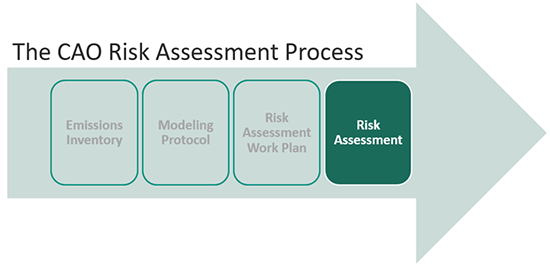
CAO Risk Assessment Process
The Emissions Inventory provides information on all the Toxic Air Contaminant emissions from a facility, and includes information on a facility's operations and activities, as well as fuel and material usage rates. This is often the longest step in the CAO risk assessment process as DEQ needs to verify that all activities have been accounted for, and that the most representative emissions data available are used. In some cases, DEQ will require a facility to perform source testing at this stage if insufficient data is available to estimate emissions. For an introduction to emissions inventories and why they matter, please see
EPA's Fact Sheet.
June 27, 2024: Facility Called In to Cleaner Air Oregon
Sept. 23, 2024: Facility submits Emissions Inventory and supporting documentation
Oct. 29, 2024: DEQ responds to the Emissions Inventory submittal with request for revisions and additional information
Nov. 11, 2024: Facility Requests Extension
Nov. 19, 2024: DEQ Responds to Extension Request
Dec. 16, 2024: Facility submits revised Emissions Inventory and supporting documentation
Jan. 6, 2025: DEQ responds to the Emissions Inventory submittal with request for revisions and additional information
Jan. 24, 2024: Facility submits revised Emissions Inventory and supporting documentation
Jan. 29, 2024: Facility submitted a revised Emissions Inventory
Jan. 31, 2024: DEQ approved the Emissions Inventory
The Modeling Protocol provides information on how the facility plans to accurately model the concentrations of Toxic Air Contaminants (TACs) that community members may be exposed to based on the TAC emissions data from the approved Emissions Inventory. A Risk Assessment Work Plan is required for more complex Risk Assessments (Level 3 or Level 4) and provides more detailed information about locations where people live or normally congregate around the facility and how risk to these community members will be evaluated.
Feb. 26, 2025: Facility submitted a Modeling Protocol and Risk Assessment Work Plan
May 30, 2025: DEQ responds to the Modeling Protocol and Risk Assessment Work Plan submittal with request for revisions
June 26, 2025: Facility submitted a revised Modeling Protocol and Risk Assessment Work Plan and supporting documentation
July 9, 2025: DEQ approved the Modeling Protocol and Risk Assessment Work Plan
The Risk Assessment provides the summary of findings on potential risks to the surrounding community from emissions of Toxic Air Contaminants (TACs) from this facility. The assessment indicates the exposure location(s) in the community with the highest potential Cancer and Noncancer health risk, and DEQ uses this information to regulate TAC emissions from the facility. In some cases, the risk may be very low and no further action may be required, or the risk may exceed health-based standards where DEQ can require risk reductions. In most cases, permit conditions will be developed and included in a facility's air quality permit to regulate TAC emissions based on the results of the risk assessment.
Oct. 31, 2025: Facility submitted the Risk Assessment Report
Risk Assessment Report
- Risk Assessment Appendices
Nov. 25, 2025: DEQ requested minor revisions to the Risk Assessment Report
Dec. 12, 2025: Facility submitted a revised Risk Assessment Report
Dec. 17, 2025: DEQ approved the Risk Assessment
About the Facility
Amazon Data Services, Inc. operates PDX-4, a data center (electronic data processing center), that houses computer systems and associated components, such as telecommunications and data storage systems. The facility includes data communications equipment, security systems, environmental controls, and backup emergency power supplies (engine-generator sets). The principal use of the facility is the storage, management, and dissemination of electronic data. To date, the facility has installed 98 emergency engine-generator sets. The data center was previously operated by Vadata, Inc. and has been operating since 2013.