This page has RH Program-specific trainings for each clinic-type, information about what trainings RH Program-certified clinics must take, and training resources from trusted reproductive health organizations.
Reproductive Health Access Fund (RHAF) Trainings
Trainings Required for RHCare, CCare, and AbortionCare Clinics
RH Program Hosted Trainings
Reproductive Health Access Fund (RHAF) Trainings
The following trainings are for staff at RHCare, CCare, and AbortionCare clinics and are helpful for new staff or those who need a refresher. RH Coordinators should be familiar with each.
RHAF Orientation
This 25-minute Reproductive Health Access Fund (RHAF) Orientation, updated June 2024, gives a high-level overview of the RH Program's clinical program; its funding streams; client eligibility for coverage; services; billing and data; program monitoring; and program resources.
Video |
Slides (with clickable links)
Client Enrollment Process (updated March 2026)
Learn more about the enrollment form and process as well as how to use the eligibility database. This training is for RHCare, CCare, and AbortionCare clinics. Following the training, take a short Test Your Knowledge quiz. This can be accessed via the QR code at the end of the training or by following the link listed on the slide.
Video |
Slides (with clickable links)
CVR
Learn about how to submit data and bill the RH Access Fund! Billers, clinical staff, and anyone who touches the CVR should watch.
RHCare Clinics: Video | Slides (with clickable links)
CCare Clinics: Video | Slides (with clickable links)
Trainings Required for RHCare, CCare, and AbortionCare Clinics
This table shows the training requirements for staff at RHCare, CCare, and AbortionCare clinics.
Please note: if staff already attended a training about the required topic, it may meet the program's Certification Requirement.
See a menu of trainings that meet these requirements. 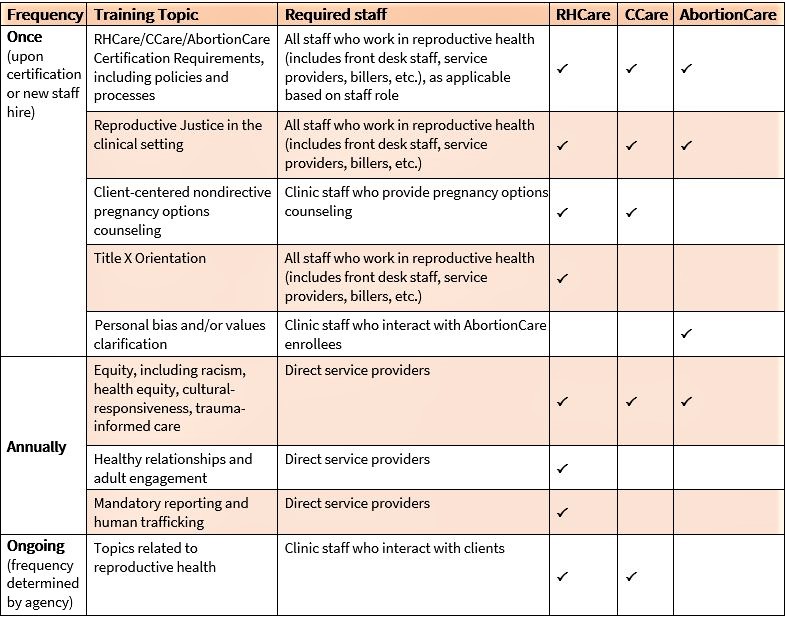
RH Program Hosted Trainings
The following webinars are available for viewing by our clinical network. To access the recordings, please email
rh.program@oha.oregon.gov and include which training you want access to and what organization you are from. Currently, we are only providing access to staff from our clinical network.
Cultivating Trauma Informed Care for Self and Community (Feb 2025)
This webinar was a continuation from a presentation at the 2024 RHC Meeting. Lydia Bartholow shared more about trauma informed care, neuroscience of compassion, and triggers and glimmers.
Sexual and Reproductive Health Coalition Building and Sustainability (May 2025)
During this webinar we shared best practices related to coalition building and sustainability. Guest panelists, Katie Tobiska, from Coos County, and Lexie Futter, from Umatilla County, shared their experiences leading local coalitions as part of their PE 46 work. They will share coalition goals and community reach/membership, as well as triumphs, and challenges.
Contraception in Practice (Oct 2025)
Need a crash course on contraception? This 75-minute webinar will give an overview of all contraceptive methods currently available in the United States. Participants learn how to assist clients in choosing a method that best fits their preferences, lifestyle and reproductive goals. We also discuss common medical contraindications, how to screen for them, and how to use the CDC Medical Eligibility Criteria (MEC) to safely provide contraception to clients.
Pain Management for IUD Insertions and Other GYN Procedures (June 2025)
Are you trying to better understand pain management options for patients at your clinic? Watch an hour-long webinar presented by Dr. Lisa Bayer, from OHSU. Dr. Bayer presents research on pain and pain perception, guiding principles for addressing pain during gyn procedures, and a range of evidence-based techniques you can implement at your clinic.
Providing Adolescent Friendly Care (May 2024)
The Reproductive Health Program partnered with Advocates for Youth and OHA's Statewide Youth Advisory Council (YAC) to provide this webinar. This webinar identifies barriers to healthcare access faced by adolescents, describes elements of adolescent-friendly health services, and introduces the HEEADSSS and SHEEADSSS models of patient interviewing. Participants discuss several strategies for providing youth-centered care, including ensuring confidentiality, developing a referral network, adopting a strengths-based approach to interviews, fostering a youth-friendly clinic environment, and maintaining a non-judgmental attitude toward patients. Hear directly from three members of OHA's Youth Advisory Council about their thoughts on what makes a clinic adolescent friendly.
Providing Trauma Informed Pelvic Care Part I (Feb 2024)
The RH Program partnered with Advocates for Youth to provide this Trauma Informed Pelvic Care webinar. This interactive training, designed for healthcare providers, offers historical examples of healthcare-related trauma; reviews current research on the experience of trauma among patients, and describes the importance of trauma-informed pelvic care, especially among adolescents and youth adults. Providers receive step-by-step guidance on how to provide trauma-informed reproductive and sexual health care including appropriate language to use, how to manage patients who have experienced acute trauma, and how to perform pelvic exams using a trauma-informed approach. The training also covers issues related to patient consent to care and provides scripting for providers as they assess potentially activating responses in patients.
Providing Trauma Informed Pelvic Care Part II (October 2024)
The Oregon Reproductive Health Program continued the partnership with Advocates for Youth to host Part II on Trauma-Informed Pelvic Care. This webinar will takes a deeper dive into the actionable steps to providing pelvic exams using a trauma-informed approach. This interactive training, designed for healthcare providers, expands on the accommodations shared in Part I and will give attendees a chance to share their approaches and work through various case studies to put the information into practice.
Understanding Open Adoption
We teamed up with staff at Open Adoption & Family Services (OAFS) to help train clinic staff on how to provide compassionate support and accurate information to pregnant people considering adoption.
In this webinar, OAFS staff dive into:
- Why the era of closed adoption is over and open adoption is now the norm.
- How openness serves the needs of the adoptee, birth parents, and adoptive parents.
- What a high-integrity open adoption looks like and how the process works.
- Best practices in options counseling and adoption planning services.