The Oregon Department of Environmental Quality is overseeing the cleanup of the 13.4-acre former United States Postal Service Processing and Distribution Center. This is a significant cleanup effort in the center of what is now a commercial area of northwest Portland.
In the past, this site was integral to transportation in the region – passenger railcars were cleaned and restocked onsite, and a gas plant manufactured the gas to light the railcars that carried passengers through Union Station. In the 1960s, the site was repurposed for the USPS, and it is now transforming again into a new mixed-use residential, commercial and community hub for present day Portland. Learn more about the Broadway Corridor project and the future of this site.
Prosper Portland owns the site and is leading its cleanup and redevelopment as part of the Broadway Corridor project. DEQ's role is to ensure that the cleanup and remediation is performed properly and will be protective of human health and the environment.
Cleanup Status
Why does this site need to be cleaned up?
The Northern Pacific Terminal Company developed the site as a railyard in the early 1880s. Railcar repairing and cleaning was conducted on the west half of the site, while freight depots operated on the east half (see below figure).
The Pintsch Compressing Company operated a plant in the northwest corner of the site that manufactured compressed gas from crude oil for passenger rail car lighting from about 1893 to 1934.
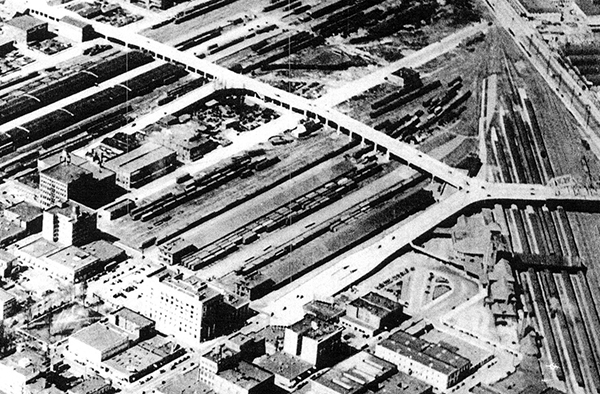
The USPS facility was constructed on the site in the early 1960s and USPS purchased the site from the railroad in 1974. The facility processed all outgoing mail for the state of Oregon.
In 1993 and 1994, five underground storage tanks were removed from a vehicle maintenance facility at the north end of the site, and a heating oil tank was removed from the south end of the processing building. Pockets of petroleum-contaminated soil remained in place around both excavations because they could not be removed without compromising the adjacent buildings.
Remaining contamination across the rest of the site generally consists of diesel and heavy oils along with arsenic, lead and petroleum constituents known as polycyclic aromatic hydrocarbons, or PAHs.
In 2012, DEQ determined that there was no risk to public health and the environment if the site remained in its current condition – as a paved industrial facility that was operated by the USPS. When Prosper Portland purchased the site in 2016, it signed an agreement with DEQ to clean up the contamination before reselling or redeveloping the site.
DEQ required Prosper Portland to remove areas of highly contaminated soils known as hot spots, along with the pockets of petroleum-contaminated soils. The site redevelopment will serve as a cap that isolates the remaining contamination, where coverage of the site will include buildings, pavement and at least a two-foot layer of clean soil.
Learn more
View technical information and project documents in Your DEQ Online.
Prosper Portland's Broadway Corridor website has more details about development plans including the most recent project updates.
Frequently Asked Questions
This is a significant cleanup effort in the center of what is now a commercial area of NW Portland. In the past, this site was integral to transportation in the region – passenger railcars were cleaned and restocked onsite, and a gas plant manufactured the gas to light the railcars that carried passengers through Union Station. In the 1960s, the site was repurposed for the USPS, and now it will transform again into a new use for present day Portland. Learn more about the Broadway Corridor project and the future of this site.
The cleanup effort is necessary to protect people and the environment from contamination that was left over from previous operations. The cleanup will allow people to safely use the Broadway Corridor Project development for its intended purpose – as a new mixed-use residential, commercial and community hub that will connect the Old Town/Chinatown and Pearl District neighborhoods.
A deed restriction recorded on the property in 2011 requires DEQ's approval before the property is redeveloped for residential use. DEQ will review excavation plans to ensure workers and neighbors are protected during construction. DEQ will also review final building and hardscape design plans, including streets and sidewalks, to ensure the new construction is protective for residential use.
Prosper Portland's Broadway Corridor website has more details including the most recent project updates. You can also contact project managers at DEQ or Prosper Portland below: