
Oregon State Flag An official website of the State of Oregon »

Oregon.gov Homepage

December 2025 Education Update

Oregon Achieves... Together!

A Message from Oregon Department of Education Director Dr. Charlene Williams

ODE Director Dr. Charlene Williams 

Dear Education Community,

I am looking forward to a time (and I have to have faith that it will come) when I can write to you all and start the message with something more hopeful, more potent, more powerful than an acknowledgement of what you are facing and how deeply challenging it is.

Over the past few weeks, we have heard from districts, educators, families, and students who are navigating the trauma of neighbors being detained, families being separated, and children unsure of what awaits them when they return home from school. Across Oregon, there is an increase in fear and uncertainty as Immigration and Customs Enforcement (ICE) activity intensifies in our communities. This is not about abstract policies—these are real impacts on Oregonians, our students, and the communities we serve.

While federal actions may continue to shift rapidly, our values do not. In Oregon, we remain grounded in our shared belief that EVERY child—regardless of race, national origin, language, citizenship, or immigration status—has the right to learn, to feel safe, and to be supported in our public schools. We are committed to using every lever within our authority to uphold these rights, protect our students, and stand with the communities experiencing heightened fear.

To support your efforts, ODE has compiled these resources for you to utilize as you navigate the coming months in support of the children and families in your community.

Preparing for Breaks and Transitions with Care and Connection

This climate of fear is impacting school attendance and engagement with other critical resources at a time that we already know can be challenging for students and staff. If they do not feel safe, our scholars cannot achieve the academic excellence that they deserve.

Reactions to interruptions in routines and regular activities can take many forms: frustration, anger, irritability, sadness, and withdrawal. That is why we are continuing to encourage schools and districts to prioritize care, connection and community. Please review this flyer to access resources that promote and support health and well-being.

Budget Update

Earlier this fall, the Legislative Fiscal Office required all state agencies to prepare 2.5% and 5% reduction options for the 2026 Legislative Session amid economic uncertainty. ODE submitted its options on November 3.

Shortly after, the state revenue forecast was released, which brought some encouraging news: Oregon’s economy remains resilient, recession risks are easing, and the projected General Fund deficit has narrowed significantly. However, it’s important to understand that, even with this positive news, the state budget remains out of balance, especially when factoring in federal HR 1 impacts and ongoing needs for essential state services. This means the legislature is still likely to face difficult choices in 2026.

Any discussion about budget reductions can cause concern. This stage, though, is about transparency and planning—no decisions have been made, and no reductions are happening now. ODE will continue to communicate clearly and share updates as the legislative process unfolds.

2025 Highlights

Even with all the challenges we face (and because challenges can often foment negativity), I find it especially important to regularly make space for gratitude, and I hope you do, too. For me, this can be as simple as giving thanks for a sunny day, a good audio book, or spending quality time with my family. Gratitude reminds us of life’s gifts and goodness, and I encourage you to find ways to build gratitude into your daily life.

As we close out 2025, I am grateful for our shared successes over the past year. I know there are TOO MANY to list, but here are a few highlights:

Looking Forward

As we turn to a new year, I am excited to see the ODE strategic planning and alignment project continuing to take shape. Through this work, we are aligning the agency’s efforts under a unified plan that clarifies goals and outcomes, defines measurable objectives, and strengthens internal alignment. This process will lead to two tangible outputs: an agency-aligned strategic plan with strategies and measurable targets organized under our three pillars (Academic Excellence, Belonging and Wellness, Shared Accountability), and an implementation and monitoring plan. I look forward to sharing more in the new year about this work.

Standing Together

Thank you for your courage, leadership, and commitment during this deeply challenging time. Your steadiness and compassion make all the difference for the children and families who depend on us.

As I have mentioned in the past, there is a beautiful phenomenon in nature, when danger approaches, a herd will often close ranks—positioning the vulnerable at the center and standing shoulder to shoulder to protect its own. Today, we do the same. We stand together, outward-facing, resolute, and united in our purpose to safeguard the hopes and dreams of every Oregon learner.

As always, thank you for all that you do.

In Love and Justice,

Dr. Charlene Williams

Celebrating 50 Years of IDEA

On November 29, Oregon joined districts, families and communities across the country in recognizing the 50th anniversary of the Individuals with Disabilities Education Act (IDEA), the federal law that ensures students with a disability are provided with a Free Appropriate Public Education (FAPE). This milestone marks five decades of progress in ensuring that children experiencing disability have access to public education and the services they need to learn and grow.

IDEA shapes the way we work together in Oregon. It guides ODE’s support to schools, helps districts plan instruction and services, gives families a clear role in their child’s education and reminds communities of the importance of welcoming every learner. This shared work is reflected in our results. Graduation rates for students with disabilities improved and dropout rates decreased, with 72.02 percent of students with disabilities exiting special education by earning a regular diploma in FFY 2023, an increase from 66.91 percent in FFY 2022.

As we mark this anniversary, we recognize both the progress made and the responsibility ahead. Oregon will continue working alongside districts, families, and communities to uphold the promise of IDEA and ensure every child receives the education they are entitled to.

On December 2, ODE joined in the recognition of National Special Education Day, a moment to honor students experiencing disabilities and the families, educators and school teams who work every day to support their learning and growth.

Special education is built on the belief that every student can learn and deserves instruction, services, and opportunities that match their needs. Across our state, educators and school staff are committed to helping students build skills, access strong instruction, and make progress toward their goals. Families continue to play a vital role as partners in this work, and we are grateful for the dedication they bring to their children’s education.

At ODE, we are proud to support districts and programs as they work to provide the best possible services to students. Today is a reminder of the effort, teamwork, and care that go into helping every learner move forward.

Thank you to everyone who contributes to special education in Oregon. Your work makes a difference every day!


OSCIM Program Continues to Help Districts with Construction Projects

On Election Day, voters in the West Linn-Wilsonville School District passed a bond measure that got a boost from the Oregon School Capital Improvement Matching (OSCIM) Program. The $6.1-million in OSCIM funds will be added to the $190 million approved by voters. Commitments are made to districts ahead of the election so districts can inform their communities of the potential for additional funds from the state if the local bond passes. Before submitting an application for the OSCIM Program, districts must also submit a Facilities Assessment and Long-Range Facility Plan. Districts are awarded grants based on their position on the Priority List or First in Time List.

Since the first round of grants in 2016, the OSCIM program has awarded 106 grants, providing more than $500 million in matching funds that added to $10.5 billion in bonds approved by voters. To date, 99 of Oregon’s 197 school districts have received at least one OSCIM grant, with seven districts earning the matching funds twice.


Oregon Students Demonstrate Increased College Readiness Through Advanced Placement

New data released by the College Board show that Oregon students with access to challenging courses continue to make strides in college readiness, particularly through the state’s growing participation and success in Advanced Placement (AP) coursework and exams.

According to the 2025 Advanced Placement State and District Integrated Report for Oregon, the number of Oregon students participating in AP courses has increased by 70% since 2021, including a 4% increase between 2024 and 2025. Oregon exceeded pre-pandemic participation levels in 2024, and participation continued to rise this year. In 2025, 21,862 Oregon students took 37,203 AP exams, up from 19,464 students taking 32,007 exams in 2019. Oregon’s High School Success initiative has played a key role in expanding access to advanced coursework.
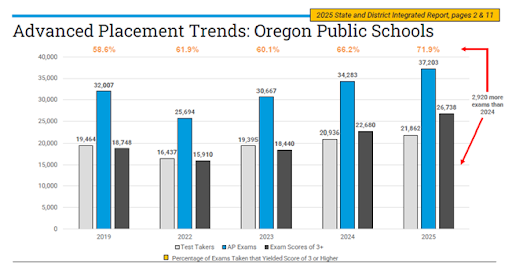
Among the 2025 highlights:

  • Participation in AP courses grew 4.4% overall from 2024, including a 16.2% increase among Black/African American students and a 4.1% increase among Hispanic/Latinx students.
  • Overall participation in AP exams increased by 8.5% from 2024.
  • 20.9% of AP test-takers qualified for the state-funded AP Test Fee Program for students experiencing poverty.
  • The number of students receiving scores of 3, 4, or 5 increased by 32.9% for Black/African American students and 17.7% for Hispanic/Latinx students compared to 2024.

In addition to AP, many Oregon students also earn college credit through International Baccalaureate (IB) programs and dual credit or dual enrollment opportunities, which together provide multiple pathways for students to demonstrate college readiness and reduce the cost of higher education.

Through strategic investments and partnerships, Oregon is strengthening pathways for students to earn college credit while in high school through:

  • High School Success funds, created by Measure 98 (2016), which help schools expand access to accelerated college credit opportunities such as AP, IB, and dual credit courses, including CTE dual credit. These funds also support communication with students and families so they understand available options and how to access them.
  • ODE’s Student Success Plans and related grants, which provide districts with strategies to improve outcomes for historically underserved student groups. Each plan includes goals to increase college readiness, often through expanded accelerated credit opportunities.
  • Collaboration between ODE and the Higher Education Coordinating Commission (HECC) through the AP/IB Policy Workgroup, which coordinates the Statewide Course Credit Policy. The policy’s online table shows how AP and IB exam scores translate to credit at Oregon’s 24 public colleges and universities, helping students plan their postsecondary pathways.
  • State-funded exam fee support, as the legislature allocates funding each biennium to cover full AP and IB exam costs for students experiencing poverty and to reduce fees for all Oregon test-takers.

Together, AP, IB, and dual credit opportunities reflect the state’s ongoing commitment to expanding college readiness opportunities for all students, especially those historically underrepresented in higher education pathways. When given the opportunity to learn and high expectations, Oregon students are showing that they will rise to the occasion.


ODE In the News


New STEAM Toolkit, Science and TSEL Resource, and Information Literacy Toolkit Available Now!

ODE’s Well-Rounded, Integrated & Digital Learning team is excited to release several new resources to support well-rounded and digital learning across the state:

Mark Your Calendar

The next Science Ignite Session on Wednesday, February 4 at 4:00 p.m., will focus on the Integrating Oregon’s Transformative SEL and K-12 Science Education resource. Register here to join ODE's TSEL Education Specialist, Dr. Fynn, along with Science Education Specialists, to explore how these resources continue to support the learning conditions for students.


Be part of groundbreaking research on student cell phone use in Oregon!

Dr. Angela Duckworth asking Oregon educators to join a landmark study on school cell phone policies

On behalf of the National Governors Association, Dr. Angela Duckworth of the University of Philadelphia is asking Oregon educators to join a landmark study on school cell phone policies. Click on the image to watch her video.

What do you think about phones? And how are things going at your school?

Take part in a national survey on school cell phone policies.

Why participate?

  • Just 5 minutes
  • Completely confidential
  • Be entered to win one of ten $500 gift cards
  • Instant snapshot of national results

Make your voice heard by going to www.phonesinfocus.org.


Elevating Education-System Employee Wellness

December is a busy month. There are the usual seasonal changes, winter break, community, cultural and religious events, and eventually the welcoming of 2026. These moments can offer equal parts connection and isolation depending on our life circumstances. For these reasons we are sharing more about the humanizing impacts of Adult Transformative Social Emotional Learning and taking a brief detour from our journey into somatic practices to learn more about Mental Health Literacy with a focus on how to seek help effectively.

Oregon’s Transformative Social and Emotional Learning Framework and Standards have been developed to help adults and students navigate life’s complex pathways and transform systems to be more humanizing. Similarly to students, adults benefit from intentional relationship building and a deep sense of community. Creating conditions for adult connection and self/community care supports Adult SEL.

As individuals, it’s vital to reflect on our own social and emotional needs and interests. Getting curious about factors such as relationships, stressors, life pressures, and health status can help prioritize the approach needed to reach goals. Honoring one’s identity and lived experience, and advocating for needs and interests fosters empowerment and well-being.

As a community we can create conditions to deepen our collective care and well-being. Adults thrive in conditions that nurture creativity, respectful relationships, well-being, and healthiness. Structures such as affinity groups, check-ins, wrap-around services, team routines, and practices that affirm individual and collective contributions can help build collective efficacy while reducing feelings of isolation, demoralization, burnout, and vicarious trauma.

Please consider the following resources as we prioritize individual and collective Adult SEL and well-being. 

Resources from the Oregon Instructional Frameworks Transformative SEL website:

Resources to nurture adult relationships at your next check-in, team meeting, or retreat:

As educators, many of us spend a lot of time thinking about Early Literacy, focusing on strategies, curriculum, and professional development. What about Mental Health Literacy? Health – both physical and mental – is something we all carry with us and managing it is part of everyday life. Mental Health Literacy provides a framework for understanding how to take care of our own mental health, understanding common mental health disorders and treatments, how to seek help effectively, and how to eliminate the stigma that surrounds mental and behavioral health. Of note, behavioral health is a term that is inclusive of behaviors such as substance use disorders and other addictions like gambling, eating, etc.

Educators are in a unique position to notice when a colleague (or student) may be struggling with their mental health. It can be helpful to know what resources are available, especially those that are part of our insurance benefits. Here is some information to help navigate the process of finding the help and support you are looking for.

  • Calling or texting 988 is an excellent resource if you are looking to get some immediate support before looking for other services.
  • The Oregon Educators Benefit Board (OEBB) invests in great health benefits for Educators and your loved ones. Kaiser Permanente, Moda Health and the Canopy Employee Assistance Program each offer a wide range of benefits to support you and your family’s physical, mental, emotional and financial wellbeing. These partners can also connect you with resources and programs to help with food, housing, clothing, internet costs, utilities and more.
    • If you have insurance with Kaiser Permanente, visit the Community Resources page.
    • If you have insurance with Moda Health, contact the Social Determinant of Health (SDoH) advocates at 833-960-8988 or sdoh@modahealth.com.
    • If your employer offers an Employee Assistance Program through Canopy, call 1-800-433-2320 to talk to a real person anytime. See Canopy’s Summary of Services page to learn more.
  • It’s also worth taking a look at the OEBB Wellness Guide to learn more about managing ongoing health conditions, and to see what is available to support your physical, financial and emotional well-being needs. For questions about your OEBB benefits, contact OEBB Member Services at oebb.benefits@odhsoha.oregon.gov or 888-469-6322.

May this month bring some rest, connection, and joy.


Student Spotlight