Nominations are Open for the 2026-27 Oregon Teacher of the Year
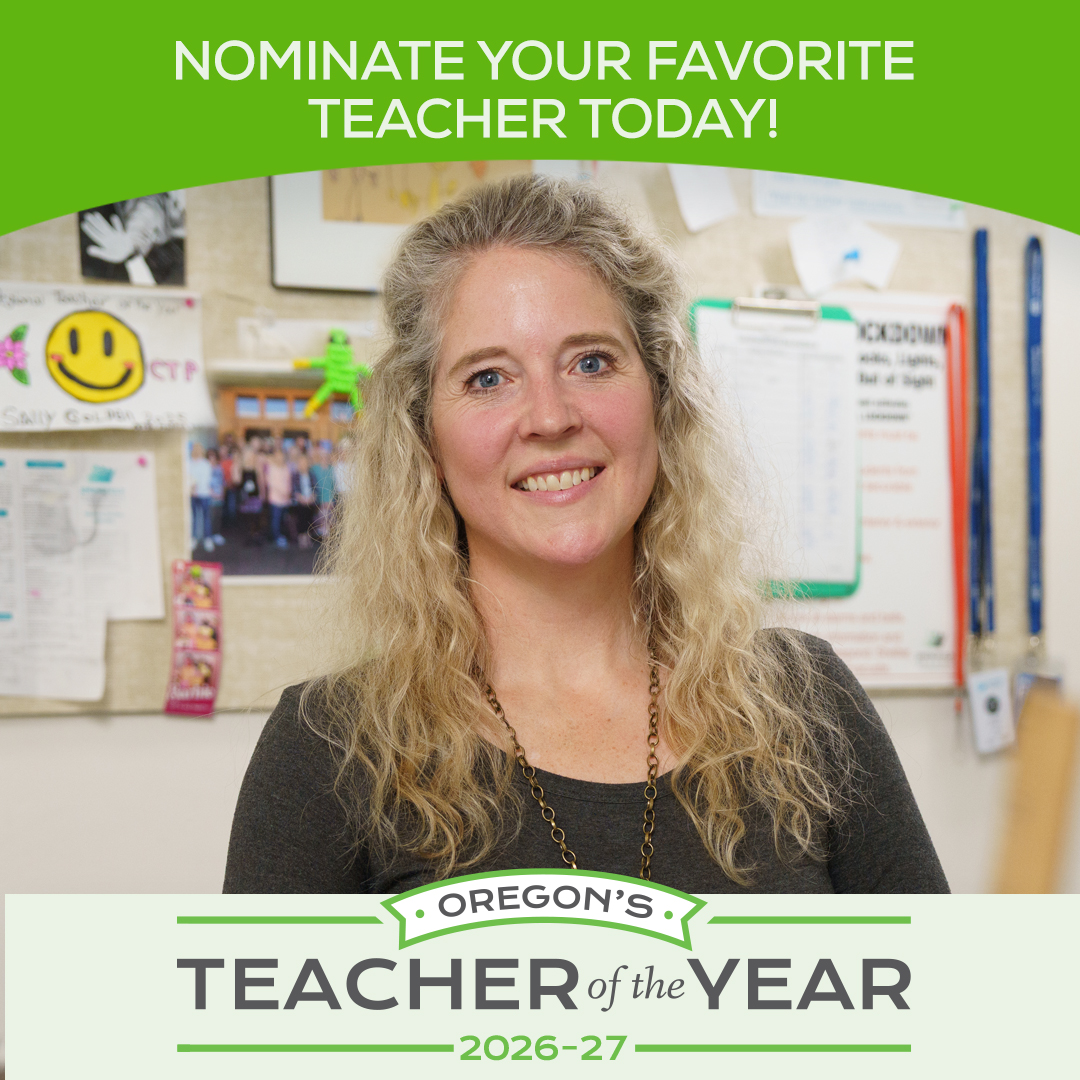 The Oregon Teacher of the Year program recognizes and honors teacher excellence, with the state Teacher of the Year serving as the face and voice of exemplary educators across the state. Candidates for Oregon Teacher of the Year are exceptionally dedicated, knowledgeable, and skilled licensed public school educators in grades preK-12.
Do you know a teacher who should be considered for this distinction? Nominate them now! Nominations are open statewide through 5:00 p.m. on February 11, 2026.
What happens after nominations close in February?
All eligible teachers* who have been nominated will be invited to submit an application. Candidates who apply will then be in the running to be selected as a Regional Teacher of the Year in one of the 19 Education Service Districts statewide. Every Regional Teacher of the Year will be awarded $1,000 and will be celebrated across the state in September.
Finalists for the 2026-27 Oregon Teacher of the Year will be selected from amongst the regional winners by a blue-ribbon panel. Following additional application questions and interviews, the panel will then select the state honoree. Thanks to ODE’s partnership with the Oregon Lottery, the Oregon Teacher of the Year receives an award of $10,000, as well as a special fund to cover all travel costs for the year.
"My experience thus far as Oregon Teacher of the Year has been nothing short of humbling, exhilarating, heartwarming, and amazing, and my time has only just begun,” said Sally Golden, Oregon’s 2025-26 Teacher of the Year. “This honor is for every student, parent, educational assistant, specialist, support staff, teacher, administrator, and community partner who has contributed to and taken part in the beauty and magic that is the Springfield Community Transition Program. I am beyond excited to represent my program, my district, and my state and hope to make everyone proud!"
The Oregon Teacher of the Year will also submit an application to be considered for the honor of National Teacher of the Year.
If you have questions about the program, please reach out to the Oregon Teacher of the Year Program Coordinator, Michelle Goodness.
*Prior to nominating, we encourage you to review the Oregon Teacher of the Year eligibility requirements - please see the “About” section on the Oregon Teacher of the Year website.
Elevating Education-System Employee Wellness
 Welcome back from break and to the first wellness column of 2026! To support education-system employee wellness, the ODE School Wellness, Inclusion Safety & Health Unit features a monthly article in the Education Update. Creating a culture of belonging and wellness for education-system employees leads to higher levels of professional satisfaction and promotes employee retention and well-being, which creates a ripple effect that impacts student success!
Part of the landscape of employee well-being includes looking at the entire workforce continuum from recruitment through retirement (and everything in between!). This month we will pick up where we left off in December’s column about Transformative Social Emotional Learning (TSEL), how it connects to adult well-being, and the intersection of TSEL and the work being done to support educator preparation programs. What was taught 5, 10, 15 years ago may or may not align with the skills and resources that are needed in 2026. To that end, we invited a colleague from the Teacher Standards and Practices Commission (TSPC) to share some thoughts and resources.
Nurturing a Thriving Teacher Pipeline Upstream – Kristen Rush, TSPC
Across Oregon, educator preparation faculty are working with purpose and care to prepare future teachers to step into classrooms grounded, confident, and ready to support all students. Since the launch of the TSEL standards, faculty have deepened their focus on the social, emotional, and cultural growth of adults, recognizing that educators deserve to thrive and flourish not only for their students, but for their own well-being. Faculty weave evidence-based SEL practices and culturally sustaining approaches throughout entire programs and content areas, ensuring that well-being is not an add-on but an essential thread of professional identity. They reimagine candidate learning experiences so future teachers practice building strong relationships, meeting challenges with compassion, and creating classrooms where every child is a capable and confident learner.
Faculty also tend to their own well-being, supporting one another through communities grounded in collaboration, care, and emotional awareness. Their way of teaching becomes a way of being, offering candidates lived examples of what healthy, human-centered education can be.
These upstream efforts are already strengthening schools. Candidates enter classrooms more prepared to support students and themselves. By placing adult well-being at the heart of preparation, faculty help cultivate a future where educators flourish and school communities thrive.
Many thanks to Kristin Rush from TSPC for this contribution.
Wellness Spotlight: Mt Hood Community College
As we all know, the definition of well-being varies from person to person, and even from season to season. This means that the most effective educator well-being programs don’t take a “one size fits all” approach. Instead, they work to offer a variety of well-being supports that take staff needs, interests, and barriers into account.
As a Flourish Grantee from Oregon Well-Being Trust, Mt. Hood Community College is an organization that works hard to offer diverse and accessible well-being activities for all of their staff. They utilize staff knowledge and experience in their well-being program and aim to make their program responsive to staff feedback. They’ve hosted everything from weekly drop-in yoga classes to a grow-your-own mushroom class utilizing staff feedback and expertise.
Char Lede, Wellness Coordinator at MHCC, had this to say about their educator well-being work: “We recognize that wellness takes many forms. Staff are encouraged to foster their well-being in a way that aligns with their goals and interests through our different initiatives.”
If you are interested in cultivating Employee Well-Being in your school, district or ESD, please check out ODE’s Employee Well-Being website or reach out to ODE.HealthySchools@ode.oregon.gov for more resources and information.