Transformative Social and Emotional Learning Overview
In June 2023, the State Board of Education adopted the first Oregon Transformative Social and Emotional (TSEL), Framework and Standards that represent K-12 social and emotional learning expectations for students. Oregon’s Transformative SEL Framework is intended to enact ORS 329.045 and help build capacity for strengthening equity-focused school cultures that support student and adult wellbeing.
According to ORS 329.045: “The board shall require school districts to implement the standards and framework no later than July 1, 2024.”
In response to Senate Bill 5701 Section 304, WestEd partnered with the Oregon Department of Education's Office of Teaching, Learning and Assessment to support the implementation of Oregon’s Transformative Social and Emotional Learning (SEL) Standards for schools and districts. Implementation resources resulting from this partnership are available on the
Oregon Transformative Social & Emotional Learning Instructional Frameworks webpage.
Transformative Social-Emotional Learning
TSEL Framework and Standards
Oregon’s Transformative SEL Framework describes the conditions that transform learning environments to support whole child approaches in meeting the full scope of students’ social, emotional, and academic needs. These conditions include partnerships, policies, and practices that support both Adult and Student SEL. The framework and standards utilize and expand on CASEL’s definition of Transformative SEL to help build capacity for strengthening school cultures that center equity, and support student and adult well-being through a systemic approach. Oregon’s Transformative SEL Framework is comprised of four Components: Guiding Principles, Conditions for Learning and Thriving, Adult SEL, Student SEL.
Oregon’s Transformative SEL Standards have been developed to
- Provide a well-rounded education that teaches to the whole child,
- Builds on student and adults’ strengths, perspectives, and contributions,
- Guides the interactions and relationships between students and adults.
Framework & Standards Documents:
Oregon’s Transformative SEL Standards support schools in ensuring Student Transformative SEL. The five standards were developed by braiding CASEL’s descriptors for each of the five competencies (Self-Awareness, Self-Management, Social Awareness, Relationship Skills, and Responsible Decision-Making) with the five transformative SEL focal constructs (Identity, Agency, Belonging, Collaborative Problem-Solving, and Curiosity).
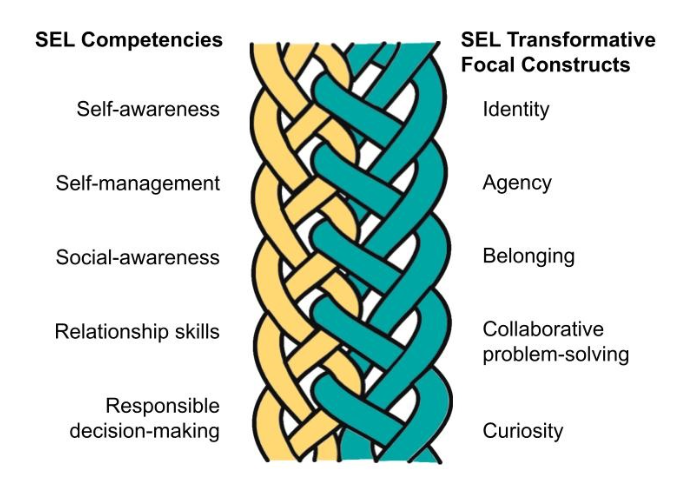
Oregon’s Transformative SEL Standards describe what a person needs to know, understand, and be able to do when it comes to Transformative SEL. Each standard includes 3-4 practices that demonstrate progression towards meeting the standard with more focused knowledge and skill. Each practice also includes a set of four growth indicators organized by Webb’s Depth of Knowledge (Webb, 1997, 1999), providing guidance on what these may look like in action and indicate growth towards the practice and standard. The growth indicators are also intended to help guide adults in making decisions about what learning opportunities are most appropriate for use with individual students and the learning community as they learn, practice, and reflect on how they are making progress towards the standards.
Implementation Resources