Cleaner Air Oregon is a health-based permitting program that regulates emissions of toxic air contaminants from facilities based on risk to nearby communities. CAO requires facilities to report toxic air contaminant emissions, assess potential health risks to people nearby and reduce toxic air contaminant risk if it exceeds legal limits.
As part of the Cleaner Air Oregon process, each facility has a dedicated web page to provide communities access to facility information and updates on where it is involved in the process.
- Each step of the CAO risk assessment process has a section that includes DEQ's communications and deliverables from the facility.
- The graphic below shows where a facility is in the Cleaner Air Oregon Process.
For additional information and history of the program, visit the Cleaner Air Oregon website.
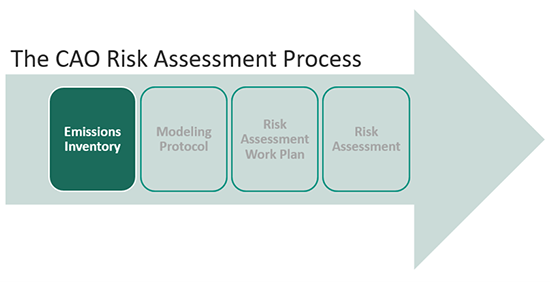
CAO Risk Assessment Process
The Emissions Inventory provides information on all the Toxic Air Contaminant emissions from a facility, and includes information on a facility's operations and activities, as well as fuel and material usage rates. This is often the longest step in the CAO risk assessment process as DEQ needs to verify that all activities have been accounted for, and that the most representative emissions data available are used. In some cases, DEQ will require a facility to perform source testing at this stage if insufficient data is available to estimate emissions. For an introduction to emissions inventories and why they matter, please see EPA's Fact Sheet.
Aug. 29, 2024: Facility called in to Cleaner Air Oregon.
Nov. 11, 2024: Facility submits Emissions Inventory extension request.
Nov. 21, 2024: DEQ responds to Emission Inventory extension request.
Feb. 25, 2025: Facility submits an Emissions Inventory and supporting documentation (currently in DEQ review).
Feb. 13, 2026: DEQ responded to the Emissions Inventory submittal with a request for additional information.
The Modeling Protocol provides information on how the facility plans to accurately model the concentrations of Toxic Air Contaminants (TACs) that community members may be exposed to based on the TAC emissions data from the approved Emissions Inventory. A Risk Assessment Work Plan is required for more complex Risk Assessments (Level 3 or Level 4) and provides more detailed information about locations where people live or normally congregate around the facility and how risk to these community members will be evaluated.
Feb. 25, 2025: Facility submits a Modeling Protocol and Risk Assessment Work Plan (currently in DEQ review).
Feb. 13, 2026: DEQ responded to the Modeling Protocol and Risk Assessment Work Plan submittal with a request for additional information.
About the Facility
Columbia Forest Products, Inc. produces hardwood faced plywood panels from pre-dried hardwood veneer sourced from other locations which is glued to core panels either processed onsite from raw logs or brought in from other sources. Raw logs are brought onsite, debarked, cut to length, conditioned in steam vats, and then peeled on lathes into veneer pieces. The veneer is sorted for use onsite, for sale offsite, and also chipped for fuel. Green veneer to be used onsite is dried in one of two dryers to a specific moisture content, glued together, and then pressed into panels. Finishing operations include trimming, patching, conditioning, sanding, and coating. Steam for the operations is provided by a single wood-fired boiler.