Nate Jackson Honored as Oregon’s 2026-27 Teacher of the Year
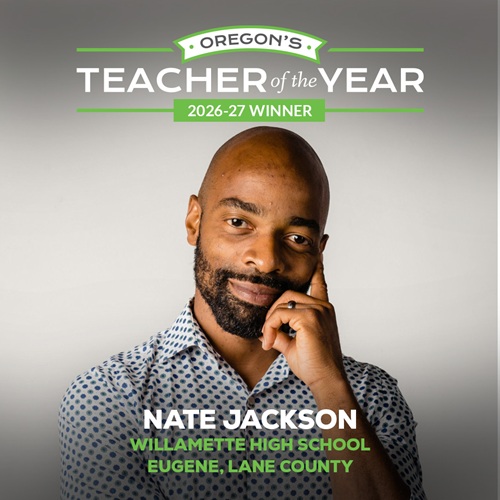 Social studies teacher Nate Jackson was named and celebrated as Oregon’s 2026-27 Teacher of the Year in a ceremony at Willamette High School (Bethel School District) on October 6.
For the last seven years, Jackson has taught American Studies, World Studies, and Black Studies at Willamette High, where he also co-advises the school's Black Student Union. He helped organize the first Black Summit, bringing students across the district together to connect with peers from other schools, engage in meaningful discussions, and see that their experiences were shared by others. He has raised more than $60,000 to provide transformative educational travel experiences that broaden student perspectives, inspiring them to envision new possibilities for their futures. Jackson started his career in broadcasting in Washington and California and served as in-game emcee for University of Oregon games and pep rallies before becoming a teacher.
“Mr. Jackson knows that meaningful learning begins with relationships and that every student deserves to feel seen, valued, and empowered to discover their purpose,” Oregon Department of Education (ODE) Director Dr. Charlene Williams said. “He is able to inspire his students by asking himself, ‘Whose voices are still missing?’ when developing his lesson plans. That means more students see themselves reflected in the curriculum, and every student gains a fuller understanding of the people whose contributions shaped history.”
“Education should challenge students while supporting them,” Jackson wrote in his application. “By combining rigorous historical analysis, intentional scaffolding, and opportunities for student voice, I create a space where all students can engage deeply with difficult topics and grow both academically and personally. Ultimately, my goal is not just to teach history, but to help students better understand themselves, each other, and the world they are shaping.”
The Oregon Teacher of the Year program is sponsored by ODE in partnership with the Oregon Lottery. Jackson was celebrated as a Regional Teacher of the Year in September and received a $10,000 cash award as the 2026-27 Oregon Teacher of the Year. A $5,000 award was also given to Willamette High School.
“Mr. Jackson has created a culture of trust, belonging, and opportunity,” said Oregon Lottery Director Mike Wells. “By building strong relationships and empowering students to lead, he has helped young people gain the confidence and purpose needed to succeed in school and in life.”
The Oregon Teacher of the Year is selected after an extensive application process. Nominees from schools throughout Oregon submitted packets of information including testimonials and letters of support from administrators, students, and colleagues. Applicants were assessed on leadership, instructional expertise, community involvement, understanding of educational issues, professional development and vision.
As the 2026-27 Oregon Teacher of the Year, Jackson will serve as a spokesperson and representative for all Oregon teachers. He will also receive year-long professional development and networking with other state Teachers of the Year through the Council of Chief State School Officers’ National Teacher of the Year program.
Photos and video from the announcement ceremony are available in this folder.
Do you know an outstanding teacher? Please nominate them as the 2027-28 Oregon Teacher of the Year by
visiting the Oregon Teacher of the Year website.
Oregon’s 2026-2032 STEM Education Plan is Live
 During the last year, ODE has partnered with the Oregon STEM Investment Council and the Higher Education Coordinating Commission to revise
Oregon's 2026-2032 STEM Education Plan. Developed through collaboration with educators, STEM Hub leaders, industry representatives, higher education partners, community organizations, and state agencies, the plan provides a shared vision for strengthening STEM education statewide.
During the last year, ODE has partnered with the Oregon STEM Investment Council and the Higher Education Coordinating Commission to revise
Oregon's 2026-2032 STEM Education Plan. Developed through collaboration with educators, STEM Hub leaders, industry representatives, higher education partners, community organizations, and state agencies, the plan provides a shared vision for strengthening STEM education statewide.
The plan focuses on four key priorities:
- Advancing belonging and equitable outcomes in STEM
- Strengthening math and science foundations
- Expanding pathways to careers
- Preparing learners for an increasingly digital future
It also establishes clear outcomes to support continuous improvement across Oregon's STEM ecosystem.
The STEM Education Plan serves as a roadmap for collective action and invites educators, schools, community partners, employers, and policymakers to work together to ensure every Oregon learner has access to engaging, meaningful, and future-focused STEM opportunities.
If you have questions, please
contact Deb Bailey and/or
ODE.STEM@ode.oregon.gov.
October is National Farm to School Month
 Governor Kotek has proclaimed October as Farm to School Month – a statewide celebration of the connections between Oregon students, schools, communities, and local agriculture. Farm to School activities help students learn where food comes from through hands-on experiences like school gardens, taste tests, classroom lessons, farm visits, and locally sourced school meals. These efforts support student learning while strengthening connections to Oregon farmers, ranchers, and food producers.
The Oregon Department of Education's (ODE) Farm to Child Nutrition Program supports these efforts through grants, technical assistance, training, and partnerships that expand access to Oregon-grown foods and agricultural education opportunities in schools across the state. During Farm to School Month, schools and communities are encouraged to participate in activities that celebrate local food, school gardens, and the people who help bring healthy meals and food education to students.
Help Put Oregon School Gardens on the Map
ODE and partners are currently conducting a statewide school garden survey to better understand and support school garden programs. This survey is completed every five years, and results will help inform future funding, policy, and technical assistance opportunities. Whether your school has a large garden, a few containers, an indoor growing space, or is just getting started, participation is encouraged. The survey takes just a few minutes and will help create the most complete picture possible of school garden education across Oregon.
Take the survey for your school garden online!
Celebrate with Oregon Crunch At Once
On Thursday, October 22, thousands of students across Oregon will participate in Oregon Crunch At Once. By taking a synchronized bite of locally grown produce, they will celebrate Farm to School Month and recognize the farmers who grow our food. Schools throughout the state are invited to join this fun and visible celebration of local agriculture and healthy eating.
Sign up for Crunch at Once online!
Engage with the Farm to School Community
The Oregon Farm to School Network's 2nd Annual Movement Meeting will be held virtually on October 27. The inaugural movement meeting last year was very well attended. This year will again bring together educators, nutrition professionals, farmers, nonprofits, and community partners to share progress and inspiring stories toward Oregon's 10-Year Strategic Vision for Farm to School and explore opportunities for continued collaboration.
Register online to attend the Movement Meeting!
Celebrating Fall and Winter Holidays
 Every November and December, public school students, parents, teachers, and administrators have a chance to celebrate all the various religious and cultural holiday traditions observed during that time of year. These holidays provide opportunities to build cultural competency, promote understanding of diverse traditions, and create inclusive learning environments where all students see their backgrounds valued.
School officials must be thoughtful about being inclusive and ensure they do not give students the impression that one set of holidays or beliefs is more important or more acceptable than others. Prominently featuring a holiday symbol associated with a single religious tradition is not an inclusive practice.
It is also important for school leaders to consider that even in communities where many families share the same faith or cultural background, a family's outward affiliation does not always reflect what they believe or practice at home. Staff, substitute teachers, new students, and visiting families may not share the surrounding community's traditions even when most do. Communities also change over time, and students who only ever see one tradition represented at school are less prepared for the more varied world they will enter as adults. Because the relevant legal protections apply to every public school regardless of local demographics, this guidance is a baseline for all schools, not a response to diversity alone.
Be accurate and sensitive
Religious and cultural holidays offer excellent opportunities to teach about culture, religion, and their historical importance.
Please keep in mind that many holidays begin in the evening, with religious and family obligations. During the winter season and especially in December, we celebrate:
- Diwali (follows the Hindu Lunar calendar; In 2026 it is November 8)
- Bodhi Day (December 8)
- Hanukkah (follows the Hebrew calendar; In 2026 it begins on December 4)
- Las Posadas (December 16-24)
- Winter Solstice (December 21)
- Christmas (December 25)
- Kwanzaa (December 26 - January 1)
- Three Kings Day (January 6)
- Orthodox Christmas (January 7)
- Lunar New Year (February 6)
- Ramadan (follows the Islamic calendar; In 2027 it begins on February 8)
- Lailat al Mraj (Shab-e-Meraj) (follows the Islamic calendar; In 2027 it begins on January 6)
Be inclusive in programming and activities
Winter holiday school activities such as assemblies, choral presentations, and plays should be inclusive. Instead of a 'Christmas concert,' consider a 'winter celebration' or 'holiday music’ from around the world.
When studying holiday traditions, present multiple celebrations with equal depth and respect. Consider inviting community members from different backgrounds to share their traditions.
Be aware that some religions teach that celebrating holidays and birthdays is unacceptable
Holiday participation must not be required. Students should have the opportunity to engage in other optional, enjoyable activities. Consider inclusive activities and avoid making non-participating students feel isolated or excluded.
Do not make assumptions
Children in our public schools represent a myriad of religions, cultures, and traditions. Within those groups, not all members of the same cultural or religious group necessarily observe the same holidays or celebrate them in the same way. Many children, being multi-denominational and/or multiracial, commemorate more than one holiday tradition.
Other Considerations
Some students observe religious dietary laws (kosher, halal, vegetarian traditions). When planning food-related activities, offer multiple options or focus on non-food celebrations.
Many religious holidays begin at sundown the evening before the calendar date. Avoid scheduling important school events, tests, or mandatory activities on major religious holidays.
Holiday seasons often involve gift-giving traditions that can create economic pressure; avoid mandatory gift exchanges or Secret Santa activities. Focus on the values of giving and gratitude rather than material exchanges.
Exploring the meaning and significance of holidays is supported by
Oregon's K-12 Social Science and TSEL Standards, for example:
-
Social Science K.C.DP.5 (Democratic Principles): Recognize holidays as special days that may celebrate democratic values, have religious significance, and recognize noteworthy events or people in history.
-
Social Science 4.H.CP.6 (Communities and Pluralism): Identify the history, religion, languages, and cultural practices of the Indigenous Tribes of Oregon, including cultural celebrations.
-
Social Science 6/7.H.CP.8 (Communities and Pluralism): Compare the origins and development of early world religions from the Neolithic to 1500 CE.
-
Social Science HS.US.CP.17 (Communities and Pluralism): Analyze the role of religion in shaping social, cultural, and political developments in the United States during the 20th century.
-
TSEL.K12.SAB.3A (Social-Awareness & Belonging domain): Demonstrate awareness and understanding of the similarities and differences that define, influence, and affirm personal and collective identities.
-
TSEL.K12.SAB.3C (Social-Awareness & Belonging domain): Foster a sense of belonging that cultivates acceptance, support, inclusion, and encouragement of others within a diverse community, while addressing the impact of systemic injustices across situations and environments.
ODE In the News