Centering Joy This Pride Month
 Pride Month is a meaningful opportunity for education leaders to integrate LGBTQ2SIA+ history and ongoing resilience with queer joy and celebration. Whether through a youth pride event, lavender graduation, pride spirit week, LGBTQ2SIA+ history display, or a rainbow family read-along, we stand with all Oregonians in honoring the ongoing contributions of LGBTQ2SIA+ people in Oregon communities.
Research affirms that LGBTQ+ students with more supportive educators, anti-bullying policies that explicitly mention sexual orientation and gender identity, LGBTQ+ inclusive learning, and GSA presence report a higher sense of belonging and higher GPAs. Those students are also less likely to miss school due to feeling unsafe. As one student shared, “My school teachers are very inclusive with everyone whether by race or sexuality; last year we even had a teacher that had a rainbow sign outside her door, saying she accepted all. My school has participated in the transgender day, and all other days in which we celebrated one another…this is my favorite school so far.”
ODE staff will be tabling at quite a few pride events around Oregon this year, sharing the LGBTQ2SIA+ Student Success Plan (SSP), zine, flyer, and card and supporting our LGBTQ2SIA+ SSP grantees. We hope to see you at your local pride event!
Oregon Honors the 2026 Education Support Professional of the Year, Erica Carrillo!
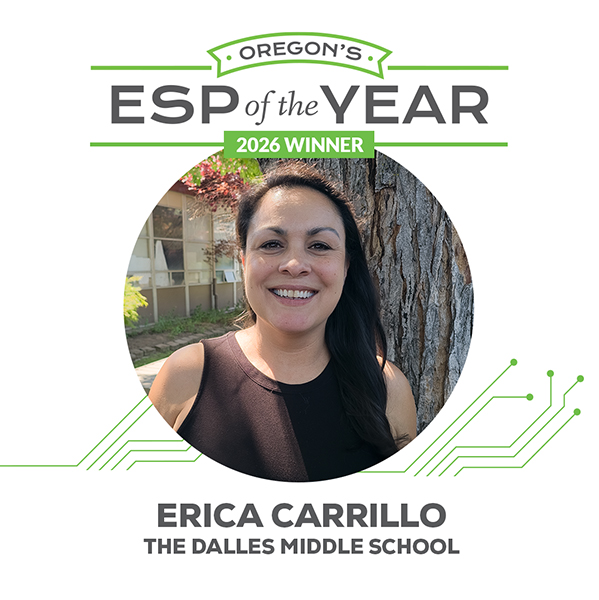 Last month, The Dalles Middle School Bilingual Family Liaison Erica Carrillo was honored as Oregon’s 2026 Education Support Professional of the Year! ODE Director Dr. Charlene Williams joined Oregon Lottery leaders, North Wasco County School District Superintendent Dr. Carolyn Bernal, and The Dalles Middle School Principal Sherri Kilgore and Assistant Principal Shudhi Datta in presenting the award at a surprise event.
Dr. Williams and Jen Roper with Oregon Lottery led the event and awarded Carrillo the honor.
“Education support professionals like Ms. Erica Carrillo are at the heart of strong schools and strong communities,” Governor Tina Kotek said. “Through her leadership, compassion, and commitment to students and families, she has helped ensure that every family feels welcomed, connected, and empowered to participate in their child’s education. Ms. Carillo’s work reminds us that creating belonging in our schools can change the trajectory of students’ lives.”
“Ms. Carrillo exemplifies what it means to remove barriers so students and families can thrive,” said Dr. Williams. “Whether she is helping families navigate school systems, connecting students to basic needs, translating critical information, or creating opportunities for families to engage with their school community, Ms. Carrillo approaches every part of her work with care, creativity, and deep dedication. Her impact extends far beyond The Dalles Middle School; she represents the vital role education support professionals play in building trust, strengthening partnerships, and helping every student feel seen and supported.”
Thanks to ODE’s partnership with the Oregon Lottery, Carrillo received an award of $5,000 and a commemorative plaque. A matching plaque and banner were awarded to The Dalles Middle School to mark Carrillo’s achievements and her impact in the North Wasco County community.
“We’re proud to honor Ms. Carrillo for her ability to foster trust and connection with families and build a welcoming community,” said Oregon Lottery Director Mike Wells. "This award highlights her outstanding work in supporting students beyond the classroom.”
“This award reflects Erica’s outstanding commitment to serving students and supporting excellence in education every day,” said Superintendent Dr. Bernal. “She represents the very best of our district, and we are thrilled to celebrate this achievement with her.”
Check out some photographs of the event.
Program History
Oregon’s Education Support Professional (ESP) of the Year Program is a result of House Bill 2964, passed by the Oregon Legislature in May 2019. This bill directed ODE and Oregon Lottery to design and implement a program to honor an Oregon education support professional serving students in any grade from prekindergarten through grade 12. ESPs work together with teachers and administrators in Oregon public schools to perform a variety of jobs promoting quality education, fostering positive learning environments, offering nutritious meals, providing reliable transportation, maintaining safe and clean schools for students, and so much more. Educators nominated for Education Support Professional of the Year are employed by an Oregon public K-12 school or school district and meet the definition of an ESP in Oregon. Nominations for 2027 will open again soon on the Education Support Professional website. Be sure to nominate the life-changing ESPs in your school!
OSCIM Program Continues to Help Districts with Construction Projects
 Last month, three school districts around the state passed bond measures that got a boost from the Oregon School Capital Improvement Matching (OSCIM) Program. Commitments are made to districts ahead of the election so districts can inform their communities of the potential for additional funds from the state if the local bond passes. Before submitting an application for the OSCIM Program, districts must also submit a Facilities Assessment and Long-Range Facility Plan. Districts are awarded grants based on their position on the Priority List or First in Time List.
Since the first round of grants in 2016, the OSCIM program has awarded 109 grants totaling $528 million in matching funds to districts. Here are the districts receiving matching funds following successful bond elections last month:
| District Name | Local Bond
Amount | OSCIM Grant |
|---|
| Sweet Home SD 55 | $40,000,000 | $12,252,000 |
| Athena-Weston SD 29RJ | $4,980,000 | $4,980,000 |
| Cascade SD 5 | $30,000,000 | $10,210,000 |
|
Total |
$74,980,000 |
$27,442,000 |
Elevating Education-System Employee Wellness
 In schools, June is a season of endings, celebrations and much-needed breaks. Educators live by a unique tempo: the high energy of the school year followed by the quietude of summer.
As this year closes, the School Wellness, Inclusion, Safety, and Health (SWISH) team wants to extend a sincere thank you for your dedication, time and care. We wish you and your loved ones a restorative summer filled with the activities that bring you the most joy.
If you are looking for ways to physically and mentally "reset" this break, we’ve curated a few somatic practices designed to help you release the tension of the past ten months. Somatic work isn't about fixing yourself; it's about giving your nervous system the permission to shift!
A Relational Reflection on Interpersonal Well-Being
By: Michael Essien, ODE Assistant Superintendent of Equity, Diversity and Inclusion
After 21 years in the classroom and 10 years as a site leader, I understand that educator well-being is not an abstract idea. It lives in the daily realities of schools, in conversations before students arrive, in difficult meetings after long days, in moments of uncertainty, and in the relationships that sustain us when the work feels heavy.
In this moment, many of us are feeling the weight – tight budgets, real constraints, and the urgency that comes with student performance data that does not yet reflect our aspirations. These conditions are real, and they shape how we show up with one another.
So, the question becomes: who are we to each other in this work?
In schools, I learned that people are more willing to take risks, innovate, and remain committed when they feel respected, valued, and trusted — especially during difficult seasons. Educators do not need the absence of accountability; they need environments where accountability and humanity can coexist.
In times like these, it is easy for urgency to create distance. But it can also be an invitation to deepen trust, to check in, to ask for support, and to stay connected even when the work is hard.
Our well-being is not separate from our relationships. It is built through them. And how we choose to show up for one another will shape not only how we feel, but what we are able to accomplish.
Educator Spotlight: Sherman County School District
Sherman County School District, located in the frontier town of Wasco in north central Oregon, knows the strengths and challenges of organizing districtwide wellness efforts in a rural region. With the support and encouragement of their superintendent, they have been a grantee and partner of Oregon Well-Being Trust (OWT), to fund and expand their employee wellness program since 2022.
Sherman County SD’s two part-time wellness coordinators use their small community’s close-knit culture to overcome resource constraints, address employee turnover, and support educators who were stretched thin to create a wellness program that is tailored to their workplace needs. As they created their program, they administered a staff well-being survey to make sure that all voices were represented and that they were able to offer a variety of opportunities that fit diverse preferences and schedules.
Employees currently take part in quarterly wellness challenges, prize drawings, and games that add levity and fun. Wellness events and celebrations—such as rotating potlucks and an end-of-year party—give staff time to connect, decompress, and build community. Gratitude walls, where students and colleagues share appreciation, bring everyday moments of connection at school. Wellness coordinators report strong results, including higher morale and a greater sense of community.
Interested in learning more about Oregon Well-Being Trust and funding that could support your staff’s well-being? Please don’t hesitate to reach out to siri@oregonwellbeing.org.
School Safety Workshop Strengthens Reunification Preparedness Across Oregon
 The Oregon Department of Education’s School Safety and Emergency Management (SSEM) program recently hosted a comprehensive school reunification workshop in partnership with the Redmond Police Department, bringing together educators and community partners from across the state to strengthen emergency preparedness efforts.
Held on May 9, the workshop drew 78 participants representing 68 school districts, organizations, and agencies from 13 Oregon counties. The training focused on preparing school leaders and their community partners for one of the most challenging aspects of emergency response: safely reunifying students with their families following a disaster or critical incident.
Participants received instruction on the SSEM-recommended Standard Reunification Method, a nationally recognized system developed by the I Love U Guys Foundation. The method provides a consistent framework for managing reunification efforts and reducing confusion during high-stress situations.
Following the training, participants applied their learning through structured tabletop exercises designed to simulate real-world emergency scenarios. The exercises challenged attendees to navigate complex decision-making processes while identifying opportunities to coordinate with local partners, including law enforcement, fire services, and mental health providers.
The workshop, offered at no cost to participants, highlighted the value of Oregon’s SSEM program in supporting schools, districts, and charter schools statewide. SSEM provides free technical assistance and resources to Oregon’s K-12 public education community, helping schools develop and implement emergency operations plans with a strong emphasis on community collaboration and preparedness.
By bringing together education leaders and emergency response partners, trainings like this help ensure Oregon school communities are better prepared to respond effectively to emergencies and leverage local, county, and state resources when they are needed most.
For more information about the SSEM program and upcoming training opportunities, visit the SSEM website.
ODE In the News